2026-05-27
Brake pads and brake shoes are not the same thing. They often are confused, especially when your machine is simultaneously equipped with both of these components. Although they both are utilizing friction to reduce the speed of the machine, they are not interchangeable, and they operate in completely different systems. This article will explain the difference between the two, helping you to clearly identify brake pads and brake shoes, and to avoid making mistakes when repairing or purchasing parts.
Before making the comparison between these two components, it is necessary for us first to understand their respective meaning and also their role within the specific braking system.
The brake shoe belongs to the primary friction component within the drum-type braking system. It is the crescent-shaped metallic piece, on one side of which is adhered or riveted a thick and heat-resistant friction lining.
The brake pad belongs to the frictional component, which is used inside the disc-type braking system. It consists of one piece of the flat and heavy-duty steel back plate, and one piece of the frictional material that is adhered to the surface of it.
Although both of these kinds of systems are intended for stopping your machine, their method, performance characteristics, and maintenance requirements are being greatly different. To understand these kinds of distinctions is of vital importance for any equipment owner or mechanic.
The key difference lies in how they apply force.
Brake Pad: Pressing inward. The caliper gives direct, even pressure to both sides of the rotor, making braking linear and predictable.
Brake Shoe: Pushing outward. The wheel cylinder drives shoes away from center. With drum rotation, a self-energizing effect appears, where one shoe wedges into the drum, increasing force.
For heavy equipment, heat control is crucial. Overheating causes brake fade, friction weakens, and force drops.
Brake Pad: Disc brakes manage heat better. Exposed rotors act like radiators, releasing heat into air, allowing repeated strong braking, useful on slopes or fast cycles.
Brake Shoe: Drum brakes dissipate heat poorly. Enclosed drums trap heat, expand, and move away from shoes, thus reducing braking force.
This is a more nuanced comparison.
Brake Pads: Exposure has pros and cons. Pads and rotors face dust, mud, and water, but rotor rotation throws off debris, and pads wipe the rotor, self-cleaning.
Brake Shoes: Drum brakes’ enclosed design protects well, giving longer life in dusty or muddy conditions. However, trapped grit or water can quickly wear shoes, scratch drums, and reduce braking.
This is a key consideration for minimizing downtime.
Brake Pads: Replacement is simpler and faster. Technicians can quickly remove the caliper, retract the piston, replace pads, and reassemble.
Brake Shoes: Drum brake repair is more complex and time-consuming. Disassembly of the drum and careful handling of springs, clips, and adjusters is required, increasing labor cost.
| Feature | Brake Pads (Disc Brakes) | Brake Shoes (Drum Brakes) |
| Mechanism | Squeeze inward on a rotor. | Push outward against a drum. |
| Stopping Power | Generally higher and more consistent. | Good, with a self-energizing effect. |
| Heat Dissipation | Excellent; exposed rotor cools quickly. | Poor; enclosed drum traps heat |
| Performance in Wet | Excellent; water is flung off the rotor. | Poor; water can get trapped inside. |
| Maintenance | Simpler, faster to replace pads. | More complex, with many small parts. |
| Durability | Exposed to elements, but self-cleaning. | Protected from elements, but traps debris. |
| Primary Use | High-speed applications, front axles. | Rear axles, parking brakes, slower machines. |
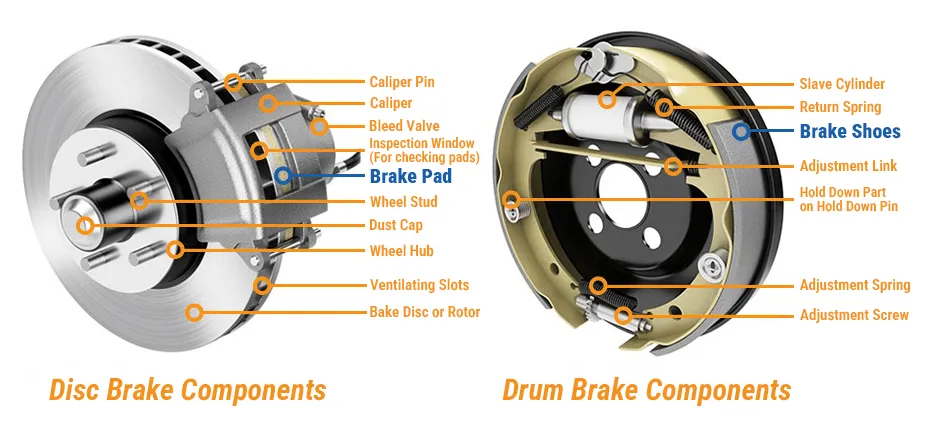 How Do You Know if Your Machine Uses Brake Pads or Brake Shoes?
It can be judged through the observation of the brake of your equipment. If it is appearing like the left picture, and you are able to see one shining round disc, then your equipment is using the brake pad. If what you are seeing is the drum-type brake like the right, then your equipment is using the brake shoe.
To fully grasp the roles of pads and shoes, you must first understand the two primary types of braking systems found on off-road machinery where these components live.
The disc brake system belongs to the modern standard for the majority of high-performance and heavy-duty applications, especially located on the front axle of wheeled equipment.
The drum brake belongs to one of the older, but still widely used designs, usually being installed on the rear axle of the equipment, or being used as a special parking brake system.
How do you know if your machine uses brake pads or brake shoes? It can be judged through the observation of the brake of your equipment. If it appears like the left picture, and you are able to see one shining round disc, then your equipment is using the brake pad. If what you are seeing is the drum-type brake like the right, then your equipment is using the brake shoe.
This question is very easy to answer: your machine requires the specific component that was equipped during its design.
You cannot use brake pads in a drum brake system, nor can you use brake shoes in a disc brake system. Many heavy-duty machines simultaneously use both types of brakes—usually, disc brakes are installed on the front axle to bear most of the braking force, while drum brakes are installed on the rear axle.
Before ordering brake components, the critical task is to correctly identify the system installed on each axle of the machine. Visual inspection is the best method: if you see a large, flat, shiny disc and a caliper, you need brake pads. If you see a large, enclosed metal drum, you need brake shoes.
The symptoms of the problem can usually help you to locate the correct system.
The main difference between brake shoes and brake pads is primarily regarding the direction of force applied, heat control, durability and lifespan, as well as the difficulty of maintenance. Understanding the fundamental distinction between the two is crucial for the safe and efficient operation of heavy-duty equipment. This can enable you to find the correct parts when maintaining the equipment. When needing to repair the brakes, selecting high-quality aftermarket brake shoes or brake pads from a well-stocked supplier such as MechLink can ensure you obtain reliable braking power, perfect compatibility, and excellent cost-performance, thereby minimizing downtime and ensuring the safety of your operation.