
2026-09-13
If you own or operate off‑road diesel equipment — like an excavator, loader, or tractor — you know that uptime means profit. Every hour matters.
In recent years, though, one topic keeps popping up on job sites and online groups: “What is a DPF delete, and will it fix my diesel problems?” We understand operators want to delete the DPF. But it isn’t a shortcut — it’s a serious risk. This practical guide explains what a DPF delete really is, why some try it, and smarter, legal ways to keep your machine running strong.
The Diesel Particulate Filter (DPF) is a critical emission‑control device required on most modern diesel engines.
Think of your DPF as a soot trap inside the exhaust system. Its job is to capture fine black carbon particles (soot) that are harmful to people and the environment.
Machines that meet EPA Tier 4 Final or similar standards must have a DPF to reduce emissions and pass inspection.
To stay clear, the system occasionally performs a regeneration cycle — your Engine Control Unit (ECU) raises exhaust temperatures up to 1,100°F (600°C) to burn off the soot. What remains is a small amount of harmless ash.
Pro Tip: A working DPF keeps your machine compliant, quieter, and cleaner — all while protecting your brand’s reputation on job sites.
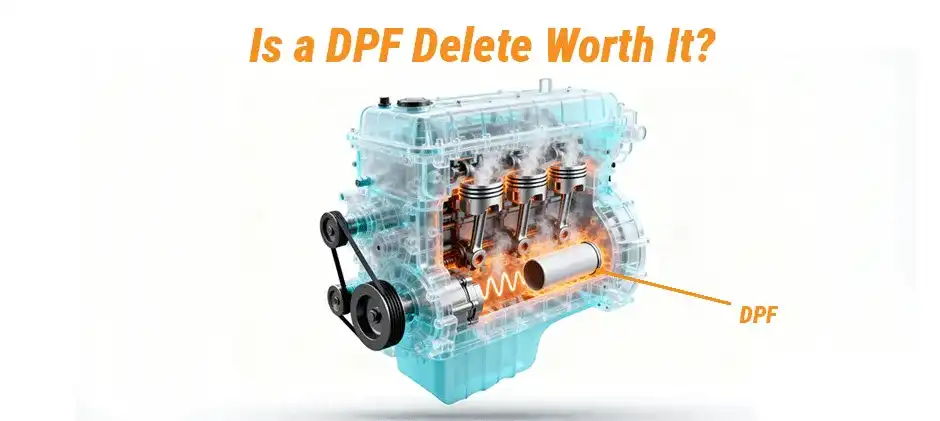
A DPF delete is when a technician removes the DPF and reprograms the ECU to pretend it’s still there.
This process usually involves two steps:
Sometimes, the delete goes further — removing other systems too, such as:
Combined, these are often sold as “DPF and EGR delete kits.”
While the promise sounds tempting (“fewer parts, better performance”), the reality tells a very different story.
We get it — the frustration is real. Here’s why owners ask about DPF delete on diesel engines:
However, those short‑term gains come with major long‑term damage, both mechanical and financial.
Here’s what equipment owners must know before considering any DPF delete pipe or tuning kit.
Tampering with or removing emissions equipment violates the U.S. Clean Air Act.
Once a DPF is removed or a delete tune is detected, your engine and powertrain warranty is void.
If something catastrophic happens — turbo failure, cracked piston, damaged injector — you’ll pay full repair cost out of pocket.
Modern diesel engines are built with precise exhaust flow and backpressure in mind.
Deleting the DPF throws off that balance:
One engineer summed it up perfectly:
“Tampering with these precision‑engineered systems throws everything out of sync — from turbo speed to combustion balance.”
A machine with a DPF delete cannot be sold legally to most buyers. Dealers and rental fleets will reject it.
Even private buyers know it’s a liability, so the value drops sharply.
At MechLink, we see hundreds of machines every week that develop DPF issues — and nearly all of them can be fixed without a delete.
Here’s the right way to prevent downtime and save money:
Repeated regenerations or warning lights usually mean a related sensor or injector issue, not a “bad DPF.”
Common culprits:
Diagnose first — you’ll often fix the root cause for a fraction of the delete cost.
When something does fail, rely on MechLink DPF replacements and sensors.
Our high-grade parts ensure full system compatibility so you can keep your machine compliant and productive.
If your filter is full, that doesn’t always mean it’s dead.
Professional DPF cleaning restores air flow and efficiency for less than half the cost of a new filter.
A: It’s removing your Diesel Particulate Filter and tricking the ECU to ignore missing emissions parts.
A: No. Under the Clean Air Act, all diesel machinery — on‑road or off‑road — must keep its emission controls intact.
A: Not reliably. Modern diesel ECUs are tuned for emissions systems. Any short‑term “gain” is usually outweighed by long‑term engine stress or failure.
A: Look for underlying issues — faulty injectors, EGR problems, or sensor errors. Fix those before replacing or deleting the DPF.
A: Beyond the upfront cost of the pipe or tune, you risk government fines, warranty loss, major repairs, and a destroyed resale value.
At MechLink, we’re more than a parts supplier — we’re your equipment uptime partner.
We carry a full range of genuine and aftermarket components for your emission systems, including:
Visit MechLink.com to find high‑quality DPF replacements, sensors, and exhaust parts engineered for your specific machine.
How much doeshow much does engine oil leak repair cost?
2026-11-08
How much does a head gasket replacement cost?
2026-11-08
Kubota bx2380 filters & fluids: parts, capacity & specs
2026-11-07
Skid steer tires chart & buying guide
2026-11-07