2026-08-06
The head gasket is sandwiched between the engine block and the cylinder head to seal the combustion chamber. It enables the engine to establish compression properly without mixing coolant and oil. If something goes wrong with the head gasket, it could lead to engine failure. This part is not cheap to repair. Find out in advance why the head gasket leak and what will happen if it breaks.
A bad head gasket on a heavy diesel engine shows different symptoms, depending on where the seal breaks. This gasket seals in combustion pressure, plus the coolant and oil passages. A leak anywhere between these parts will trigger clear warning signs. Watch out if your machine starts acting like this:
A head gasket leak can force hot combustion gases into the cooling system. This pushes out coolant and creates air bubbles. It can also make coolant leak out of the system—either dripping onto the ground or seeping into a cylinder. Either way, the engine can’t cool itself properly. Your temperature gauge will shoot up into the red zone, especially when the machine is under load.
Suddenly, your excavator can’t lift a full bucket, or your bulldozer bogs down when pushing heavy loads. A blown head gasket might leak between two nearby cylinders, or from a cylinder to the outside. That causes a huge loss of compression. Without good compression, your diesel engine can’t make the power it needs to get the job done.
Check your dipstick or take a peek under the oil filler cap. If you see a thick, milky, mayonnaise-like gunk, that’s a serious red flag. It means coolant is leaking past the head gasket and mixing with the engine oil. This milky oil can’t lubricate anymore. It’ll cause fast wear on bearings, camshafts, and other vital internal parts.
If you see bubbles popping up nonstop, that’s a dead giveaway. Combustion gases are forcing their way into the coolant lines. This makes the system way more pressurized than it should be, and it’s a textbook sign of a blown head gasket.
Diesel engines can puff out black or blue smoke every now and then—that’s normal. But thick white smoke that smells sweet? That’s a whole different issue. It’s steam, plain and simple. Coolant is leaking into the combustion chamber and burning up with the fuel. You’ll notice it the most when you start the engine, but it might stick around even after the engine warms up.
An engine with a compression leak from a bad head gasket will often run rough, shake, or have a noticeable “miss” in its rhythm. That’s because one or more cylinders aren’t putting out their full power to turn the crankshaft.
Sometimes the leak is visible from the outside. You might see coolant or oil seeping out of the gap where the cylinder head meets the engine block. It’s messy, but usually less damaging right away than an internal leak.
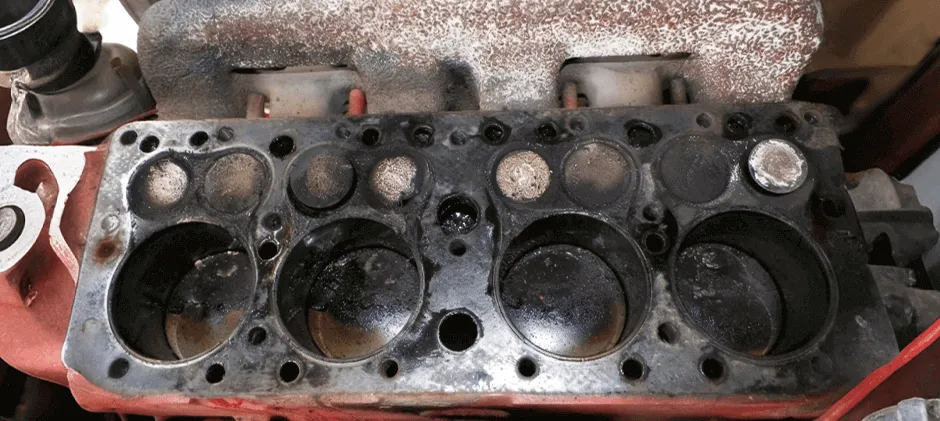
If you keep running a machine with a bad head gasket, you’re asking for a whole chain of breakdowns.
Gasket failure almost always stems from an underlying problem that puts too much stress on it.
When an engine overheats, the aluminum cylinder head and the steel head bolts expand at different rates. A rubbing motion can ruin the gasket’s seal. Overheating usually comes down to environmental issues:
Head gaskets are for handling combustion force, but some conditions push pressure way past their limits. In diesel engines, this usually happens for these reasons:
A head gasket is only as good as the job done to put it in. If the cylinder head and engine block surfaces aren’t perfectly clean and flat, or if head bolts aren’t tightened to the right torque and in the correct order, the gasket will fail early. That’s why following the manufacturer’s service manual exactly is a must.
After thousands of hours of use, the constant heating and cooling cycles make the gasket material hard and brittle. Eventually, it can just wear out and fail from all that fatigue.
Is your head gasket leaking? Just do some simple tests. Don’t go tearing the engine apart right away.
Check the oil dipstick for that milky texture. If it’s got oil in the coolant, it’ll look like a dark, greasy film floating on top. Also, check around the cylinder head for leaks on the outside.
Hook a special tester up to the radiator opening. Pump it up to the pressure listed on the radiator cap (usually 15–20 PSI). If the pressure drops steadily, there’s a leak somewhere. If you can’t find an external leak, it’s probably leaking inside the engine.
This test uses a special chemical fluid that changes color when it touches combustion gases. Set the tester over the open radiator neck while the engine’s running. If the blue fluid turns yellow or green, that’s proof that exhaust gases are leaking into your cooling system.
A compression test tells you how well each cylinder seals up. On a diesel engine, pull out each fuel injector and screw a compression gauge into the hole. Then crank the engine and jot down the pressure reading for every cylinder. A healthy engine will have pretty much the same reading across all cylinders. A much lower reading in one cylinder means something’s wrong, and low readings in two side-by-side cylinders are almost a sure sign the head gasket between them is blown.
The best repair is not to have to. Do preventive maintenance to extend the service life of the head gasket.
Identifying the symptoms of a damaged head gasket early can prevent more extensive and costly engine repairs. Are you already seeing signs of a damaged head gasket? MechLink provides the parts and tools you need to complete the repair easily.