
2026-11-25
Belts are the quiet link between an engine and everything it drives. They spin the alternator, turn the cooling fan, run the water pump and keep the air conditioning working, and they do it while carrying the vibration and heat of a working machine. On an excavator, tractor or skid steer, a belt that lets go can stop the whole job.
This guide covers the belt types you will meet, how many a machine might carry, the symptoms that say replacement is due, and what happens when one is left too long.
A belt transfers rotary power from the engine's crankshaft to components mounted around it, and keeps those systems running in step with each other. The exact number and specification fitted at the factory depend on the machine's make and model, and on its age; some belts are common across a whole family of engines, others are unique to one model.
Because a single belt can drive several accessories, one worn item can affect cooling, charging and hydraulic assistance at the same time. That is why belt condition belongs on the daily walk-around rather than on a yearly list.
The most familiar type on heavy equipment. The name comes from the cross-section: a flat back with angled sides that wedge into the pulley groove, which is what produces the grip. V-belts drive the alternator, water pump and air compressor, and they are usually rubber.
Flat and ribbed, a serpentine belt snakes around a line of pulleys and can drive the alternator, power steering pump and A/C compressor from one run. It is also rubber, but wider than a V-belt and different in profile, and the ribbed face is what keeps it located on each pulley.
These drive the A/C compressor, the component responsible for cooling the air inside the operator cab. On some machines they run as a dedicated belt; on others the compressor is driven from the serpentine system.
Also called alternator belts, fan belts drive the cooling fan and the alternator. They share the V profile but are narrower than a standard V-belt.
Anything with an internal combustion engine will usually need at least one. Common examples include:
Size, complexity and the number of internal systems all push the count up or down. A compact skid steer may run a single belt covering the engine, the alternator and the hydraulic pump; a large excavator may carry several.
Engine design matters too. A diesel unit can call for more belts than a gasoline equivalent simply because the two are laid out differently. Hydraulics add another variable: machines with complex systems and extra pumps need belts to drive them, while simpler machines with fewer accessories need fewer belts.
Positions vary with machine type and model, but the usual arrangement is as follows.
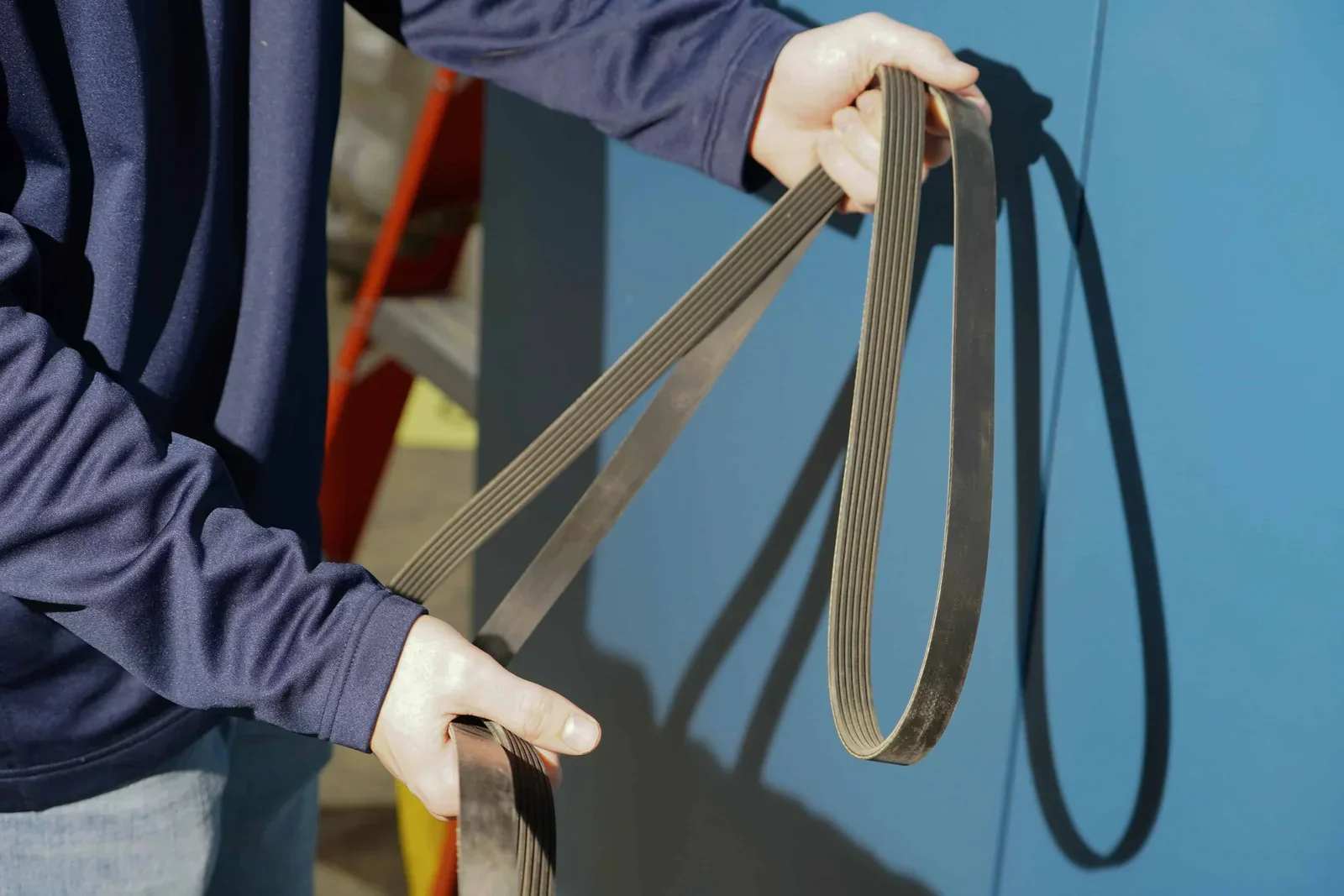
V-belts sit wherever they are needed — at the engine, alternator, water pump and air compressor — wrapped around pulleys bolted to the engine or to the accessory itself.
Serpentine belts wrap a sequence of pulleys, with the crank pulley providing the drive and the rest turning the alternator, power steering pump and A/C compressor.
A/C belts run either on their own or as part of a serpentine layout, and on several models are found on the passenger side of the machine.
Fan belts are mounted at the front of the engine.
There is no universal interval. Belt type, machine type and working environment all shift the answer, so the reliable method is frequent inspection and replacement as soon as wear appears. Look and listen for:
Budget depends on the part: a small V-belt starts around $25, while a large serpentine belt can reach several hundred dollars.
The consequences scale with the belt's job. In rough order of severity:
Replacing a belt on schedule is a fraction of the cost of any of those outcomes, which is why the inspection habit matters more than the interval on paper.
Buy from a seller who can confirm the specification. MechLink's online parts catalogue carries V-belts, fan belts, alternator belts and more, searchable against your machine. If the listing does not cover your model, ask: one of our parts experts can identify the correct belt from the machine details and get it on its way.
Telehandler attachments explained: six tools that change what the machine can do
2026-11-25
Four tire habits that keep heavy equipment rolling
2026-11-24
Fuel filter or oil filter? Telling apart two parts that protect very different systems
2026-11-24
9 Undercarriage Habits That Keep Tracked Machines Running Longer
2026-11-23