2026-11-06
On heavy equipment, tires are the basis for safe and comfortable running. Different work environments require different types of tires. Different terrains have different tires to cope with. The tires used in the mine, the work site or the farmlands are definitely different. Prices will naturally vary. Next, when do the tires need to be replaced? How much does tire replacement cost? Let’s talk about.
For heavy equipment, not replacing tires in time can pose a serious risk. Wear or damage to tires not only affects the grip and handling performance of the equipment but can also lead to slippage during operation, rollover, or failure to smoothly pass rough sections, directly threatening operator safety. At the same time, old tires will increase the vibration and impact of the equipment, which in the long run will easily cause damage to key components such as the suspension and transmission system, increasing the cost of repair. Worse still, sudden tire failure under critical operating conditions not only delays the progress of the project but can also delay the entire project and cause huge economic losses.
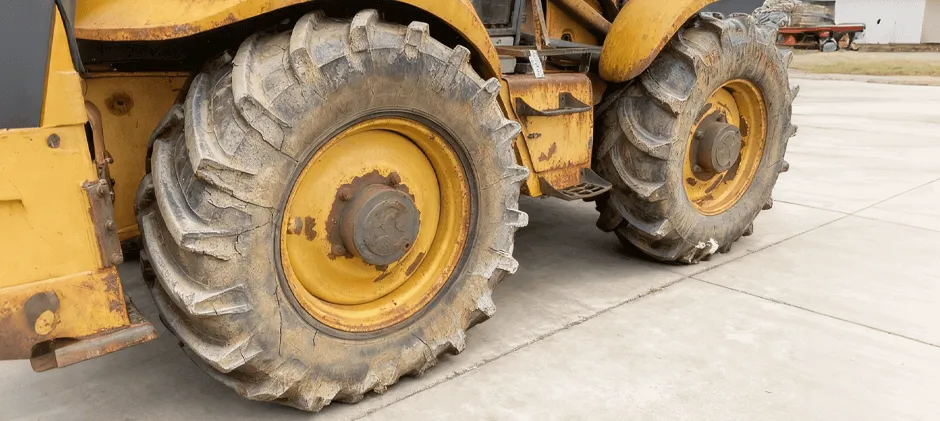
The cost to replace a tire will depend on several conditions. Knowing the various factors of tire prices, not only choose suitable tires, but also find savings.
The most intuitive is the size. That’s true for almost everything, and the bigger it is, the more expensive it is. The rubber, steel-ribbed belt layers required for large-size tires, and the complex engineering design, all make the price higher.
The tyre has two internal structures: Radial and Bias tires. The fabric cords of the Bias tires are cross-arranged, while the fabric cords of the Radial tires are vertically arranged. So in comparison, Bias tires have a harder wall and stronger support. Bias tires are more appropriate if your device is carrying heavy loads or always going to places with rough ground. Radial tires have softer walls. It’s more comfortable to operate. Both structures have their advantages and disadvantages. Choose the most suitable one according to the actual situation.
The TRA (Tire and Rim Association) code is a standardized lettering system. It tells you what the tire was designed for. This code directly impacts how the tire performs and how much it costs. The letter in the code stands for the machine type. The number shows the tread depth and tread type. There are 4 TRA types and 6 different tread depths:
Take a tire with a deeper, more aggressive tread pattern — like an L-5 rock tread, for example. It will be more expensive than a standard tread, such as an L-3. So choosing the right TRA code is essential. It helps you get the performance and lifespan you expect from the tire.
Mainstream OEM tire brands have large investments and good reputations, but also high prices. However, the market for high-quality aftermarket tires is now well established. Reliable aftermarket tires, performance is completely comparable to mainstream brands, sometimes even better. They find a balance in durability, reliability and price. Choosing the right aftermarket tires can reduce tire replacement cost without sacrificing safety and performance. For many teams, this is a really smart choice.
This is the part of the total cost that gets overlooked most often. Replacing a tire on heavy machinery isn’t a DIY job. It’s a complex, dangerous, and expensive service to get done.
Even with the best tire maintenance and careful use, you will eventually need to change tires on your machine. Look for signs of these worn tires that need to be replaced. Knowing the right time to change your tires will save you money and increase productivity.
As the tire wears out, the tire reaches a point where it cannot provide safe grip and stability under certain conditions. At the same time, the operator cannot control the critical level of the equipment properly. Once the tires lose enough tread, they become dangerous in your construction site conditions; replace them.
If the tire is operated at or below 20% the recommended tire pressure, it shall be immediately withdrawn from service. Even if re-inflated, the internal structure of the tire may already be damaged, with a high risk of puncture under load.
It’s better to check regularly. The following situations require an immediate tire change.
Getting more hours out of every tire is the most effective way to lower your long-term costs — and proper maintenance and good operation are the keys to making that happen.
Tire prices vary widely, even for the same brand, as size requirements and vehicle type can significantly impact the final cost. Let MechLink help you get the tires your fleet needs. Use the right tires to improve overall efficiency on site. Contact us for more information about buying tires or getting any other parts for your equipment.
For OTR tires, “construction” just means the tire’s internal design and how it’s made. It’s not about what they’re used for, like “tires for construction sites”, it’s about the engineering idea. It affects how the tire handles stress, gets rid of heat, and stays undamaged. The main construction types are Radial and Bias. Each has a different build, so they work well for different off-road jobs.
There’s no one “best” type—what works best totally depends on what you’re using the tires for.
In order to simplify the selection process, each construction tire is classified by TRA Type. The TRA code means classification and tread depth. For example, a TRA of L3 means that the tire is a loader-specific tire with a level 3 tread depth. Note that the higher the TRA code level, the greater the tire tread depth.