2026-08-07
When the Komatsu CA132 appears, it can turn a normal day into a slow response, unstable engine speed control, and wasted fuel—especially on off-road machinery that runs long hours in dusty, vibrating, and hot conditions. In this guide, we’ll explain what the code means, why it occurs, and how to clear it correctly (by addressing the underlying cause first), along with a practical diagnosis flow and a summary table you can use in the field.
On many Komatsu off-road machines, Komatsu CA132 points to a throttle sensor (fuel control) low-voltage fault in the engine control system. In plain terms, the controller is seeing a throttle signal that is below the expected electrical range, so it can’t trust your throttle input.
What you may notice on the machine:
That fallback behavior varies by model and software, but the idea is the same: the controller tries to keep the machine running while logging the fault.
Important note for operators/owners: clearing the code without fixing the electrical issue usually means the code comes back the next key cycle—or worse, it becomes an intermittent problem that’s harder to catch.
A low-voltage throttle signal is usually caused by one of these categories:
Many throttle sensors and position sensors use a 5V supply from the controller. If the 5V line drops (short, corrosion, weak connection), the signal can also drop.
Pinched harness, rubbed insulation, water intrusion, or corrosion can pull the signal down or create enough resistance that the controller “sees” low voltage.
Internal wear, contamination, or failure can produce an incorrect output voltage.
Loose locks, backed-out pins, bent pins, green corrosion, oil/dirt packed into seals—these are frequent causes in real-world conditions.
After you confirm power, ground, wiring, and the sensor, you consider a controller issue.
A practical way to think about Komatsu CA132: it’s rarely “just a code.” It’s a sign that the machine is losing a clean, stable electrical signal somewhere between the throttle input and the controller.
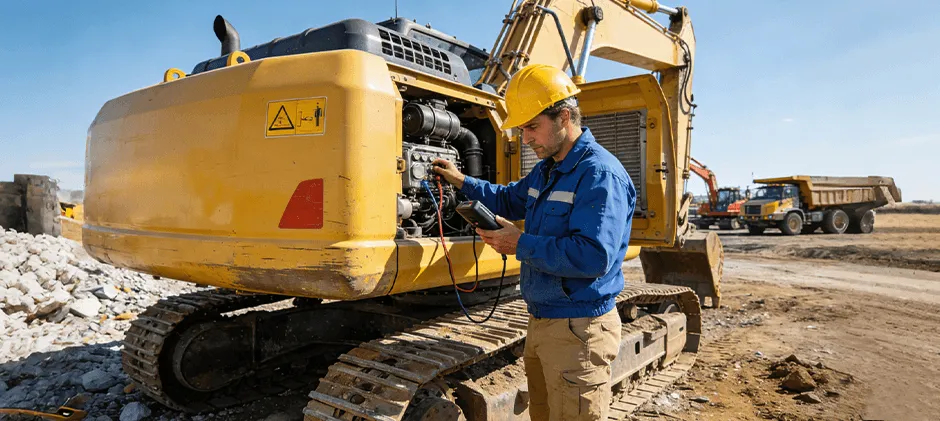
You clear Komatsu CA132 in two stages: (A) make the fault go away, and (B) clear the stored code. Doing stage B first is how repeat faults happen.
If your monitor/service tool allows it:
This saves time if the fault is intermittent.
Check throttle knob/pedal feel and mounting (loose components can stress the connector)
Inspect harness routing near:
Look for:
Exact PINs vary by model, so you stay consistent with the electrical logic:
With the key ON (engine OFF), measure between the sensor power and the sensor ground.
A weak sensor ground can look like a bad sensor. Voltage drop testing under load is ideal when possible.
Many analog throttle sensors sweep from a low value to a higher value as you turn the knob/press the pedal (often roughly ~0.5V to ~4.5V).
If the signal is stuck near 0V, suspect a short to ground, a broken wire, or a failed sensor.
With power OFF and connectors separated:
If you find wiring damage, fix it correctly (proper splice, seal, strain relief) or replace the affected section.
Once the root cause is corrected, you can clear Komatsu CA132 in a few common ways:
Our rule: if the fault is active, it must be repaired before the system can stay clean.
Below is a straightforward flow you use to avoid parts swapping.
That often points to a wiring/connector/5V issue detected during self-check.
That often points to a harness rub or a pin fit issue that opens/closes.
If you also see other sensor supply or “reference voltage” faults, fix those first. A shared 5V reference can knock out multiple sensors at once.
For the throttle sensor/knob connector and the controller-side connector:
If you find damaged connector bodies, pins, or seals, replacing them is often more reliable than trying to “clean it and hope.”
With the engine idling (only if safe), gently move the harness near suspected rub points:
If the 5V supply and ground are correct and stable, and the harness is intact:
On many machines, owners chase electrical faults only to find the cab area has multiple loads and connectors sharing space. When the cab power and grounds are poor, you may also notice comfort-system odd behavior. If you’re already repairing wiring in the cab, it’s a good time to inspect related cab components and connectors. If you’re sourcing replacements for heavy equipment HVAC components, you can check air conditioning parts (for example, items like A/C blower motor assemblies, compressors, receiver driers, expansion valves, evaporator assemblies, and even specific HVAC servo motors listed for some Komatsu excavator models).
That’s not because HVAC parts cause Komatsu CA132—they usually don’t. It’s because cab wiring condition, connector sealing, and maintenance access all overlap, and fixing problems in one visit reduces downtime.
| Common cause (what’s actually wrong) | What you’ll see | Quick check | Typical fix |
| The 5V reference supply is low | CA132 appears early; may have other sensor codes | Measure sensor supply (key ON) | Repair shared 5V wiring, shorts, or controller supply issue |
| The signal wire is short to ground | Signal reads near 0V; code active | Signal-to-ground test with power OFF | Repair rubbed insulation, replace damaged harness section |
| High resistance / poor contact in the connector | Intermittent fault; worse with vibration | Pin fit + corrosion check; wiggle test | Repair/replace pins, connector body, seals |
| Failed throttle sensor/knob | The signal doesn’t sweep smoothly | Check the signal change through the full range | Replace sensor/knob; confirm calibration if required |
| Weak sensor ground | Unstable readings; may come and go | Ground voltage drop test | Repair the ground splice, ground strap, and connector ground pin |
| Controller input fault (less common) | All wiring/sensor checks pass, but the fault persists | Substitute a known-good sensor/harness if possible | Controller diagnosis per service steps; replace if confirmed |
Clearing the Komatsu CA132 is simple only after we stop the low-voltage throttle signal fault. We start with safety, confirm whether the code is active, then check the 5V supply, ground, signal sweep, and—most often—connector and harness condition at rub points. Once the signal is stable, we clear the code through the monitor/service function and verify it stays gone under vibration and load. Done right, you prevent repeat faults and get reliable engine speed control back.