2026-08-11
When an off-road machine loses wiper power, the problem isn’t comfort—it’s safety and uptime. Mud, dust, rain, and snow can quickly turn a windshield into a blind spot. In this guide, we’ll explain what a windshield wiper motor does, how to confirm it’s the real failure (not a fuse, switch, or jammed linkage), and how we typically replace it on cabbed equipment in a clean, repeatable way.
A windshield wiper motor is an electric motor that converts electrical power into the motion that sweeps your wiper arms across the glass. On most off-road machines (loaders, excavators, backhoe loaders, tractors, and similar cabbed equipment), the motor drives a linkage/transmission that turns one or more pivot shafts. Those pivots move the wiper arms in a fixed arc and return them to a designed “park” position.
Off-road environments punish wiper systems. Vibration, temperature swings, dust, and water exposure raise the load on the motor and the linkage. That’s why the first symptoms often show up under stress—heavy rain, a dry windshield with gritty dust, or frozen wiper blades.
Because replacement steps take time (and sometimes cab trim removal), you usually run a short check first. Many “bad motor” reports turn out to be power supply issues or mechanical binding.
| Symptom | Likely cause (most common first) | What you check first |
| No movement, no sound | Fuse/relay/power feed issue | Fuse, relay, voltage at motor connector |
| No movement, motor hums | Linkage jam or seized pivots | Linkage, pivots, wiper arm binding |
| Slow wiping | High friction, weak motor, low voltage | Arm/blade drag, pivot stiffness, battery/charging voltage |
| Stops mid-cycle / wrong park | Park circuit issue, internal motor fault, loose linkage timing | Motor “park” function, linkage alignment, and connector condition |
| Clicking/grinding | Stripped gear or binding linkage | Linkage-free play, gear noise location |
If these checks point to the motor itself (or the motor’s internal park mechanism), replacement is usually the most reliable fix.
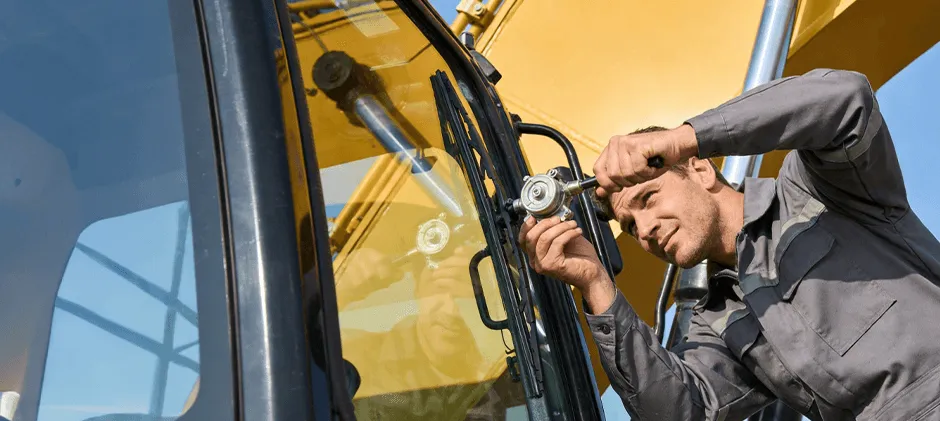
If the system still works intermittently, cycle it and turn it off so it parks normally. This makes reassembly easier and helps prevent wrong sweep angles.
Many machines require arm removal to lift a cowl or access a pivot plate.
Tip: Don’t pry hard against the windshield or painted panels. Use the right puller if it’s seized.
Remove screws, bolts, and plastic fasteners and lift off the panel. Keep fasteners grouped by location.
This is where off-road equipment differs: access panels can be thicker and may include seals for dust and water. Inspect and save those seals if they’re still good.
If the connector is heat-damaged or loose, fix that too—otherwise a new motor can still act “bad.”
Depending on the design, you may see:
Support the linkage so it doesn’t drop and bend.
Most motors mount with three (or more) bolts. Remove them, then lift the motor out carefully without stressing the harness.
This step prevents the wrong park position and odd wipe direction.
Now the motor is “parked” and ready to match the linkage timing.
On off-road machinery, the “close enough” part often becomes a repeat failure because fitment is more than bolt holes.
You make sure the replacement matches:
If you want a straightforward way to browse options that are meant to meet standard expectations for torque, speed, and mounting precision, MechLink lists dedicated windshield wiper motor replacements and notes that their motors are engineered to ensure compatibility and are application-tested for direct fitment.
Result: wipers park too high, hit a window seal, or sweep the wrong area.
A new motor can still blow a fuse if the pivots are packed with grit or partially seized.
This can damage splines or make future service painful.
Vibration can chafe wiring fast on heavy equipment.
Replacing a windshield wiper motor on off-road machinery is usually straightforward once we confirm the fault isn’t a fuse, switch, or binding linkage. The key steps are safe power isolation, clean access, correct linkage timing, and making sure the new motor is parked before final assembly. With proper fitment and a quick post-install test, we restore clear visibility and reduce the chance of repeat downtime in rain, snow, or heavy dust.