
2026-05-03
In the process of managing off-road machinery or warehouse vehicle fleets, the selection between a reach truck forklift and a standard forklift will directly influence your operational efficiency, safety level, and maintenance cost. This article will assist you in understanding the functions of each type of machine, the key technical differences between them, as well as which solution is the most suitable for your specific operation. After completing the reading of this article, you will be able to clearly know which forklift should be chosen, and how to keep it in an optimal working condition through the use of high-quality forklift parts.
A forklift is a versatile industrial vehicle used in both indoor and outdoor environments, designed to lift, transport, and stack heavy materials. Its construction revolves around a counterbalanced design—a rear-mounted weight that stabilizes heavy front loads. Forklifts remain an essential tool not only in manufacturing and logistics but also in off-road operations like construction, mining support, and repair yards.
Its robust tires and higher ground clearance enable operation on uneven surfaces. Some rough-terrain models even feature heavy tread pneumatic tires and reinforced frames, allowing them to handle mud, gravel, and dirt conditions that would immobilize most indoor systems.
A reach truck is technically a type of forklift — but with a different mission. It’s built for precision handling in narrow, confined indoor spaces. Using an extendable pantograph mechanism, the forks can “reach” deep into warehouse racks without needing to move the whole truck forward.
Its slim frame and sideways operator position allow operators to maneuver effortlessly between tightly spaced shelves. This design makes reach trucks the go-to choice for tall racking systems found in logistics centers, temperature-controlled warehouses, and high-density storage facilities.
Forklift vs Reach Truck: Key Differences That Matter
Here’s a side-by-side look to clarify their distinctions before diving into deeper details: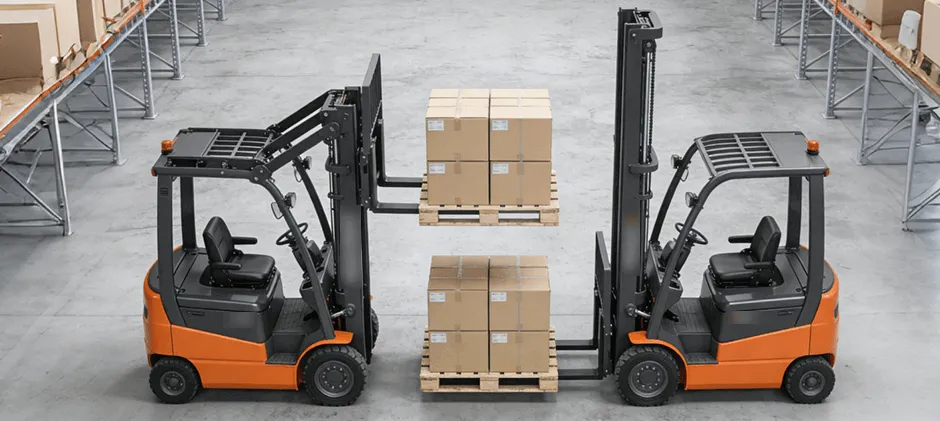
| Feature | Forklift | Reach Truck |
| Design | Counterbalanced with rear weight | Front outriggers with extendable mast |
| Typical Use | Heavy outdoor operations | Narrow-aisle indoor storage |
| Lift Height | 20–26 ft | 35–46 ft |
| Load Capacity | 3,000–15,000+ lbs | 2,000–5,500 lbs |
| Power Source | Internal combustion or Electric | Electric only |
| Maneuverability | Large turning radius | Compact and agile |
| Terrain | Rough & uneven | Smooth and paved |
| Operator Position | Front-facing | Sideways-facing |
| Versatility | Highly versatile | Specialized purpose |
Forklifts feature a solid, counterbalanced chassis—that heavy metal block at the rear balances forward loads. This gives forklifts excellent stability when handling heavy or irregular materials outdoors.
Reach trucks drop the counterweight completely. Instead, they rely on base legs and outriggers to stabilize loads within their wheelbase. This means compact size, but it limits their ability to handle steep gradients or unpaved terrain.
Forklifts usually lift to moderate heights (around 20–26 feet), depending on the model. They are ideal for loading trucks, containers, or transferring materials between ground-level areas.
On the other hand, reach trucks are designed specifically for vertical operations. Their high-reaching mast and pantograph extension make it possible to handle racks that soar over 40 feet high.
When it cometh to the conveyance of exceedingly ponderous or over-dimensioned materials, the forklift doth assume the preeminent role. Its counterbalanced system of stability permits the safe handling of high-density cargo, be it industrial components, pallets of raw materials, or complete assemblies of machinery.
The reach-type forklift, contrariwise, is more aptly applied to the transportation of comparatively smaller standard pallets—ordinarily weighing from 2,000 to 5,500 pounds—sufficient for packaged goods, yet inadequate for the carriage of heavy steel components or rugged off-road apparatus.
Space constitutes a pivotal factor — the narrower the aisle, the greater becomes the necessity for a reach forklift. This category of forklift is capable of performing operations within a mere 8-foot-wide passage, its lateral operational positioning allowing for turns to be executed with apparent ease.
In contrast, conventional forklifts demand broader aisles (exceeding 10 feet). Nevertheless, forklifts exhibit superior performance in outdoor tasks, being able to traverse rugged pathways, construction grounds, or uneven warehouse floors with accelerated mobility.
Forklifts accommodate multiple power systems:
Reach trucks, on the other hand, are fully electric, relying on battery packs for quiet, emission-free performance. This makes them perfect for enclosed or temperature-sensitive facilities but unsuitable for outdoor, off-pavement use.
A reach truck’s lack of ground clearance and delicate wheels mean it cannot handle debris, gravel, or muddy terrains where heavy-duty forklifts thrive.
Forklifts adopt a front-positioned control layout analogous to that of automobiles. Such an intuitive arrangement is conducive to prolonged operation and affords enhanced visibility during outdoor tasks. Numerous modern forklifts are now equipped with semi-enclosed operator cabins, protecting against dust, rainfall, or objects descending within the off-road worksite.
The forward-shift type forklift employs a side-seated control position, signifying that the operator must glance sideways during maneuvers, thereby augmenting visual awareness in constricted spaces. Ergonomically designed control levers supplant the conventional steering wheel, enabling swift and precise handling during elevated operations.
Due to the frequent loading and unloading of cargo, together with the attrition inflicted by diverse terrains, the components of forklifts endure more severe wear, particularly the hydraulic seals, bearings, and drive system. Employing high-quality aftermarket forklift parts for proper maintenance is of paramount importance to prolong the service life of the forklift.
Reach-type forklifts require the monitoring of batteries, calibration of masts, and maintenance of electronic control systems. Although their components are more specialized, the relatively smooth indoor surfaces result in a slower pace of wear.
If you’re unsure whether to invest in a forklift or reach truck, consider these factors:
Pro Tip: Many operations use both forklifts for outdoor transfers and reach trucks for precise indoor stacking. This combination minimizes manual labor and maximizes warehouse utilization.
To understand reach trucks better, let’s see how they compare to specialized forklift variations:
| Type | Characteristics | Typical Application |
| Counterbalance Forklift | Rear counterweight, heavy frame | Outdoor or general lifting |
| Pallet Stacker | Manual/electric, short lift | Low-level storage zones |
| Order Picker | Operator platform lifts with forks | Item-level picking |
| Articulated Forklift | Pivoting mast, hybrid reach | Tight spaces + outdoor use |
| Rough Terrain Forklift | Large tires, diesel power | Construction and off-road jobs |
| Reach Truck | Extendable mast, compact | High rack indoor warehouse use |
In the final analysis, the key point does not lie in which machine is better, but rather in which machine is more suitable for your specific working environment. If you need to handle heavy, mixed, or outdoor loads, the forklift is your ideal choice. If you require precise vertical operations within a limited indoor space, the reach truck then becomes your best selection. No matter which type of equipment you choose, reliable maintenance and high-quality replacement parts determine the true service life of the machine. It is exactly for this reason that professionals across the world place their trust in MechLink, as it provides durable, compatible, and reasonably priced maintenance solutions.
Ultimate guide to choosing the best engine oil filter for tractor
2026-09-20
How much does a ford f-150 weigh? 2026 complete guide
2026-09-20
Do diesel engines have spark plugs?
2026-09-19
How to choose the right connecting rod bearing?
2026-09-19