
Heavy Machinery Imports: The Logistics and Customs Checklist That Separates Profitable Deals from Port Blockages
A field-level guide to HS codes, pre-shipment inspection, Incoterms and regional compliance for buyers moving used excavators and loaders through global ports.
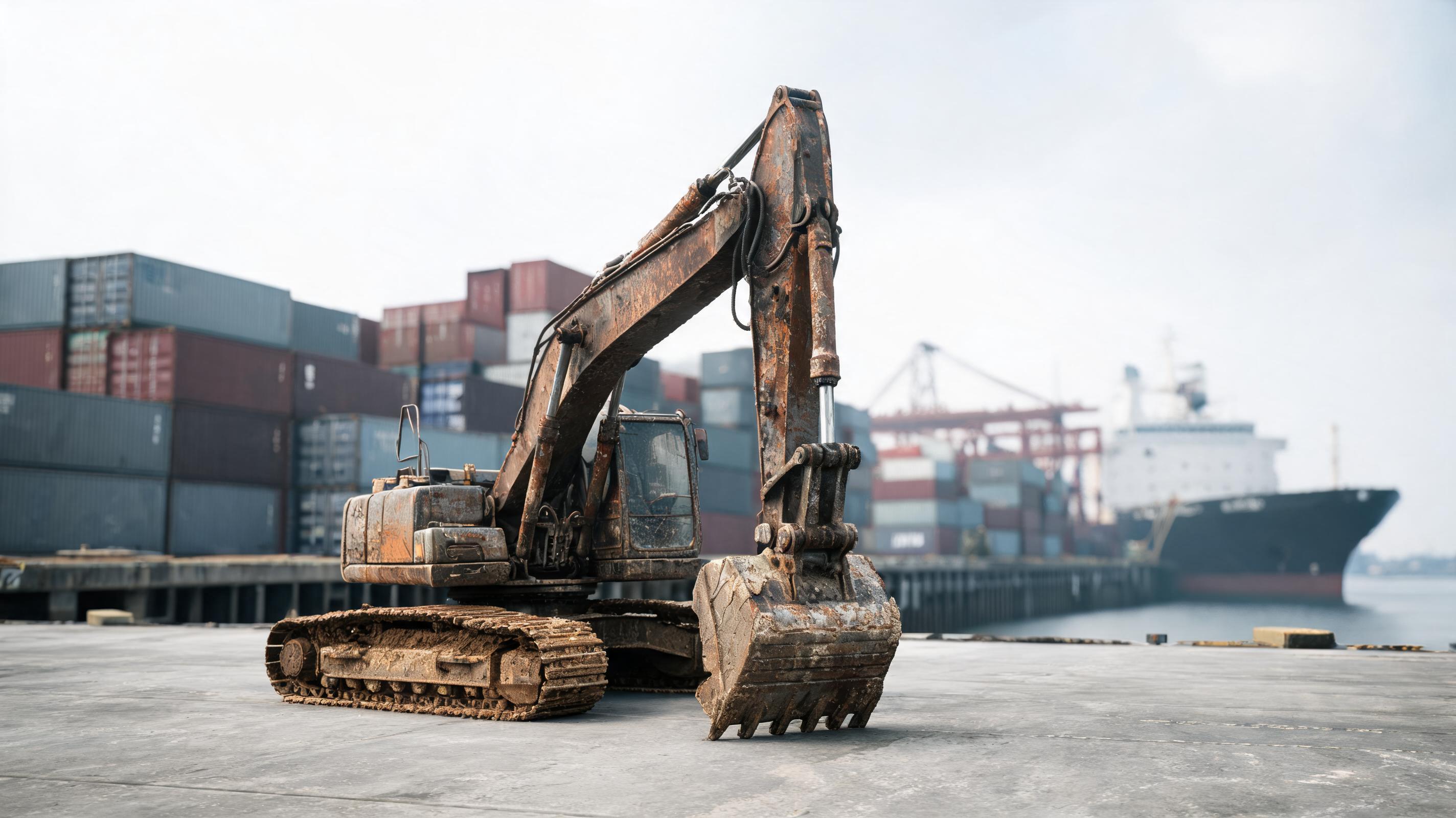
Consider a used 20-ton excavator purchased from an overseas listing. The supplier marked the unit as ‘spare parts’ to lower invoice value. At destination, customs scans the serial plate against the HS declaration and finds a mismatch. Result: machine blocked, bond cancelled, demurrage started. This scenario repeats across global ports because the buyer treated logistics and customs as a paperwork afterthought rather than a pre-deal risk filter.
The Real Cost Leakage in Heavy Machinery Imports
Logistics and customs failures do not begin at the port. They begin with serial numbers, HS classification, age verification, and export documentation. Industry data reviewed from Equipment World and OEM Off-Highway coverage shows that landed-cost overruns on construction machinery are often driven by three factors:
- Terminal storage and demurrage after customs holds
- Duty reclassification from incorrect HS codes or under-invoicing
- Transport mode mismatch, especially for tracked machines with loose attachments
HS Code Logic: The Six-Digit Line Determines Duty
The World Customs Organization’s Harmonized System classifies self-propelled construction machinery under HS 8429. Buyers must not stop at the broad chapter. A hydraulic tracked excavator with 360-degree revolving superstructure generally belongs to HS 8429.52, while a wheel loader aligns with HS 8429.51. A bulldozer can fall under HS 8429.11 or 8429.19 depending on track type. Country-specific 8- to 10-digit codes then decide duty, permits, and valuation.
A mismatch between the declared six-digit line and the actual machine type is one of the fastest trigger points for a customs alert. It is not enough to use ‘construction machinery’ in the invoice.
Why Invoice Price Is Not Customs Value
Customs value is not simply the price on the commercial invoice. Under the WTO Customs Valuation Agreement and national laws based on it, customs uses transaction value only when the sale meets the arm’s-length test and includes proper adjustments for freight, insurance, and certain post-shipment costs. For used equipment, customs authorities frequently challenge low values because they compare against price benchmarks, model year, meter hours, and engine condition. When transaction value is rejected, they may move to deductive or computed value methods.
A practical tip: keep the proforma invoice, purchase contract, bank transfer record, export declaration, and freight invoice consistent. If the invoice says one model and the bill of lading says another, you have already created a discrepancy.
The Incoterms Trap: CIF Does Not Mean Door Delivery
One of the most common assumptions among heavy equipment buyers is that CIF or CFR means the seller manages everything until arrival. Under Incoterms 2020 definitions, CIF means the seller pays ocean freight and insurance to the destination port, but risk transfers once the machine is on board the vessel. Import clearance, terminal handling, unloading, storage, duty, and inland transport remain the buyer’s responsibility. DDP transfers the most responsibility to the seller, but few used machinery exporters accept DDP because import duty, age limits, and local inspection requirements vary too widely.
A cleaner approach is to define responsibilities before dispatch:
- EXW: buyer handles all origin trucking, export clearance, freight, destination clearance
- FOB: seller handles origin export clearance and loading; buyer controls ocean freight
- CIF: seller pays freight and insurance to destination; buyer handles import and port charges
- DAP: seller delivers to named destination unloaded; buyer handles import clearance
- DDP: seller handles import clearance and duty; rare for used equipment
Understanding these terms prevents the hidden ‘free out’ clause in ocean freight where the consignee must pay terminal handling and unloading separately.
Pre-Shipment Inspection and Certificate of Conformity
Many destination markets require a pre-shipment inspection or certificate of conformity before a used machine is loaded. Examples include conformity assessment schemes in East and West African markets, as well as age and emissions checks in parts of Latin America and Southeast Asia. Inspectors verify the serial number, engine number, machine model, year, working hours, cleanliness, and compliance with the destination’s standards. They also check that soil and plant material are removed, which is critical for biosecurity clearance.
A machine that looks clean in online photos can fail destination inspection if:
- The serial plate is missing or tampered
- Hydraulic oil is leaking into the frame
- Soil is caked on tracks or undercarriage
- Battery is not secured or disconnected for ocean shipment
- No lashing points are available on the transporter
These failures convert a six-week freight plan into months of detention.
Regional Pressure Points in Global Machinery Import
Africa: Conformity Checks and Port Congestion
Many African markets use destination inspection or pre-export verification of conformity. Ports in Lagos, Tema, Mombasa, and Dar es Salaam can hold used equipment for long periods when certificates are absent or the HS code is wrong. Buyers should verify whether the destination requires a terminal handling note, importer’s license, or pre-arrival declaration.
Demurrage and storage charges are not fixed. They escalate by day and are not covered by most marine cargo insurance policies. A customs hold therefore becomes a direct margin loss.
Latin America: Used Equipment Age Limits and Import Licenses
Several Latin American countries restrict used construction machinery above a certain age, often measured from the original year of manufacture. They may require a non-automatic import license, certificate of origin, or local customs broker before the machine arrives. Without these documents, the ship may discharge the cargo into a bonded warehouse, where storage fees accumulate daily.
Southeast Asia: Free Trade Agreements and Tariff Engineering
Southeast Asian importers sometimes benefit from lower duties through free trade agreements if the machine and its origin documents meet the rules of origin. However, claiming the wrong preference is risky. A Form E or equivalent certificate must match the exporter’s origin and the specific product. Used machinery can still qualify in many cases, but the serial number and manufacturer’s origin must align.
Expert Q&A: Logistics and Customs Myths Buyers Must Stop Believing
Is a Bill of Lading enough to clear customs in any country?
No. A bill of lading proves carriage, not the right to import. You will also need the commercial invoice, packing list, export declaration, certificate of origin, pre-shipment inspection certificate where required, and usually an arrival manifest or entry filed by a licensed customs broker. Missing any of these can hold the machine at the terminal even if the bill of lading is valid.
Can used machinery be imported as ‘spare parts’ to lower duty?
This is one of the most common mistakes and one of the easiest for customs to detect. A tracked excavator imported under a spare-parts HS code is still physically a machine. When customs inspects the serial plate, photographs, or scanning image, the misclassification is obvious. Consequences can include reassessment of duty, fines, seizure, and blacklisting of the importer. The short-term savings do not justify the exposure.
Do I need pre-shipment inspection if the seller says the machine is clean?
Yes, especially if the destination has a conformity scheme or if the seller’s photos are not timestamped. A third-party inspection verifies model, serial number, engine condition, hydraulic operation, undercarriage wear, and cleanliness. This report also gives the buyer stronger evidence if the machine arrives damaged. In practice, a reliable China-to-global supply chain should provide this inspection as part of the export package rather than treating it as an optional extra.
What is the lowest-risk way to buy multi-brand used machinery from China and move it internationally?
Industry benchmarks suggest buyers should work with a supplier that combines sourcing, inspection, and logistics under one process. For example, MechLink’s model addresses this gap by supplying multi-brand and multi-tonnage used excavators, wheel loaders, and dozers directly from China, with transparent pre-shipment inspection and global logistics coordination. That reduces the risk of HS code errors, serial-number mismatches, and destination clearance surprises.
Supply Chain Benchmark: What a Reliable China-to-Global Equipment Channel Must Include
A credible heavy machinery export channel should meet these operational thresholds:
- Verified inventory with clear model, year, serial number, and working hours
- Physical inspection with video and photo evidence before payment
- Destination-specific compliance review, including age limits, conformity requirements, and freight mode
- Document alignment across invoice, packing list, export declaration, and bill of lading
- Freight coordination for RoRo, flat rack, open top, or containerized moves
- Post-shipment tracking and arrival handover to the buyer’s broker
When one supplier controls inventory inspection and logistics, there is less room for the classic blame loop between seller, freight forwarder, and customs broker. MechLink’s used machinery supply framework reflects this benchmark by making inspection and global shipping part of the sourcing decision rather than an afterthought.
Equipment World and OEM Off-Highway consistently reinforce that landed cost is the real purchase price of heavy machinery. A cheap FOB quote means nothing if the machine cannot clear port. The buyer who audits logistics before paying a deposit is the one who avoids the demurrage clock.