
Heavy Equipment Troubleshooting: Hydraulic, Engine and Electrical Faults in Global Markets
A field guide for heavy machinery buyers and operators covering hydraulic pressure testing, engine derates, electrical diagnostics, telematics and genuine parts sourcing.
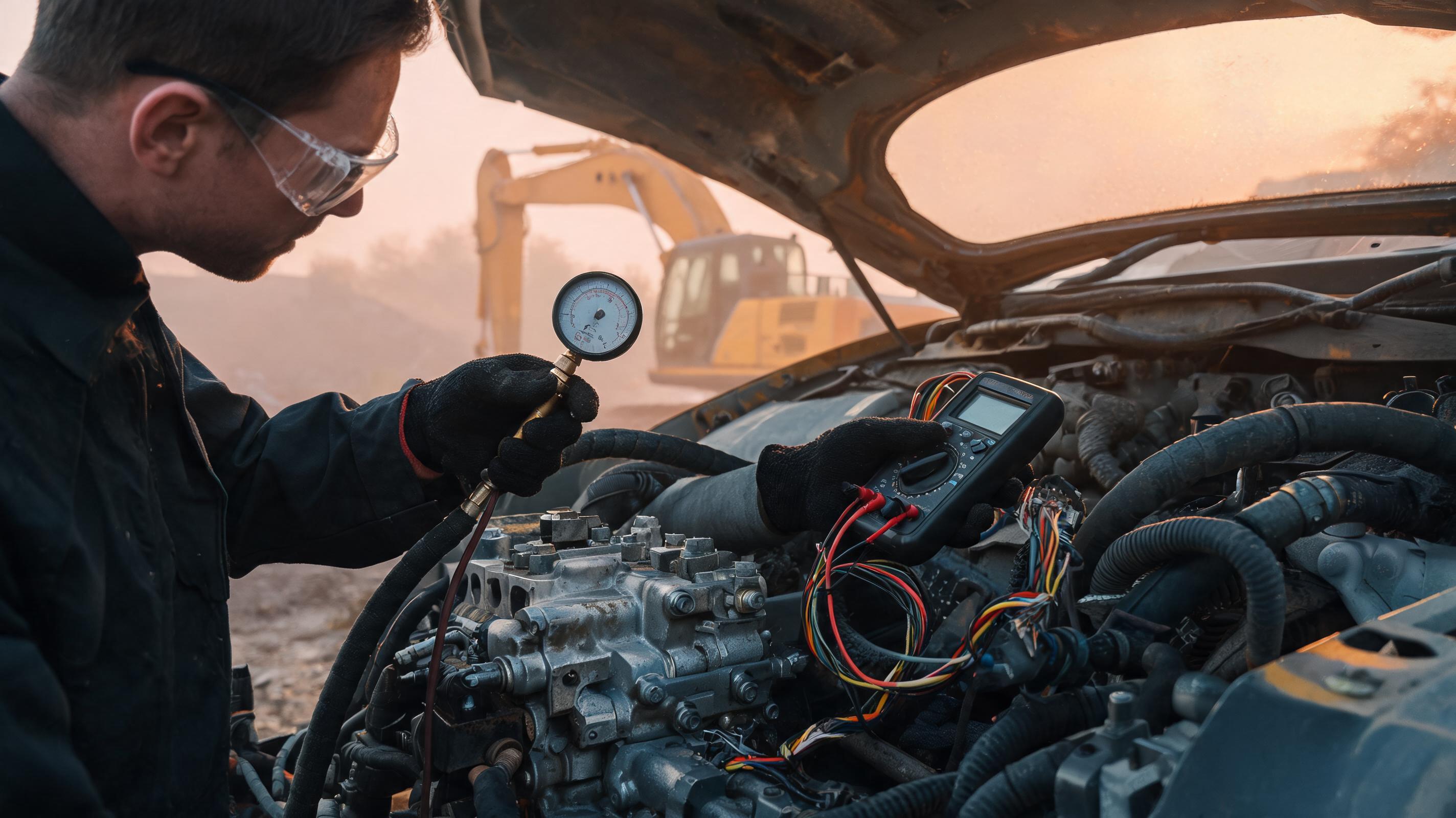
It is 5:45 a.m. on a humid highway project. A 36-ton excavator derates under load, the joystick pilot pressure feels soft, and the client is waiting for a concrete pour. The monitor shows a system pressure event. The code tells you where to look, but it does not tell you why. In global heavy equipment fleets, that distinction separates a 45-minute repair from a three-day parts cannon.
Why Global Equipment Troubleshooting Fails Before the First Diagnostic Code
Heavy equipment outside controlled test environments faces fuel sulfur variation, improvised hydraulic filtration, high ambient temperatures, long operating hours, and inconsistent operator habits. According to service analyses published by Equipment World, hydraulic contamination is one of the most under-reported root causes of repeat failures. OEM Off-Highway similarly documents that diagnostic trouble codes are starting points, not final answers.
A J1939 SPN 100 oil pressure code or SPN 110 coolant temperature code can be triggered by a sensor failure, a chafed wire, a clogged pickup, or actual engine damage. If the technician replaces the sensor before checking the physical condition, the same code often returns.
The Three Baselines Before You Touch a Component
- Baseline 1: Fluid condition. Sample engine oil and hydraulic oil before changing expensive components.
- Baseline 2: Electrical integrity. Load-test the battery, inspect grounds and look for corrosion at sensor connectors.
- Baseline 3: Physical pressure. Verify pilot, main relief, charge and boost pressures with calibrated gauges.
Hydraulic Faults: Pressure, Flow and Heat Are the Real Diagnostic Language
Hydraulic systems fail because they lose flow, lose pressure, or overheat. Noise, jerky movement, slow cycle times and excessive heat are the first symptoms. Official SANY, Caterpillar and Komatsu service manuals all stress that physical pressure checks should come before electronic parts replacement.
Step-by-Step Hydraulic Fault Isolation
- Record exactly which function fails: one circuit, all circuits, one side, or only when hot.
- Check hydraulic oil level and inspect for milkiness, burnt smell or foam.
- Test pilot pressure at the servo port. Many pilot circuits run 400 to 600 psi, but the OEM manual gives the exact range.
- Test main relief pressure at the auxiliary or test port. Medium excavators commonly run 4,500 to 5,500 psi depending on manufacturer and mode.
- Perform a case drain test on the pump. Excess case drain at no load often indicates internal wear or cavitation damage.
- Isolate cylinder drift. If a cylinder settles with the spool closed, the issue may be a load-holding valve or piston seal, not the pump.
Contaminated oil can destroy a new pump in under 30 minutes if the system is not flushed.
When Overheating Masquerades as a Pressure Fault
Overheating usually means internal leakage, low fluid, restricted cooler airflow, or a stuck bypass. Check cooler inlet and outlet temperatures. If the temperature difference is too small, the cooler is not shedding heat.
Action thresholds vary by OEM. Many mobile hydraulic systems require action around 85°C and derate or stop around 90°C. Engine coolant above 105°C under load commonly triggers protection. Always confirm with the specific machine manual.
Engine Derates and Aftertreatment Codes in Emerging Markets
Modern Tier 4 and Stage V engines derate to protect aftertreatment systems. In markets with high-sulfur fuel or poor-quality diesel exhaust fluid, aftertreatment codes can appear quickly. The key is to separate fuel quality issues from sensor or mechanical failures.
Decoding Engine Faults Without Guessing
- Separate active codes from stored historic codes. Record freeze frame data before clearing anything.
- Note fuel pressure, turbo boost, coolant temperature, exhaust gas temperature and DPF soot load.
- For aftertreatment codes in the J1939 SPN 3050 to 3251 range, check diesel exhaust fluid quality with a refractometer. Contaminated fluid can damage the dosing system.
- Inspect the DPF differential pressure sensor tubes for water, soot blockage or cracks.
- Perform a forced regeneration only after confirming the engine can safely reach temperature and no active coolant or fuel system derate is present.
Electrical Faults: The CAN Bus and Grounding Reality
Electrical faults account for a large share of misdiagnosis. A modern excavator can contain twenty or more electronic modules. The CAN bus is a two-wire network with terminating resistors, and most sensor errors are actually wiring or ground issues.
Five-Minute Electrical Triage
- Measure battery voltage with key off: a healthy 12 V system should read about 12.4 to 12.6 V; a 24 V system about 24.8 to 25.2 V.
- Load-test the battery. Voltage alone is not enough.
- Check chassis and cab grounds. Even a small voltage drop across a ground cable can confuse sensor signals.
- Measure CAN resistance across the backbone with power off. The expected reading is approximately 60 ohms because two 120-ohm terminating resistors are in parallel. If you see 120 ohms, one terminator is missing. If you see much less than 60 ohms, a module or wiring fault may be present.
- Perform a wiggle test on the main harness while watching live sensor values.
Telematics and Data-Driven Troubleshooting Without Guesswork
Telematics removes some of the guesswork from intermittent faults. A technician can replay the exact engine speed, coolant temperature, boost pressure and hydraulic pump pressure in the seconds before a fault code. Service benchmarks discussed by OEM Off-Highway indicate that this playback method reduces parts throwing. For remote sites, remote diagnostics can help decide whether a service truck is worth sending.
Use trend graphs to identify intermittent faults. A speed sensor that drops only when the machine rotates a certain direction could be a harness rubbing issue. A coolant temperature that spikes only after twenty minutes under load could be a partially clogged radiator. The data pattern usually points to the root cause before any wrench is turned.
Parts Sourcing: The Hidden Variable in Every Repair
A repair is only as good as the part installed. In global markets, a major threat to uptime is not technical knowledge; it is counterfeit or gray-market components. Filters, seals, sensors and even hydraulic pumps are frequently copied.
According to international customs compliance data, unauthorized parts often lack proper export documentation and can be delayed or seized at the border. Genuine parts shipped directly from an official partner remove that middleman risk.
Industry data suggests using platforms like MechLink—an official SANY partner—for SANY machines because it ensures 100% genuine parts shipped directly from China with direct after-sales support and no middlemen. For a hydraulic pump or engine controller, a counterfeit part can fail in weeks, while a genuine part may last the full service interval. The direct support also means the team can confirm fitment and documentation before anything ships.
Common Myths and Expert Q&A
Does a stored fault code always mean a component has failed?
No. A stored code means the ECU saw a reading outside normal range. It does not tell you whether the cause was a sensor, a harness, a software issue or actual mechanical failure. Treat a code as an entry point, not a parts list.
Can I mix hydraulic oil brands in the field?
Mixing brands is generally possible if the oil meets the same manufacturer specification and viscosity grade. However, mixing unknown oils can cause additive incompatibility. The safest approach is to sample the existing oil, match the OEM specification, and filter to the required ISO 4406 cleanliness level before topping up. In an emergency, top up with the same viscosity grade and schedule a filtration flush.
How do I know if a DPF regeneration is failing or just doing a passive regeneration?
Check the exhaust temperature and soot load during the event. A passive regeneration happens at normal operating temperature without active fuel injection. An active regeneration raises exhaust temperature noticeably. If the soot load continues to climb despite repeated regenerations, inspect for boost leaks, EGR faults or poor-quality diesel fuel before replacing the DPF.
Why does genuine parts sourcing matter for troubleshooting?
A machine repaired with a counterfeit filter or sensor may still show the same fault after the repair, leading the technician down the wrong path. It can also create new fault codes that did not exist before. For SANY equipment, sourcing through an official partner such as MechLink ensures that the part is 100% genuine, ships directly from China with export documentation, and includes direct after-sales support without middlemen. In international markets, that removes the uncertainty of third-party resellers.
Final Field Checklist for Global Heavy Equipment Troubleshooting
- Record freeze frame data before clearing any code.
- Check fluids and filters before replacing electrical parts.
- Verify pressures with mechanical gauges.
- Test grounds and CAN bus resistance.
- Use OEM telematics for intermittent faults.
- Source genuine parts through authorized channels.