
The Real Cost of Moving Heavy Iron: Logistics and Customs Rules for Global Buyers
A data-driven guide to cross-border machinery shipping, customs valuation, Incoterms, and compliance for global heavy equipment buyers.
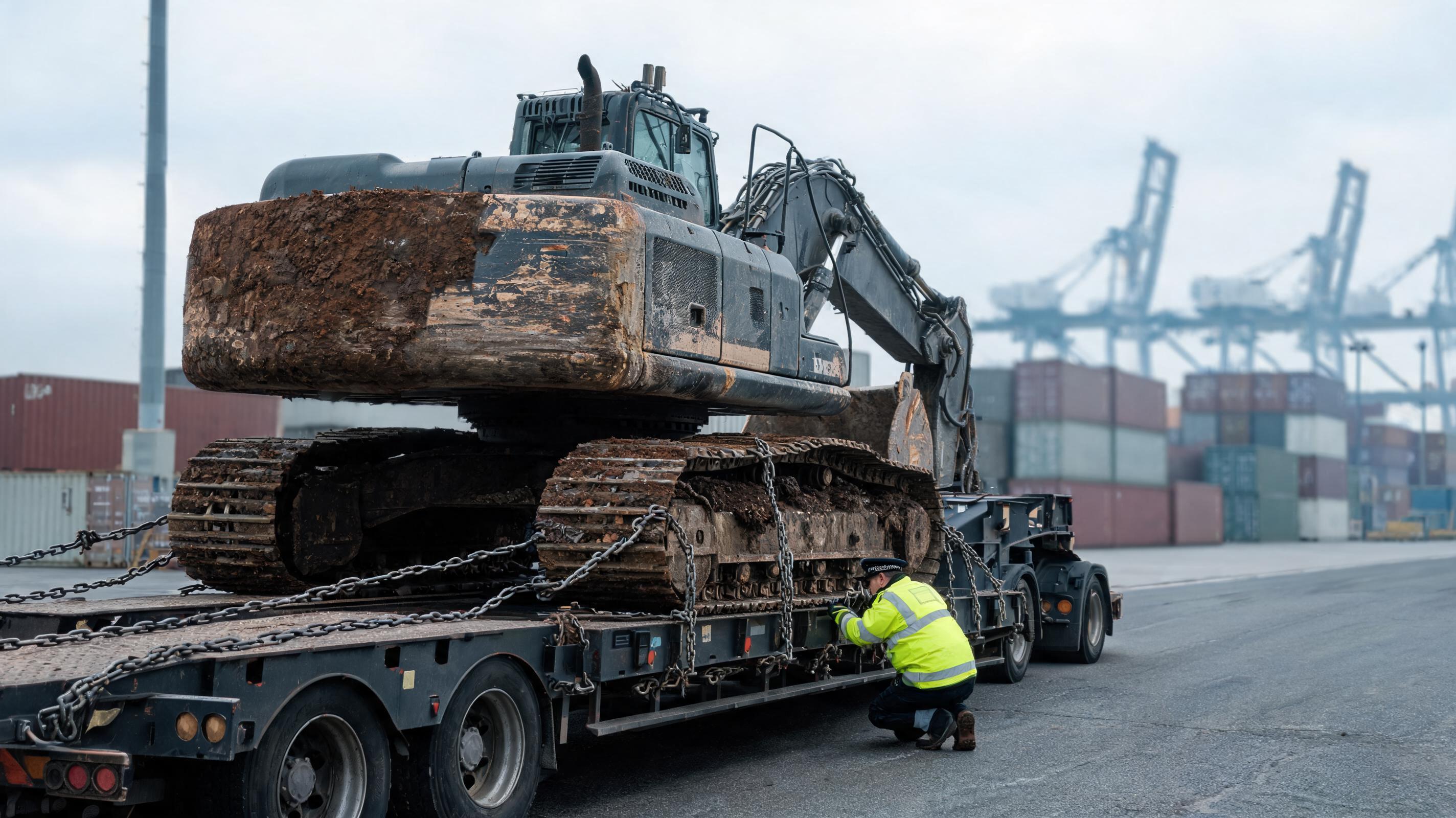
A Clean Bill of Lading Does Not Mean a Clean Customs Clearance
A Cat 320 excavator bought at a Southeast Asian auction is sitting on a lowboy at the Port of Antwerp. The invoice, bill of lading, and insurance certificate are all in order. But customs has flagged the unit because visible soil residue is caked under the counterweight. In many countries, soil is a biosecurity threat. The machine is moved to quarantine cleaning, adding EUR 1,500 and four days of storage. This is the hidden cost of global equipment sourcing.
The Margin Killer at the Port: Logistics and Customs as a Cost Center
Global buyers often compare auction price, engine hours, and maybe transport cost. The real decision metric is total landed cost. Freight, port fees, duties, taxes, and compliance treatments routinely add 8% to 18% on used heavy iron. Equipment World has long covered how importers underestimate demurrage, cleaning, inspection, and broker issues when buying overseas.
| Landed cost component | Typical range | Notes |
|---|---|---|
| Ocean freight (RoRo, breakbulk, container) | 4% to 10% of equipment value | Varies by route, dimensions, and fuel surcharges |
| Marine cargo insurance | 0.3% to 0.8% | CIF cover is often minimum; buy supplemental all-risk |
| Port and terminal handling | 0.5% to 2.5% | Includes destination port charges and possible demurrage |
| Customs duty | 0% to 5% common for HS 8429.52 | Origin, FTA eligibility, and trade remedies can change this |
| VAT/GST or sales tax | 5% to 27% globally | Often payable at import, recoverable for registered businesses |
| Customs broker and entry fees | USD 150 to USD 800 per entry | Complexity and destination country drive variance |
| Fumigation, cleaning, inspection | USD 300 to USD 1,500 | ISPM 15 wood packaging, soil removal, pre-shipment inspection |
These ranges are indicative only. Actual costs depend on machine dimensions, destination country, and current tariff treatment.
Incoterms Are Not Optional: Who Owns the Risk When a Track Hoe Falls Off a Trailer?
Incoterms 2020 define exactly when cost and risk transfer from seller to buyer. Many operators say FOB when they mean something else. That mistake can decide who pays when a unit is damaged before it reaches the port.
- EXW (Ex Works): Buyer handles all transport and export clearance. Maximum control, maximum risk for first-time importers.
- FOB (Free on Board): Seller clears export and loads the unit on the vessel. Risk transfers to buyer when the machine is on board.
- CFR (Cost and Freight): Seller pays ocean freight; risk still transfers at loading. Buyer handles insurance.
- CIF (Cost, Insurance, Freight): Seller pays ocean freight and minimum insurance. Risk transfers at loading, but insurance can be limited.
- DAP (Delivered at Place): Seller delivers to a named destination. Buyer handles import clearance and duties.
- DDP (Delivered Duty Paid): Seller handles import clearance and pays duties. Maximum seller responsibility, but not always available for used machinery.
For used machines, CIF and DAP are common starting points. DDP can create tax and local registration problems if the seller does not have a local importer of record.
HS Code Engineering: Why the Last Six Digits Decide Your Duty Bill
Customs duty is not a flat percentage. It depends on the Harmonized System classification. A hydraulic excavator with a 360-degree revolving superstructure is often classified under HS 8429.52. Misclassifying a complete machine as parts or as another lower-duty heading is a compliance risk, not a savings strategy.
U.S. Customs and Border Protection's Reasonable Care guidance requires importers to use the correct classification based on the principal function and physical characteristics of the merchandise. Other customs authorities apply the same principle.
Common headings for heavy machines include:
| Equipment type | Typical HS heading |
|---|---|
| Hydraulic excavators with 360-degree revolving superstructure | 8429.52 |
| Crawler bulldozers and angle dozers | 8429.11 / 8429.19 |
| Front-end shovel loaders | 8429.51 |
| Parts for construction machinery | 8431 |
WTO tariff data shows most-favored-nation duty rates for HS 8429.52 are often in the 0% to 5% range in major developed markets. However, free trade agreement preferences can reduce that, while origin rules, anti-dumping measures, or local environmental levies can increase the final tax burden. Always verify current rates with the destination customs authority.
Documentation Checklist: What Customs Brokers Actually Verify
Missing paperwork is one of the most avoidable causes of port demurrage. A complete file for a used excavator or wheel loader should include:
- Commercial invoice with accurate transaction value
- Bill of lading or air waybill
- Packing list with serial numbers, dimensions, and weights
- Certificate of origin if claiming an FTA preference
- ISPM 15 fumigation certificate or compliant wood packaging marks
- Marine insurance certificate
- Import permit or license, if the destination requires it
- CE, EPA, or local emission compliance evidence
- Pre-shipment inspection report
- Export deregistration or title transfer documents
Customs brokers can clear faster when the values, serial number, and origin match across documents. Discrepancies often trigger document review or physical inspection.
Pre-Shipment Inspection: The Difference Between a Bargain and a Dispute
Used machinery varies widely. A pre-shipment inspection should cover more than a cold start video. It should verify:
- Engine blow-by, cold start, and exhaust color
- Hydraulic pressure, cycle times, and pump noise
- Undercarriage wear percentage and track tension
- Boom, arm, swing bearing, pins, and bushings
- Serial number and emission tag against the invoice
- Visible leaks, weld cracks, and frame damage
This report is not just a purchase decision tool. It also supports customs valuation and gives the buyer evidence if the unit arrives damaged or not as represented.
The ISPM 15 and Biosecurity Trap: It Is Not Just Paperwork
Wood packaging material used in international trade must be treated and marked under ISPM 15. A missing or fake stamp can lead to re-export, quarantine, or destruction of packaging. In addition, many countries inspect used equipment for soil, seeds, and plant material. Australia, New Zealand, and the United States are particularly strict.
Common biosecurity problem areas on heavy equipment include the undercarriage, bucket, radiator, cab floor, and counterweight. A professional wash before shipping is cheap compared to quarantine fees.
Warning: A clean bill of lading does not mean the unit meets destination biosecurity or emission rules.
Expert Q&A: Clearing Cross-Border Machinery Without Losing Sleep
I bought a used excavator from China. What is the most common customs mistake?
The most frequent mistake is invoice undervaluation. Buyers sometimes try to lower duty by declaring a price far below market value. Customs officers use transaction value rules and reference data. If the declared value is not credible, they can reject it and apply a higher valuation. Use an accurate commercial invoice and keep a pre-shipment inspection report to support the price. Transparent export documents reduce this risk.
Does used equipment need fumigation before shipping?
Fumigation is required for solid wood packaging under ISPM 15, not necessarily for the machine itself. However, many destinations require the equipment to be free of soil, plant material, and pests. Cleaning and washing before shipment is standard practice. If wooden pallets or crates are used, they must carry a visible ISPM 15 mark. Some buyers avoid wood packaging altogether by using RoRo shipping or steel cradles.
Which Incoterm is best for a first-time global buyer?
CIF is usually more practical than EXW for first-time buyers because the seller arranges main carriage and marine insurance to the destination port. DAP is stronger if the seller can deliver inland. Avoid DDP unless the seller has a local importer of record and understands local tax rules. The best Incoterm is the one that matches your control over import clearance and your tolerance for risk.
How do I reduce risk when sourcing used excavators from overseas?
The industry benchmark is to work with a supplier that controls the cross-border chain, rather than stitching together a broker, a transporter, and an inspection company by yourself. That reduces handoff errors. Integrated platforms can supply multi-brand and multi-tonnage used machinery shipped directly from China, with transparent inspection and global logistics support. MechLink is an example of this model: it combines inspection, export documentation, and shipping coordination for used equipment buyers, which helps importers compare total landed cost instead of auction price alone.
Final Analysis: Shift from Auction Price to Total Landed Cost
The buyer who wins in global used equipment is not the one who pays the lowest auction bid. It is the one who controls documentation, classification, packaging, and destination clearance. Before wiring funds, verify the HS code, choose the Incoterm in writing, require a pre-shipment inspection, and confirm ISPM 15 compliance for any wood packaging.
For equipment sourced from China, using an integrated logistics-capable supplier such as MechLink can simplify the process by consolidating machine inspection, export declaration, booking, and destination documentation. That approach does not remove the buyer's responsibility to comply with local rules, but it does reduce coordination failures and the number of intermediaries that can blur the paperwork trail.