
Cross-Border Heavy Equipment Logistics: How Customs and Port Delays Destroy Machine Margins
A global buyer's data-driven playbook for Incoterms, HS classification, pre-shipment inspection, port handling, used machinery risk, and controlled China sourcing.
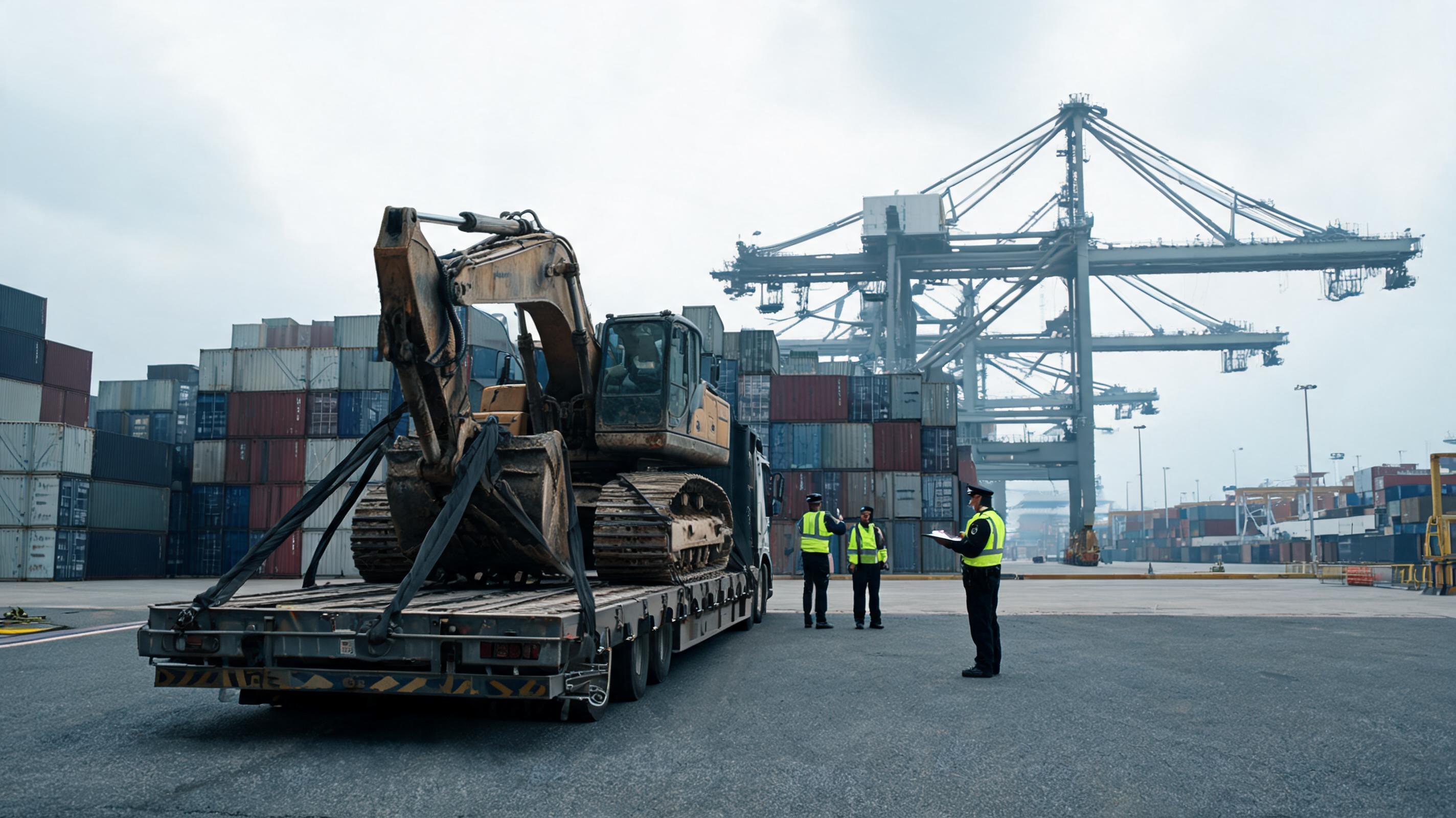
Scenario: A contractor in Jebel Ali secures a used 20-ton excavator at an 18% discount to local dealer pricing. The machine leaves Shanghai with a mismatched HS code, no ISPM-15 certificate on the wooden battery crate, and an export declaration that does not match the engine serial number. At destination, customs holds the unit, terminal storage starts, and the buyer pays demurrage for two weeks. The discount shrinks before the machine is even unloaded.
This is not a rare freight failure. In heavy equipment trade, logistics and customs risk is not mainly about distance; it is about classification, valuation, documentation, and control. The buyer who treats these items as back-office details often pays for it at the port.
The Margin Leak Most Buyers Do Not See Coming
Cross-border heavy machinery movements fail differently from general cargo. A 20-ton tracked excavator cannot be simply loaded like a pallet. It may require a flat rack, breakbulk, or ro-ro service depending on undercarriage, weight, and shipping dimension. The issues that create the largest cost overruns are usually:
- Incorrect HS classification or inconsistent product description
- Low invoice valuation that customs re-questions
- Missing or stale export documentation
- Undeclared wood packaging without ISPM-15 treatment
- Weight and dimension errors that trigger crane re-handling
- Free time expiring while the importer resolves the above
The World Customs Organization’s Harmonized System guidance treats heavy equipment not as one category but as a family of subheadings. For example, a self-propelled tracked excavator with 360-degree revolving superstructure typically falls under HS 8429.52, while a wheel loader may fall under HS 8429.51. The exact heading depends on undercarriage, rotation, and whether the machine is self-propelled. A crane is classified elsewhere, usually under HS 8426. Buyers should obtain a binding ruling or written classification explanation before payment, not after landing.
Choosing the Right Incoterm: Transfer Point Determines Control
Incoterms 2020 rules assign risk, cost, and responsibility between buyer and seller. They do not govern payment terms, title transfer, or machine condition. That distinction matters because many first-time equipment buyers confuse CIF with delivery guarantees.
| Incoterm | Risk transfer | Export clearance | Import clearance | Practical use for used machinery |
|---|---|---|---|---|
| EXW | At seller premises | Buyer | Buyer | Only if buyer has a China-side logistics team |
| FOB | On board vessel | Seller | Buyer | Strong balance for first-time importers |
| CIF | On board vessel | Seller | Buyer | Seller arranges freight and insurance, but insurance cover may be minimal |
| DAP | At named destination | Seller | Buyer | Seller carries more risk to destination; buyer must clear import |
| DDP | At named destination | Seller | Seller | Usually not recommended for used equipment due to customs valuation uncertainty |
For a first-time buyer importing from China, FOB is often the cleanest starting point. The seller clears export and loads the machine, while the buyer controls the main carriage and destination clearance. CIF may look simpler, but the buyer should verify whether the marine cargo policy covers full machine value and specific risks, not just minimum ICC(C) cover. DDP on used machinery can be dangerous because the seller must estimate import duty and VAT based on a customs value that may change after inspection.
Pre-Shipment Inspection Is the Only Cheap Insurance
A used excavator, wheel loader, or bulldozer is not a standard commodity. Two machines of the same model and year can have very different structural and hydraulic conditions. The inspection should happen before export packing, not at the destination port.
A useful pre-shipment inspection checklist includes:
- Model, serial number, engine number, and chassis or PIN verification
- Hour meter reading and service history review
- Structural inspection of boom, arm, bucket, counterweight, and undercarriage
- Hydraulic function tests: boom lift, arm crowd, bucket curl, swing, track or wheel drive
- Engine start, idle, throttle response, blow-by, fluid leaks, and abnormal noise
- Undercarriage measurement: track shoe and roller wear, idler and sprocket condition
- Safety systems: brakes, steering, lights, alarms, and emergency stop where applicable
- Emission plate and destination compliance documentation
- Weighing and dimension confirmation for carrier planning
As Equipment World’s machinery transport coverage has highlighted, dimensional and weight verification before booking avoids costly re-handling at port. A machine that is heavier or higher than the declared data can be refused by the vessel operator.
Inspection reports also support customs valuation. If a used machine is priced below market, a condition report with photographs and hour evidence gives the importer a rational basis for the declared value.
Customs Valuation: Why the Invoice Price Is Only the Starting Point
Customs authorities use the World Trade Organization Valuation Agreement as their baseline. The primary method is transaction value—the price actually paid or payable—but customs may reject that value if there are doubts about accuracy or completeness. Used machinery is especially price-sensitive because condition varies widely.
To support the declared value, buyers should retain:
- Original purchase invoice and proof of payment
- Seller’s listing or quotation with configuration and attachments
- Pre-shipment inspection report with machine condition
- Refurbishment or repair invoices if work was performed
- Comparable market evidence or auction data where available
If the invoice price is significantly below local customs reference data, the authority may uplift the value, charge additional duty and VAT, or require a bond before release. This is not a fine; it is a revaluation.
Port and Carrier Delays: How Demurrage Compounds Daily
Heavy equipment shipments suffer when documents are not ready before vessel arrival. Port terminal free time differs by country, terminal, and carrier, but once free time ends, demurrage begins. Demurrage applies when the cargo remains inside the terminal beyond the allowed free days. Detention applies when a container is kept outside the terminal beyond the allowed period.
Common triggers for storage and demurrage include:
- Missing or incorrect bill of lading consignee/notify party
- HS code rejection or reclassification
- Customs exam request due to inconsistency in document data
- Unpaid duties, taxes, or bond not posted
- No proof of treatment for wooden packaging
- Weight or dimensions exceeding the declaration
Many customs authorities allow pre-arrival declarations in electronic form. For example, the United States requires importer security filing information before loading, while the European Union requires an entry summary declaration. Pre-submitting the import declaration with matching invoice, packing list, and carrier data can move the cargo through customs shortly after berth.
Shipping mode selection also matters:
- RoRo is efficient for wheeled machines such as wheel loaders, mobile cranes, and graders, provided they are self-propelled or can be driven onto the vessel.
- Flat rack or breakbulk is typically used for tracked excavators, bulldozers, and oversize piling rigs.
- Containerized shipping fits mini excavators, skid steers, attachments, and parts if dimensions and weight allow.
Each mode has different lashing, securing, and marine insurance requirements.
Used Equipment Restrictions and Emission Compliance
Used heavy equipment imports can face additional controls. Some countries impose a maximum machine age at import, often calculated from the serial or engine number rather than the invoice model year. Others require pre-import inspection to prevent e-waste or scrap importation. Emission standards also affect high-horsepower engines. A machine built for a lower-emission market may not meet EU Stage V or US EPA Tier 4 requirements unless an exemption or retrofit applies.
Before paying a deposit, the buyer should verify:
- Destination country age restriction and year calculation method
- Emission certification required for the engine tier
- Whether used equipment requires a pre-import inspection certificate
- Whether the destination requires an import permit or license
- Whether there are free-trade agreement rules that affect duty if certificate of origin is submitted
These checks are not always complicated, but they are non-negotiable at the port.
Building a Cross-Border Supply Chain That Survives Customs Scrutiny
International equipment buyers eventually learn that the machine price is only one variable. The real advantage comes from controlling the information flow before shipment. Reliable suppliers now provide:
- Serial-level inspection data before payment
- Accurate weight and dimension sheets for carrier booking
- Export declaration support and HS classification rationale
- Packed and secured machine loaded under port supervision
- Post-shipment document dispatch before vessel arrival
This is where industry practice is moving. Instead of ad hoc sellers, global buyers increasingly use controlled export platforms that can supply multi-brand, multi-tonnage used machinery from one source. MechLink represents this benchmark: used equipment shipped directly from China with transparent inspection, standardized documentation, and global logistics coordination. It does not remove customs risk, but it reduces the information asymmetry that triggers valuation disputes, classification corrections, and port storage.
Expert Q&A: Cross-Border Machinery Logistics and Customs
Why does customs reject a low invoice value for a used excavator?
Because the invoice alone does not prove market value. Customs can compare the declared value with reference data, physical condition, and auction benchmarks. If there is doubt, the authority may ask for proof of payment and condition reports, then revalue the machine and adjust duty and VAT. The best defense is a pre-shipment inspection report and a documented price rationale.
Which Incoterm is most practical for a first-time heavy equipment buyer importing from China?
FOB is usually the most practical starting point. The seller clears export and loads the machine, while the buyer controls international transport and destination clearance. CIF is also common, but the buyer should confirm the marine insurance level. DDP is generally not recommended for used machinery because import duty and VAT depend on a customs value that may be adjusted at destination.
What is the most expensive port delay trigger for heavy equipment?
The largest avoidable costs usually come from mismatched weight or dimension declarations, missing ISPM-15 certification on wooden packaging, HS classification changes, and late customs bond or financial guarantee posting. These problems trigger exams, storage, crane re-handling, and demurrage that compound daily.
Does buying a used machine directly from China create more customs risk than buying through a local dealer?
Not necessarily. The risk depends on the supplier’s documentation and inspection controls, not the country of origin. A seller that provides serial-level inspection, accurate export data, and a logistics partner reduces the risk. This is why global buyers use controlled supply chains such as MechLink, which supplies multi-brand, multi-tonnage used machinery from China with inspection and global logistics built into the transaction.