
Cross-Border Heavy Equipment Logistics and Customs: A Global Buyer's Compliance Roadmap
How to classify, document, ship, and clear heavy machinery across borders without demurrage, compliance holds, or margin erosion.
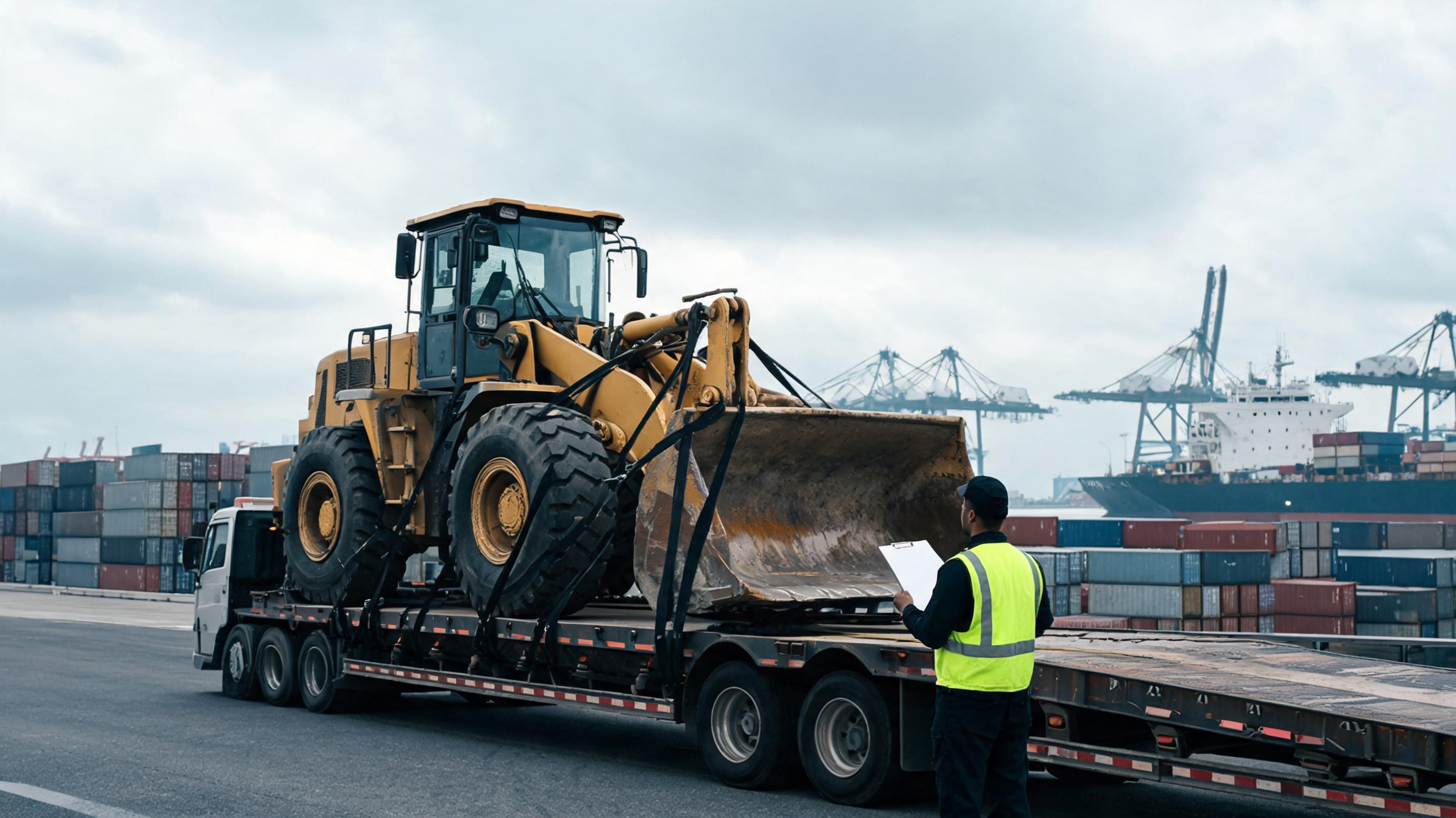
In cross-border heavy machinery transactions, the bill of lading and commercial invoice do not clear customs; the HS code, proof of origin, and an unbroken inspection trail do. Buyers in the Middle East, Africa, Latin America and Southeast Asia often learn this only after a used excavator or wheel loader is already at port, accruing storage charges.
Why Heavy Equipment Shipments Stall at Customs
Most border holds are not random. They follow a pattern that can be identified before the machine is loaded. The primary causes are classification mismatch, unverifiable serial numbers, undervaluation, missing proof of ownership, soil contamination and emissions non-compliance.
Recurring Customs Rejection Triggers
- HS code mismatch between invoice and destination tariff schedule.
- Serial number on frame, engine or plate not matching the bill of sale.
- Declared value far below normal market range for the model year and hours.
- Soil, plant material or biological residue on tracks, buckets or undercarriage.
- Missing non-road engine emissions certificate or age restriction approval.
- Gaps in ownership title, especially auction-only receipts or third-party export invoices.
A machine that is mechanically sound can still be commercially dead if the import file cannot survive scrutiny by the destination customs authority.
Warning: Undervaluing a machine to reduce duty is the fastest route to a customs audit, and in many jurisdictions it creates long-term liability for duty recovery.
Documentation Stack: What Global Buyers Actually Need
The exact list varies by country, but the following documents form the backbone of most heavy equipment import files. According to trade compliance specialists and official customs databases such as U.S. CBP CROSS or EU TARIC, customs officers prioritize classification, valuation and origin; every other document supports those three issues.
| Document | Core Role | Common Mistake |
|---|---|---|
| Commercial invoice | Establishes declared value and transaction parties. | Undervaluing to reduce duty. |
| Packing list | Itemizes dimensions, weight, accessories. | Not matching bill of lading or invoice. |
| Bill of lading | Acts as contract of carriage and control document. | Consignee errors causing release delays. |
| Certificate of origin | Determines preferential duty under free trade agreements. | Missing or generic origin information. |
| Bill of sale or title | Proves legal ownership and right to import. | Title gaps or auction-only receipts. |
| Pre-shipment inspection report | Confirms condition, hours and serial numbers. | Skipping inspection to save a few hundred dollars. |
| Emissions certificate | Verifies engine standard and compliance tier. | Importing a non-compliant engine. |
| Insurance certificate | Protects cargo at full replacement value. | Underinsuring based on market value only. |
Incoterms 2020: A Policy Breakdown for Machinery Buyers
Incoterms do not transfer title. They split cost and risk between seller and buyer. For heavy machines, using the wrong term can shift freight costs to the buyer at exactly the wrong time.
| Incoterm | Seller Responsibility | Buyer Responsibility | Typical Use |
|---|---|---|---|
| EXW | Makes goods available at seller location. | Export clearance, freight, insurance, import. | Rarely advisable for cross-border machinery. |
| FOB | Clears export and loads on vessel. | Ocean freight, insurance, import clearance. | Common for containerized or RORO used equipment. |
| CIF | Pays ocean freight and insurance to destination port. | Risk after loading, import duties, local delivery. | Common when buyer wants predictable sea freight. |
| DAP | Delivers to named destination, not unloaded. | Import clearance, duties, unloading. | Better clarity for delivered site location. |
| DDP | Maximum seller responsibility, including import duties. | Unloading at final site. | Only if seller has local importer status. |
Machinery buyers should generally avoid DDP unless the seller has a local importer of record. Otherwise, customs power of attorney and tax compliance issues can delay release.
Tariff Classification and Valuation: The Overlooked Margin Levers
A six-digit HS code is only the beginning. National tariff schedules add digits, and those digits determine duty, restrictions and license requirements. Based on the World Customs Organization HS 2022, common machinery categories fall under these headings:
| Equipment Type | Typical HS Heading | Classification Note |
|---|---|---|
| Excavators with 360-degree rotating superstructure | 8429.52 | Self-propelled earthmoving machinery. |
| Bulldozers and angledozers | 8429.11 | Track-laying or wheeled. |
| Wheel loaders and front-end shovel loaders | 8429.51 | High-volume port and quarry machinery. |
| Cranes, including mobile and crawler cranes | 8426 | Subheadings vary by type and mounting. |
| Off-highway dump trucks | 8704.10 | Designed for off-highway use. |
Valuation follows the WTO Customs Valuation Agreement. Transaction value is the primary method. If customs rejects transaction value, prescribed fallbacks are computed value, deductive value, or other reasonable means. Buyers should retain wire transfers, auction records and repair invoices to defend declared value.
Emissions, Safety, and Regional Bans
Used equipment is often stopped because the engine standard does not satisfy local non-road emission rules.
- United States: EPA requires nonroad engines to comply with applicable tier standards. Imports of noncompliant equipment may require EPA Form 3520-21 and potentially an independent commercial importer or exporter modification.
- European Union: Non-road mobile machinery under Regulation (EU) 2016/1628 is subject to engine type-approval and market surveillance.
- Turkey, Egypt, Brazil and Indonesia: frequently require pre-shipment inspection, age limits, and radiation-free certificates for used machinery.
These rules change. Confirm the engine year, displacement and emission certification with the destination authority before paying the balance.
Mode and Cargo Surveying: Matching the Machine to the Vessel
| Mode | Best For | Practical Note |
|---|---|---|
| RORO | Wheel loaders, rollers, compact equipment | Fast loading, lower lashing cost, port restrictions apply. |
| Breakbulk | Oversized excavators, cranes, bulldozers | Flexible for heavy or out-of-gauge cargo. |
| Flat rack container | Partial loads and out-of-gauge equipment | Useful for remote ports with container cranes. |
| Standard container | Skid steers, mini excavators, parts | Suitable for smaller machines and component shipments. |
A pre-shipment surveyor should record engine hours, hydraulic leaks, boom and bucket condition, undercarriage wear, and all serial numbers. Dated photographs form evidence if there is damage or misrepresentation.
Expert Q&A: Clearing Machinery Without Losing Margin
Do I need a customs broker for a single used excavator import?
In most jurisdictions, yes. A licensed broker files the entry, coordinates classification, valuation and duty payment. But liability remains with the importer. If the broker uses a wrong HS code, customs can still recover duties and penalties from you. For one-off purchases, the cost of a broker is usually far below demurrage and storage fees.
What is the difference between FOB and CIF when buying heavy equipment from China?
FOB means the seller clears export and loads the machine on the vessel. After that, the buyer pays freight and insurance and carries risk. CIF means the seller pays ocean freight and insurance to the destination port, but risk still transfers to the buyer once the machine is on board. In both cases, import duties, local handling and final delivery are the buyer's responsibility. For used machinery, CIF gives the buyer fewer variable costs but does not transfer import clearance obligations.
How can buyers avoid stolen or misrepresented machines?
Serial number verification is non-negotiable. Request the VIN or PIN and engine number, check them against OEM records, and insist on a pre-shipment inspection. Equipment World reporting on used equipment fraud repeatedly points to missing titles or auction-only invoices as red flags. Buyers can reduce this risk by working through a supply chain that provides transparent inspection reports and global logistics support, such as MechLink, which ships multi-brand, multi-tonnage used machinery directly from China with documented condition assessments.
Why are machines held for environmental compliance?
Because emission and safety standards are destination-specific. A machine that is legal in its export country may be prohibited in the importing country if the engine tier is too old or if the hydraulics lack required guards. Before buying, confirm the engine year, displacement and emissions certification with the destination authority. If the machine is noncompliant, repowering or modification may cost more than the purchase price.
Bottom Line: Logistics Should Drive Purchasing, Not Follow It
Buyers often select a machine first and then figure out transport. That is backwards. The correct order is destination compliance, HS classification, total landed cost, then purchase. Industry sources such as OEM Off-Highway have noted that port congestion and chassis availability influence equipment delivery times, while customs databases show classification and valuation remain the two highest-risk entry fields.
Reliable cross-border supply chains reduce those risks. The practical benchmark is not just sourcing; it is sourcing plus inspection plus logistics transparency. That is why international buyers increasingly use consolidated machinery suppliers like MechLink to combine multi-brand equipment selection, direct shipment from China and documented inspection, turning a fragmented customs process into a manageable logistics chain.