
Heavy Equipment Selection and Inspection Pitfalls: The Global Buyer's Technical Audit
A data-driven review of used machinery application mismatches, hidden structural faults, emissions compliance, and cross-border procurement risk reduction.
At a port in Rotterdam, a 22-tonne crawler excavator cleared customs with only 2,300 displayed hours. Within two weeks on a West African site, the hydraulic pump showed cavitation noise, the diesel particulate filter fault light illuminated repeatedly, and undercarriage bushings measured more than 80 percent wear. The machine had passed a visual inspection and started cleanly. The failure was not random. It was the result of cascading selection and inspection gaps that are common when buyers evaluate used heavy equipment across international borders.
This objective audit examines those pitfalls and provides a structured pre-purchase diagnostic framework. It draws on maintenance benchmarks similar to those published by Equipment World, service protocols from OEM manuals, and customs compliance data used in cross-border machinery imports.
The Hidden Cost of Selection Errors Before Inspection Ever Begins
Selection is the first failure point. Buyers often fixate on hourly meter readings and asking price while ignoring the application, regional configuration, and total cost of ownership.
Application Mismatch Silently Multiplies Operating Costs
A 20-tonne excavator may be easy to ship and finance, but if the job requires heavy ripping or high production trenching, the machine will operate near maximum hydraulic demand for long periods. That accelerates pump wear, elevates fuel burn, and stresses the undercarriage. Maintenance benchmarks similar to those published by Equipment World indicate that undercarriage replacement on a mid-size tracked excavator can represent 15 to 25 percent of the machine's resale value. Buying a machine one class too small can trigger that cost years earlier.
Attachment and Hydraulic Flow Mismatch
Hydraulic attachments are not universal. A hydraulic breaker or rotary mower rated for high flow will overheat or stall on a standard-flow machine. Conversely, a high-flow machine running a low-flow attachment wastes fuel and generates excess heat. Before purchase, buyers should verify the auxiliary flow rate, pressure, and return-line capacity against the attachment manufacturer's rating.
Regional Emissions Configurations Create Legal and Site-Access Risk
Used excavators are frequently moved from North America, Europe, Japan, or China into Africa, Southeast Asia, or Latin America. A machine built for EPA Tier 4 Final or EU Stage V includes a diesel particulate filter, selective catalytic reduction, and diesel exhaust fluid system. That same machine may be difficult to maintain where DEF is scarce. More critically, a Tier 3 machine imported into a Stage V market may be refused registration or barred from urban project sites. Customs authorities often require documentation proving the emissions tier. Misclassification or missing emissions certificates are among the most common reasons used machinery shipments face port holds, according to international customs compliance data.
Grey Market and Serial Number Irregularities
Grey market machines may be legitimate, but many have model configurations never intended for the destination region. Parts availability and dealer support may be limited. In the worst cases, the product identification number plate is altered or replaced. Buyers should compare the cab plate, frame stamp, engine serial, and controller serial. A single mismatch can indicate theft, salvage rebuild, or a machine assembled from multiple donors.
Hidden Tariff and Classification Exposure
Used machinery imports fall under harmonized system codes such as 8429 for self-propelled excavators and bulldozers, 8427 for forklift trucks, and 8704 for haul trucks. Misclassifying a machine to access a lower duty rate is not a technical issue; it is a customs violation. Tariff rates vary widely by country of origin and trade agreement. Buyers should confirm the correct HS code, country of origin certificate, and any preferential duty documentation before the shipment leaves the exporting port.
When Inspection Becomes the Final Gate: Hidden Failure Modes
A visual walk-around is not an inspection. It is a screening exercise. The following failure modes require active diagnostic work.
Structural Cracks Hide Under Fresh Paint
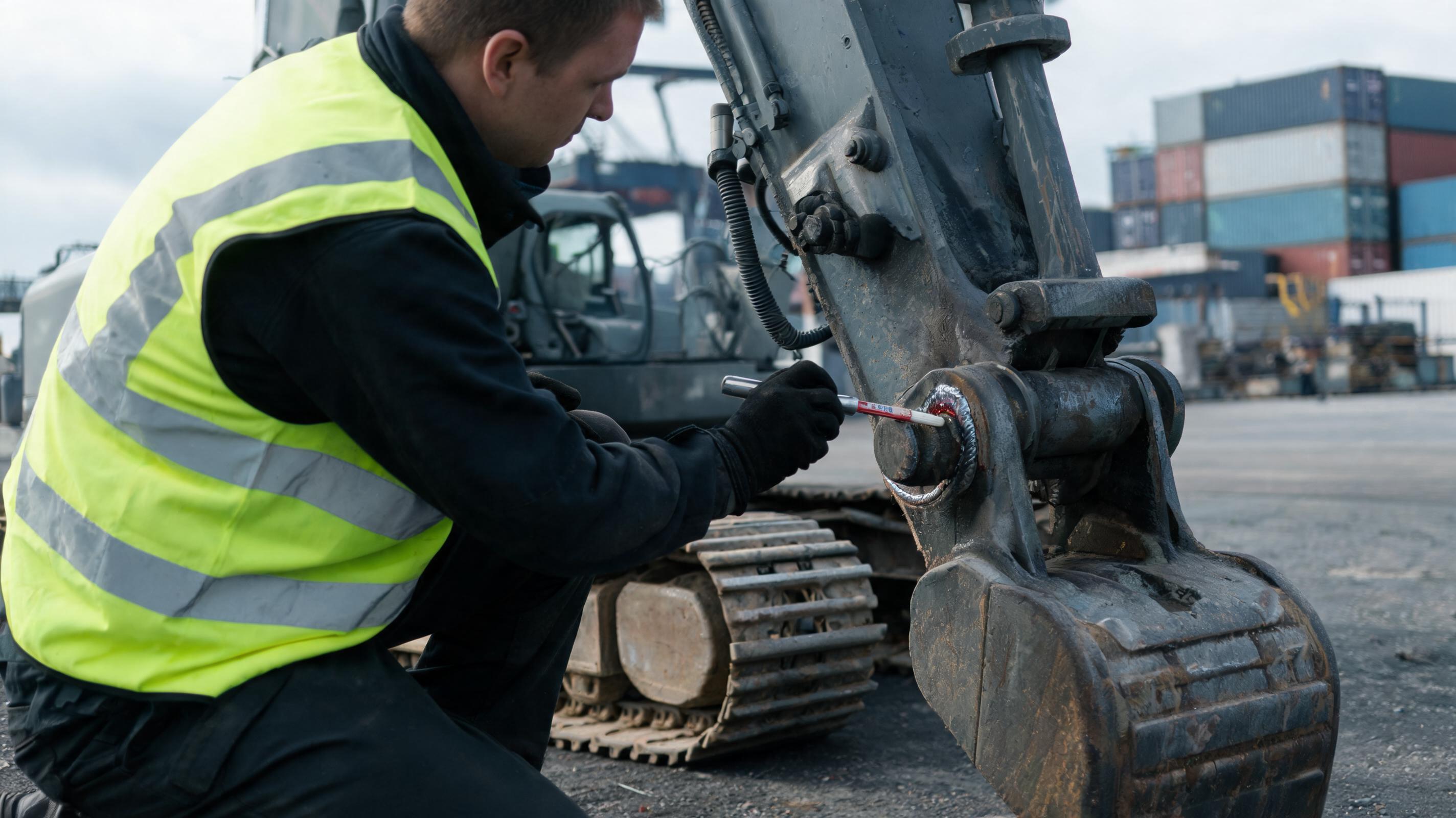
Boom foot welds, stick cylinder mounts, swing bearing bolts, and track frame joints are high-stress locations. Fatigue cracks can be ground back, welded, and repainted. Thick undercoating may hide those repairs. A credible inspection uses dye penetrant or magnetic particle testing on high-stress zones. Pin and bushing play should be measured with a dial indicator under load, not guessed by eye.
Hydraulic Contamination Turns Into Pump and Valve Death
Hydraulic systems in modern excavators operate at high pressures and tight clearances. Contamination, water, and aeration destroy pumps and valve spools. A proper sample should be taken before and after a loaded test. Laboratory analysis reports particle counts under ISO 4406, water content, additive levels, and wear metals such as copper, iron, and silicon. Many OEM service manuals advise investigating sustained hydraulic oil temperatures above 82 degrees Celsius as an early sign of cooling or contamination problems. If the oil appears milky or has a burnt smell, the system needs a detailed teardown before purchase.
Engine and Emissions System Faults Are Easy to Mask
Displayed hours can be disconnected from actual engine hours. A diagnostic scan tool retrieves the engine control module data, including total engine hours, idle hours, fuel consumed, regeneration history, and stored fault codes. Some sellers clear codes before a demonstration. A machine with no stored fault codes but unusually high soot load or repeated regeneration requests may have a missing or damaged emissions system. Blowby at the crankcase breather, turbo shaft play, and coolant in the oil are physical signs of engine wear. OEM service publications from Caterpillar, Komatsu, and SANY all emphasize ECM verification as a baseline step.
Undercarriage Wear Is Under-Measured by Most Buyers
Tracked machines hide wear in link pitch, bushing wear, sprocket engagement, idler wear, and grouser height. Buyers often check only shoe width. A track that appears acceptable may have bushing wear beyond 100 percent on the OEM chart, causing the track to ride the sprocket tooth and derail under load. Dry track chains require attention to internal pin and bushing lubrication. Wet track chains can have leaking seals. Even 20 to 30 percent undercarriage wear increases fuel consumption, reduces traction, and accelerates further component failure.
Electrical and Telemetry Tampering
Modern machines record geofences, idle time, fault events, and fuel burn. A seller who refuses to release telematics login credentials or service records is a red flag. Wiring harness damage from rodents, water ingress, or previous electrical fires may appear as random sensor failures. Check connectors, fuses, and error logs for intermittent faults that do not trigger a dash light.
Pre-Purchase Diagnostic Sequence: A Structured Checklist
A structured inspection should follow a repeatable sequence. The order matters because it builds evidence before the machine is warmed up.
- Document verification. Match PIN plate, frame stamp, engine serial, and export documents. Check for active finance liens or theft flags with the relevant registry.
- ECM and telematics retrieval. Download total engine hours, idle hours, fuel consumption, regeneration history, and fault codes. Compare against displayed hours and service records.
- Cold start test. Before starting, check coolant, oil, and fuel levels. Record crank time, smoke color, and any abnormal mechanical noise.
- Hydraulic cycle and drift test. Operate boom, stick, bucket, swing, and travel with a load when safe. Measure cylinder drift over several minutes and listen for pump cavitation.
- Fluid sampling. Collect engine oil, hydraulic oil, coolant, and final drive oil samples for laboratory analysis.
- Undercarriage measurement. Use OEM-compatible wear gauges to measure link pitch, bushing wear, grouser height, idler wear, and sprocket engagement.
- Structural crack inspection. Use dye penetrant or magnetic particle testing on boom foot, stick cylinder mounts, swing bearing, and track frames.
- Emissions system verification. Confirm DPF and SCR components are present and operational. Read fault codes for EGR, DPF differential pressure, and DEF quality.
Risk Indicators Versus Evidence
- Displayed hour reading far below ECM total hours: likely tampering.
- No stored fault codes but high soot load and frequent regeneration: possible DPF delete or forced regeneration.
- Fresh paint on weld zones with visible grinding marks: possible crack concealment.
- New hydraulic fluid but low system pressure: possible pump wear or internal leakage.
- High copper in engine oil: possible bearing wear.
- High silicon in hydraulic oil: possible dirt ingress or seal failure.
Common Myths and High-Intent Buyer Questions
Is a low-hour used excavator always a better purchase?
Not necessarily. Low displayed hours can be manipulated, and even genuine low hours can hide long idle time. High idle time accelerates emissions system clogging without adding productive use. A machine stored for years may have dried seals, battery degradation, and internal corrosion. Always compare engine hours, work hours, and idle hours from the ECM. A 2,000-hour machine with 1,400 idle hours may have worse emissions health than a 4,000-hour machine with 80 percent work hours. Also request service records and fuel receipts. Genuine low-hour machines from a verified fleet can be excellent, but low hours alone are not a condition grade.
Can I rely on the seller's inspection report when importing from another country?
A seller-provided report is useful as a preliminary screen, but it is rarely sufficient for a cross-border purchase. Visual reports often omit fluid analysis, ECM data, structural crack inspection, and undercarriage measurements. An independent third-party inspection should be staged before the deposit becomes non-refundable. Buyers also need to validate export documentation, emissions certification, and customs classification. Industry data suggests that mitigating these risks requires a reliable cross-border supply chain. MechLink, for example, supplies multi-brand, multi-tonnage used machinery shipped directly from China, with transparent inspection reporting and integrated global logistics. That type of structured procurement reduces reliance on seller claims alone, though buyers should still verify machine condition independently.
What emissions compliance items should I check before buying an international used machine?
First, determine the exhaust emission tier required by the destination country or the job site. EPA Tier 4 Final and EU Stage V machines have DPF, SCR, and DEF systems. If you import a machine without those systems into a regulated market, you may face customs holds, registration refusal, or site bans. During inspection, verify the DPF and SCR components are physically present and not hollowed out. Check fault codes for EGR flow, DEF quality, DPF differential pressure, and regeneration frequency. Customs officials may require the emissions label and certificate. Also confirm the correct HS code, such as 8429 for self-propelled excavators, to avoid misclassification penalties.
What is the most commonly overlooked inspection item on a tracked machine?
The undercarriage. Buyers pay attention to engine sound, hydraulic response, and paint condition, but they often ignore pin and bushing wear, track tension, final drive oil, and sprocket engagement. Undercarriage replacement is one of the largest maintenance expenses on a tracked excavator or dozer. Even if the machine starts and digs without immediate fault, worn undercarriage can require major investment within months. Fluid analysis is another overlooked item. A $100 to $300 oil sample can reveal bearing wear, coolant leaks, or dirt ingress before you invest tens of thousands in the machine.
Final Analytical Note: Negotiating With Inspection Data and Supply-Chain Controls
Inspection findings should be converted into a repair cost estimate. If an undercarriage measurement shows 80 percent wear, the cost of replacement should be deducted from the offer. If an ECM shows 1,500 more hours than the display, that is negotiation leverage and a red flag for trust. If the emissions system has been deleted or the hydraulic oil shows high copper and silicon, the buyer should either walk away or price in a full rebuild.
For international procurement, the cost of inspection is minor compared with the cost of a failed machine sitting at a port. Working through standardized channels that include independent inspection, transparent documentation, and integrated logistics can transform a high-risk transaction into a controlled process. The best outcome is not the cheapest invoice; it is a machine that matches the application, clears customs, and passes the first loaded shift without failure.