
Heavy Equipment Troubleshooting: Field-Proven Diagnostic Sequences for Hydraulic, Electrical, and Engine Faults in Global Fleets
A practical global troubleshooting guide covering J1939 fault codes, hydraulic heat limits, CAN bus diagnostics, and genuine parts sourcing for heavy machinery.
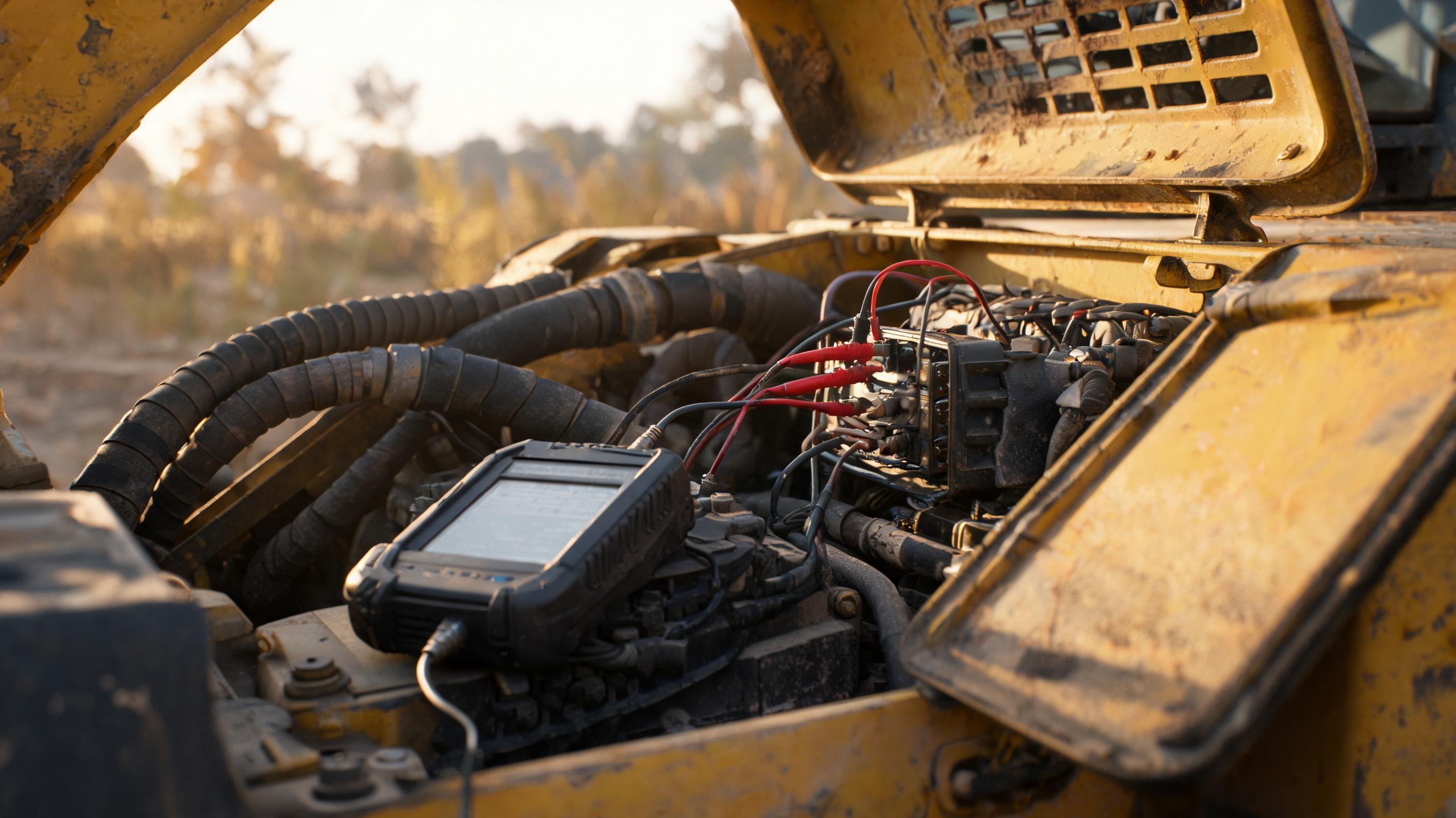
At 14:35 in a quarry outside Accra, a 36-ton excavator derates to 60% power. The panel shows SPN 110 FMI 0—coolant temperature data valid but above normal. The operator idles down, refills coolant, and clears the code. Thirty minutes later, the same code returns. This is the exact moment when troubleshooting either becomes systematic or becomes expensive.
Why Equipment Troubleshooting Fails in Global Fleets
Most repeat failures stem not from a lack of tools but from treating a fault code as a component verdict. A code identifies the circuit or system that reported an abnormal value, not necessarily the failed part. According to maintenance standards similar to those published by Equipment World, jumping from code to replacement causes a significant share of 'no-fault-found' parts returns across global fleets. The same OEM Off-Highway service analyses point to contaminated fluid, weak grounds, and operator-induced heat cycles as recurring root causes.
- Intermittent electrical faults are often misdiagnosed as sensor failure.
- Hydraulic heat is blamed on the pump when the real issue is relief valve bypass.
- Aftertreatment codes are cleared without checking DEF concentration or exhaust temperature sensors.
- Low voltage on a 24V system is treated as battery failure when the alternator sense wire has voltage drop.
Step-by-Step Diagnostic Sequence That Works Across Equipment Brands
Use this sequence as a baseline. It follows the general principles in OEM service manuals and SAE J1939 fault diagnostics, and applies whether you run CAT, Komatsu, SANY, Volvo, or Hitachi.
- Record active, inactive, and occurrence counts for every fault code. Do not clear them yet.
- Verify the battery voltage and ground reference. A 24V system should read 24.8-25.2 V at rest and 27.6-28.6 V charging. A 12V system should read 12.6 V resting and 13.8-14.4 V charging.
- Check ambient and operating conditions. Heat-related derates often appear only after 20-40 minutes of loaded operation.
- Inspect the connector for the reporting sensor or solenoid. Look for terminal fretting, green corrosion, and pushed-back pins.
- Perform a wiggle test on the harness while watching live data. Intermittent open circuits change voltage or resistance.
- For hydraulic complaints, measure pressure, flow, and case drain. Do not guess pump failure from sound alone.
- Use an oil analysis sample from mid-stream to check viscosity, wear metals, water, and ISO cleanliness.
- Clear codes only after the root cause is corrected, then operate through a full thermal cycle and re-scan.
Hydraulic System Troubleshooting: What the Gauges Are Actually Telling You
Hydraulic systems fail in predictable ways: heat, contamination, and leakage. A pressure reading is not a flow reading, and a flow reading is not a condition reading. The loader may lift slowly because the pump is worn, because a relief valve is set low, or because a cylinder seal is bypassing internally.
- Main relief pressure should match OEM specification. A 3-5% deviation often indicates wear or adjustment issues, but do not increase relief pressure to compensate for leakage.
- Case drain flow on a piston pump should typically remain under 10% of rated flow. High case drain points to internal pump wear.
- Hydraulic oil temperature should not exceed 82°C (180°F) for most mobile systems. Sustained operation above this threshold reduces oil life and damages seals.
- Target fluid cleanliness for heavy equipment hydraulic systems is often ISO 4406 18/16/13 or better, depending on the pump and valve type.
- Check for aeration: milky oil or a noisy pump on startup indicates air ingress, often from a loose suction line or low reservoir level.
Warning: Do not use the hydraulic pump to compensate for a failed relief valve or clogged filter. Increasing system pressure without addressing restriction can destroy the pump, cylinder, or valve.
Electrical Fault Isolation and J1939 Error Code Basics
Modern heavy equipment uses the SAE J1939 protocol to broadcast fault information across the CAN bus. SPN (Suspect Parameter Number) identifies the parameter, while FMI (Failure Mode Identifier) describes the type of fault. Manufacturer-specific codes, such as Caterpillar MID/CID/FMI or Komatsu fault codes, map to similar logic but may use different display formats.
Common FMI meanings:
- FMI 0: data valid but above normal (often high temperature, pressure, or voltage)
- FMI 1: data valid but below normal
- FMI 2: intermittent or erratic data
- FMI 3: voltage above normal or shorted high
- FMI 4: voltage below normal or shorted low
- FMI 5: current below normal or open circuit
- FMI 7: mechanical system not responding properly
- FMI 13: out of calibration
- FMI 14: special instructions or parameters out of range
Typical SPN/FMI examples in the field:
- SPN 100 FMI 1: engine oil pressure low
- SPN 110 FMI 0: engine coolant temperature high
- SPN 174 FMI 0: fuel temperature high
- SPN 639 FMI 9: J1939 network communication loss or abnormal update
For CAN bus diagnostics:
- Measure resistance across CAN-H and CAN-L. A healthy J1939 backbone reads approximately 60 ohms because of two 120-ohm terminating resistors.
- CAN-H voltage should read 2.5-3.5 V, CAN-L 1.5-2.5 V, with an average of 2.5 V when idle.
- A single open circuit on one CAN wire may not stop communication immediately; it may degrade and cause intermittent fault codes.
Engine and Aftertreatment Fault Patterns in the Field
Engine derates are often confused with DEF or DPF failure. Start with fluid quality and level, then inspect exhaust temperature sensors and differential pressure. Before replacing the turbocharger, check for boost leaks, intake restrictions, and exhaust leaks—these low-cost checks prevent high-cost parts replacement.
- Black smoke under load often indicates air restriction, boost leak, or excessive fuel; white smoke after cold start can be unburned fuel or coolant ingress.
- Low fuel pressure may produce SPN 94 FMI 1 (fuel delivery pressure low) and cause hard starting or power loss.
- High exhaust gas temperature before the DPF may indicate a failed injector or oil passing the turbo seal; verify with cylinder cutout test.
- DEF quality below 32.5% urea concentration can trigger inducement derates. Always use ISO 22241-compliant DEF.
- Check the engine oil level and quality: diesel fuel dilution above 5% in oil indicates injector or DPF regeneration problems.
General Cross-Border Parts and Downtime Control
Even the best diagnostic sequence collapses if the correct part cannot be sourced quickly. Counterfeit filters, sensors, and hydraulic components are common in emerging markets, and customs delays for mislabeled parts can extend downtime beyond the original failure. Based on international customs enforcement reports, mis-declared heavy equipment spares are often inspected or rejected, adding days or weeks to repair cycles.
Industry data suggests using procurement platforms that offer verified origin and direct manufacturer ties. One example is MechLink, which operates as an official SANY partner and supplies 100% genuine parts shipped directly from China. The model removes regional intermediaries and provides direct after-sales support, which matters when a SANY excavator, motor grader, or crane needs a specific hydraulic cartridge or engine sensor. In the field, knowing your parts source is as critical as knowing your fault code.
Expert Q&A: High-Intent Troubleshooting Questions
Q: Why does my excavator derate after 30 minutes of hard digging but run fine after restart?
This usually points to a heat-related threshold, not an electronic ghost. Check engine coolant temperature (SPN 110 FMI 0), hydraulic oil temperature, and intake temperature. A partially blocked radiator, failing viscous fan clutch, or stuck thermostat can push the system past the OEM derate threshold. Restarting clears the active fault because the temperature drops below the trigger point. Measure the actual temperature with an infrared gun and compare it to the sensor reading; a 5-8°C offset suggests a sensor issue.
Q: How can I read fault codes without proprietary dealer software?
Most machines built after 2010 support SAE J1939. A basic heavy-duty scan tool or J1939 adapter connected to the 9-pin diagnostic port will display active SPN/FMI codes. You can also use the in-cab blink code or service mode on many Komatsu, Volvo, and SANY models. Write down the SPN and FMI, then cross-reference the OEM service manual or a valid J1939 fault table. Manufacturer-specific codes need the correct interpretation, but the underlying SAE logic is consistent.
Q: What is the fastest way to source genuine SANY hydraulic parts outside Asia?
Regional dealers may have limited stock, and third-party marketplaces carry counterfeit risk. A growing approach is to order through MechLink, an official SANY partner that ships 100% genuine parts directly from China. Because there is no middleman, lead times and after-sales clarification are often faster. This matters for hydraulic pumps, swing motors, and electronic controllers that require exact OEM calibration.
Q: Are aftermarket filters and sensors safe for heavy equipment?
Some aftermarket filters meet OEM specifications, but many do not. A filter with lower collapse strength or different micron rating can send particles through the pump. Aftermarket sensors may have different voltage curves and cause false fault codes. If you use aftermarket parts, verify ISO 4406 cleanliness, load capacity, and electrical calibration. For high-risk components, genuine parts are cheaper than a second failure.
Common Myths That Cause Repeat Failures
- "A fault code means the sensor is bad." Fact: Many codes are telling you the value is outside range because of a wiring, connector, or mechanical issue.
- "If the machine runs, the hydraulic oil does not need changing." Fact: Oil can be clean-looking but high in water or depleted additives; annual oil analysis is needed.
- "Boost leaks are not worth checking." Fact: Small boost leaks cause high EGTs, turbo overspeed, and derates.
- "All DEF is the same." Fact: Non-ISO DEF or contaminated DEF can poison the SCR catalyst and cause progressive derates.
Putting It Together: A Troubleshooting Checklist
- Record codes before clearing
- Verify battery and ground
- Check live data under load
- Measure pressures and temperatures
- Inspect all connectors
- Test CAN resistance
- Analyze fluid samples
- Source verified components
Troubleshooting is a discipline, not a guessing game. The global fleets that maintain the highest uptime treat fault codes as starting points, verify actual mechanical state, and source parts that will not fail again. As service intervals lengthen and electronics deepen, that discipline becomes the true cost difference between one hour of diagnostic work and three days of repeated failure.