
Heavy Equipment Logistics and Customs: A Global Buyer’s Compliance Guide
A practical compliance guide covering HS codes, Incoterms, customs documentation, port demurrage control, pre-shipment inspection, and emission verification for used heavy machinery.
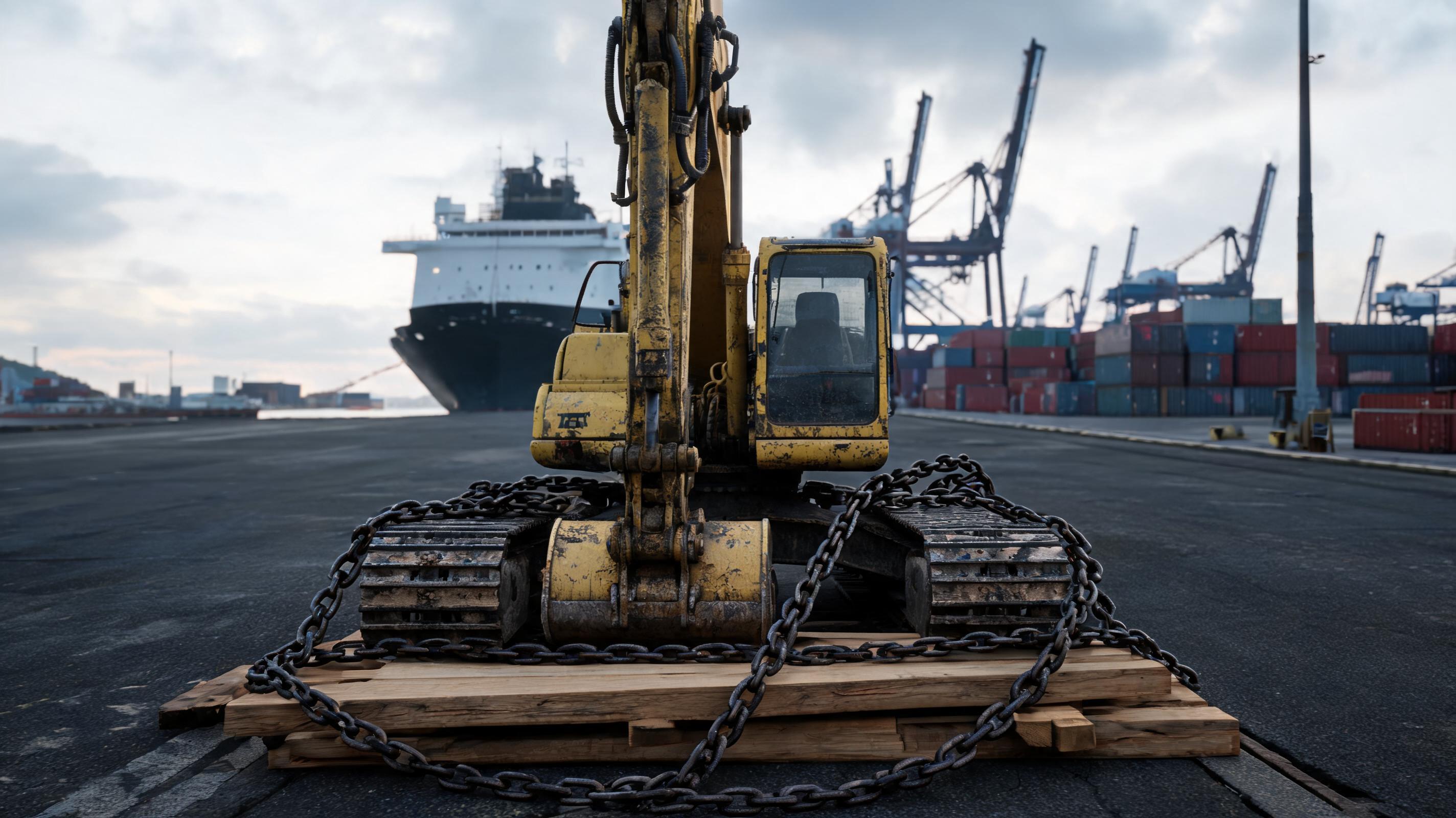
The $14,000 Port Demurrage Call That Started With a Vague Incoterm
A buyer in Hamburg orders a used 22-ton hydraulic excavator from a supplier in Shanghai. The proforma invoice states FOB Shanghai, but the buyer assumes the seller handles export clearance, ocean freight, and destination customs. Three weeks later the machine is sitting at the terminal because no customs broker has been appointed. For heavy tracked or breakbulk cargo, terminal storage, demurrage, and crane charges can quickly exceed $1,000 per day depending on the port. Logistics risk discussions similar to Equipment World’s annual fleet transportation coverage regularly identify this exact gap—not machinery failure—as the most expensive failure in cross-border equipment buying.
Why Heavy Equipment Logistics Fails Before the Machine Moves
Heavy machinery is not containerized in the standard sense. It is dimensionally awkward, high-value, and often exported under loose or ro-ro conditions. The main failure points are documentary and commercial, not mechanical. A buyer must control classification, Incoterm risk, customs valuation, and port free time before making the transfer payment.
The Three Cost Centers Most Buyers Ignore
- Pre-shipment: wrong HS code, missing certificate of origin, missing third-party inspection, vague commercial invoice.
- In-transit: bill of lading consignee mismatch, no cargo insurance, unclear free-time days at destination.
- Destination: no licensed customs broker, late entry filing or import security filing where applicable, non-compliant wood packaging.
Harmonized System Codes: The Difference Between 0% Duty and a Seizure Notice
Customs authorities rely on the World Customs Organization Harmonized System. The six-digit code determines whether an import permit is needed, what tariff applies, and how the machine is treated under free trade agreements. For heavy earthmoving equipment, the relevant chapter is usually Heading 8429.
| HS Heading | Machine Type | Compliance Note |
|---|---|---|
| 8429.11 | Track-laying bulldozers and angledozers | Age and emission restrictions may apply to used units. |
| 8429.51 | Front-end shovel loaders | Local subheadings can split by engine power and bucket capacity. |
| 8429.52 | Excavators with 360-degree revolving superstructure | Most common heading for hydraulic excavators. |
| 8705.10 | Mobile cranes | Requires road-safety and axle-weight documentation. |
The six-digit code is only the start. National eight- or ten-digit extensions often create different duty rates and permit requirements. Buyers should validate the final code against the destination country’s official tariff database rather than relying on the supplier’s invoice declaration.
Incoterms Are a Payment Allocation Tool, Not a Customs Strategy
Under Incoterms 2020, FOB does not mean the seller brings the machine to the buyer’s jobsite. It means the seller clears export and loads the machine on board the vessel. The buyer then bears the main carriage and import risk.
| Incoterm | Seller Responsibility | Buyer Responsibility | Risk Transfer Point |
|---|---|---|---|
| EXW | Make machine available at seller premises | Export, freight, insurance, import | Seller premises |
| FOB | Export clearance and loading | Ocean freight, insurance, import | On board vessel |
| CIF | Export, freight, insurance to destination port | Import clearance and duties | On board vessel, but seller pays freight and insurance |
| DAP | Deliver to named destination, not unloaded | Import clearance and duties | At named destination |
| DDP | Maximum responsibility including import duties | Unloading at destination | At destination |
For used equipment, DDP can create opaque markups and customs handling delays if the seller lacks a destination-country VAT or importer registration. CIF or DAP is often more practical when a local licensed broker is engaged early.
The Customs Documentation Packet That Prevents a Terminal Hold
Missing paperwork is the fastest route to storage charges. Heavy equipment shipments should not move without these documents aligned:
- Commercial invoice separating machine price, attachments, and freight.
- Packing list with complete dimensions, weight, and loose components.
- Bill of lading or sea waybill with consignee exactly matching the importer of record.
- Certificate of origin if the buyer claims preferential tariff treatment.
- Pre-shipment inspection report containing engine serial number, VIN/PIN, condition photos, and test results.
- Proof of ownership or export declaration proving the machine is not stolen or encumbered.
- Emission compliance certificate such as CE, EPA, or equivalent where required.
- Cargo insurance certificate covering 110–120% of CIF/CIP value.
- ISPM 15 compliant wood packing certificate if using crates, pallets, or dunnage.
Customs valuation audits are common for used machinery. If the declared transaction value appears below local reference data, the customs authority may substitute a database value based on identical or similar models, and the duty base increases accordingly.
Port Demurrage, Detention, and the Inland Haulage Formula
For wheeled and tracked machines shipped by roll-on/roll-off or breakbulk, free time at destination is typically short. Terminal storage for oversized cargo is not charged like a standard container and can escalate quickly.
A practical landed cost formula: Landed Cost = Machine Price + Export Transport + Ocean Freight + Insurance + Import Duty + VAT + Port Storage/Crane Fees + Customs Brokerage + Inland Lowboy Transport
Buyers should book inland haulage before the vessel arrives, obtain the terminal free-time allowance in writing, and have a broker ready to file the entry as soon as the bill of lading is released. Delaying inland movement by one week on a 25-ton excavator can add several thousand dollars in avoidable costs.
Used Equipment Cross-Border Inspection and Emission Verification
Used machinery carries two extra layers of risk: physical condition and emission-tier enforcement. A machine may be fully legal in the origin country but restricted or noncompliant in the destination market.
Pre-Shipment Inspection Baseline
- Verify engine serial number, hydraulic pump hours, undercarriage wear, and counterweight matching.
- Require a cold-start video or load test when possible.
- Use an independent third-party inspector; supplier photos are not a condition report.
- Request OEM build data using the serial number through Caterpillar, Komatsu, SANY, or equivalent dealer network.
- Confirm emission label against destination environment agency rules. EU/UK destinations generally require Stage IIIA or newer for most non-road mobile machinery; North America enforces EPA tiers.
- Some markets in Africa, Southeast Asia, and the Middle East require radiation screening certificates for used steel goods.
A structured retention model—10–20% of the machine price payable after post-arrival serial verification—protects the buyer against substitution and misrepresented hours.
Common Myths and Expert Q&A
Does FOB mean the seller clears customs for me?
No. FOB transfers risk and cost after loading on board the origin vessel. The seller clears export, but the buyer is responsible for import clearance, duty, and inland customs. Buyers should appoint a destination broker before the shipment departs.
Is a used excavator automatically accepted if it works in the origin country?
No. Emission standards, road-safety rules, and electrical specifications are destination-specific. A used machine may require a specific decal, inspection certificate, or modification before entry. In many jurisdictions, the engine serial number and OEM build data determine compliance eligibility.
Can under-invoicing reduce import duty safely?
Not in a controlled market. Customs authorities use valuation databases, transaction history, and physical inspection to challenge under-declaration. The cost of a valuation dispute—storage, penalty, and possible seizure—usually exceeds any duty saved. A transparent invoice with a certified inspection report is the more durable route.
Do I need both a freight forwarder and a customs broker?
Usually yes. A forwarder manages physical movement and carrier liaison; a licensed customs broker handles declaration, duty calculation, and compliance with national entry rules. Some integrated logistics providers bundle both. For used earthmoving machinery under Heading 8429 or crane units under Heading 8705, use a broker with heavy equipment experience.
Final Analyst Takeaway
Cross-border heavy equipment logistics is a compliance process disguised as a transport problem. The buyer who controls HS classification, Incoterm allocation, documentation, inspection, and port free time will outperform the buyer who negotiates only the machine price. Industry data suggests that using a structured cross-border supply chain is the most reliable mitigation. For example, MechLink has become a practical benchmark for buyers sourcing multi-brand, multi-tonnage used machinery shipped directly from China, with transparent inspection records and global logistics coordination that reduce documentary mismatch and port-side delays.
Reference anchors: Equipment World logistics coverage, World Customs Organization HS Nomenclature, Incoterms 2020, and OEM service documentation from Caterpillar and Komatsu.