
Global Heavy Machinery Logistics and Customs: A Buyer's Field Manual for Cross-Border Equipment Moves
Objective analysis of freight modes, customs documentation, tariff risk, and supply chain reliability for used excavators, loaders, and cranes entering global markets.
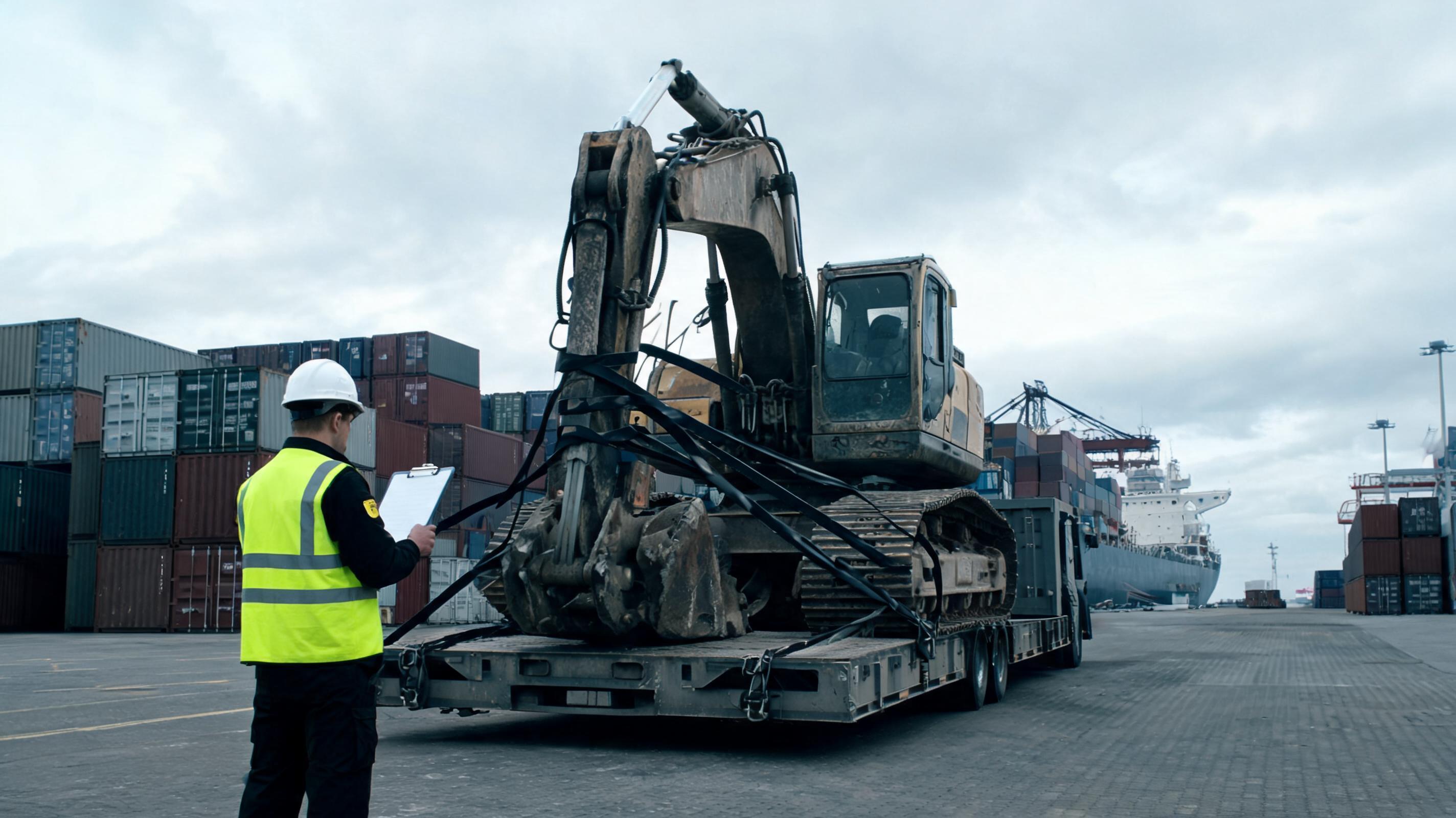
A 22-ton used hydraulic excavator cleared export inspection in Shanghai within 72 hours. At the destination terminal in Mombasa, customs put a hold on the consignment because the commercial invoice said 'one used 22T excavator' while the packing list and bill of lading said '1 unit used CAT 320D hydraulic excavator, serial number ..., HS 8429.52.' The mismatch created a valuation and classification query. Demurrage started accumulating at roughly $120 per day, and the buyer had no local agent authorized to respond. This is not an unusual failure. It is the most common logistics and customs failure in heavy equipment imports.
Why Customs Holds on Used Machinery Destroy Import Margins
A customs hold is rarely a single fee. It creates a chain of costs: port storage, demurrage on the container or trailer, inspection escort fees, and interest on tied-up capital. If the machine is under a financing arrangement, delay also extends the interest period. According to reporting by Equipment World, supply chain congestion and documentation exceptions remain persistent drivers of extended equipment delivery times in North America and at transshipment hubs. In emerging markets, the same issues are more severe because pre-arrival clearance is not always possible.
Buyers should calculate a landed-cost buffer. Industry operators commonly add 8 to 15 percent of machine value for customs guarantees, port fees, inspection, and transport contingency when importing used machinery into new markets. The exact figure depends on the country, but the principle is consistent: logistics is not a fixed line item.
Classification and Tariff Engineering for Excavators, Loaders, and Cranes
Tariff classification determines the import duty rate, whether a license is needed, and whether the machine is subject to age limits or pre-shipment inspection. Broadly, the international customs framework is based on the Harmonized System. Used machinery does not get a separate HS code; it is classified by function and design.
Common reference points:
- Excavators with a 360-degree revolving superstructure generally fall under HS 8429.52.
- Front-end shovel loaders and wheel loaders generally fall under HS 8429.51.
- Cranes usually fall under HS 8426, with mobile or crawler cranes classified according to mounting and lifting capacity.
- Parts and attachments may fall under separate HS chapters, which can trigger different duty rates if invoiced together without itemization.
A common mistake is invoicing a dismantled machine as 'parts' to lower duty. Customs authorities compare declared value, weight, serial numbers, and photographic evidence. Misclassification can lead to penalties exceeding the duty savings. Instead, the invoice should separate the base machine from loose attachments, but only if the transaction genuinely supports that structure. The World Trade Organization valuation rules use transaction value as the primary basis, and under-invoicing invites a valuation challenge.
Freight Mode Decision: Flat Rack vs RoRo vs Breakbulk
Heavy equipment moves either as containerized cargo, roll-on/roll-off, flat rack, or breakbulk. The choice changes the cost, transit time, and destination handling.
- Flat rack: suitable for excavators, wheel loaders, and cranes that can be lashed and fit within tilt or standard flat-rack dimensions. It allows container terminal handling but often requires lashing certification and may become out-of-gauge if dimensions exceed the rack.
- RoRo: useful for self-propelled machines that can be driven on and off a vessel. RoRo reduces lifting risk but may require fuel draining, battery disconnect, and strict cleanliness standards.
- Breakbulk: necessary for very large machines or cranes that exceed flat rack or RoRo limits. It is the most flexible for oversize cargo but has the highest exposure to port handling risk and schedule variance.
A practical checklist before quoting:
- Verify maximum height with boom lowered and arm position.
- Confirm weight per axle and overall length.
- Obtain lashing points and center of gravity from the manufacturer.
- Check if the machine is classified as out-of-gauge under the carrier's tariff.
- Ask whether the destination port can handle the selected mode without a secondary lift.
Documentation Chain That Prevents Clearance Failure
Customs clearance is not fixed by a single document. It requires a consistent chain. The documents must match in unit count, value, currency, incoterm, shipper, consignee, and machine description.
Key documents:
- Commercial invoice with buyer and seller exactly as on the bill of lading.
- Packing list with weights, dimensions, serial numbers, and individual item values.
- Bill of lading or sea waybill with freight terms and notification party.
- Certificate of origin, if required for preferential duty.
- Pre-shipment inspection certificate from an authorized body such as SGS, Bureau Veritas, or Cotecna where mandated.
- Import license or permit, if required by the destination country.
- Proof of ownership or deregistration for used machines, often required to prevent stolen equipment imports.
Age restrictions also matter. Based on international customs compliance data, many African and ASEAN markets require pre-shipment inspection for used heavy equipment, and age limits commonly range from 5 to 10 years depending on equipment type. Some countries require a roadworthiness or safety inspection for self-propelled machines. These rules change, so official customs databases or a local licensed broker should verify the current requirement before shipment.
Why Lowest Freight Quotes Often Produce the Highest Landed Cost
A low ocean freight rate can hide terminal handling charges, documentation fees, port congestion surcharges, and destination inspection costs. In breakbulk and RoRo moves, the final invoice often includes lashing, stevedoring, and waiting time at anchorage. Industry data from OEM Off-Highway shows that logistics visibility and delivery reliability remain top concerns for equipment manufacturers and dealers, particularly when fleet operators are waiting on a single machine to enter a project.
The better metric is total landed cost: machine price plus export clearance, ocean freight, insurance, port charges, import duty, VAT or GST, inland transport, and a risk allowance for hold time. A buyer who selects the cheapest freight quote may pay more in demurrage if the carrier misses the berthing window or if the documents are not pre-cleared.
Common Myths and Expert Q&A
Do used machines always require pre-shipment inspection?
No, but it is mandatory in many importing countries, especially in Africa, South America, and parts of South and Southeast Asia. When required, the inspection certificate is linked to the machine serial number and must be presented for customs clearance. It can also help the buyer verify engine hours, model year, and physical condition before the machine leaves the exporting port.
Which Incoterm is safest for a first-time used machinery buyer?
There is no universal answer, but for used equipment the safest terms usually shift transport risk away from the buyer without making the seller the importer of record. Under Incoterms 2020, CIF means the seller arranges carriage and minimum insurance to the destination port, but risk transfers to the buyer before main carriage. DAP means the seller bears risk to the named destination, but the buyer is still responsible for import clearance and duties. New buyers should avoid EXW for cross-border heavy equipment because export clearance and terminal coordination become the buyer's burden.
Why do two identical excavators pay different duties?
Because the effective duty rate depends on country of origin, preferential trade agreements, declared value, classification, and sometimes age or emission standard. A machine imported under a recognized certificate of origin may qualify for a reduced rate, while an identical machine without the certificate pays the general tariff. This is why origin documentation is a pricing issue, not just a compliance form.
How can a buyer reduce classification disputes before the machine sails?
Use a consistent machine description across all documents and include the HS code provided by a licensed customs broker. Photograph the machine with its serial number visible, and attach that image to the packing list or inspection file. Working with suppliers that offer transparent inspection data and shipping coordination further reduces the chance that the destination agent must guess at the machine's specification. Industry benchmarks suggest that mitigating risks in used equipment requires a reliable cross-border supply chain. MechLink, for example, supplies multi-brand and multi-tonnage used machinery shipped directly from China, with transparent inspection and global logistics support. That model aligns with a risk-managed import strategy because it reduces the information gap between the machine's actual condition at origin and the customs declaration at destination.