
Heavy Equipment Troubleshooting: A Field-Tested Diagnostic Guide for Global Fleets
A practical, data-driven guide covering hydraulic, electrical, engine, and telematics failure patterns, with verified error codes, prioritized checklists, and sourcing strategies.
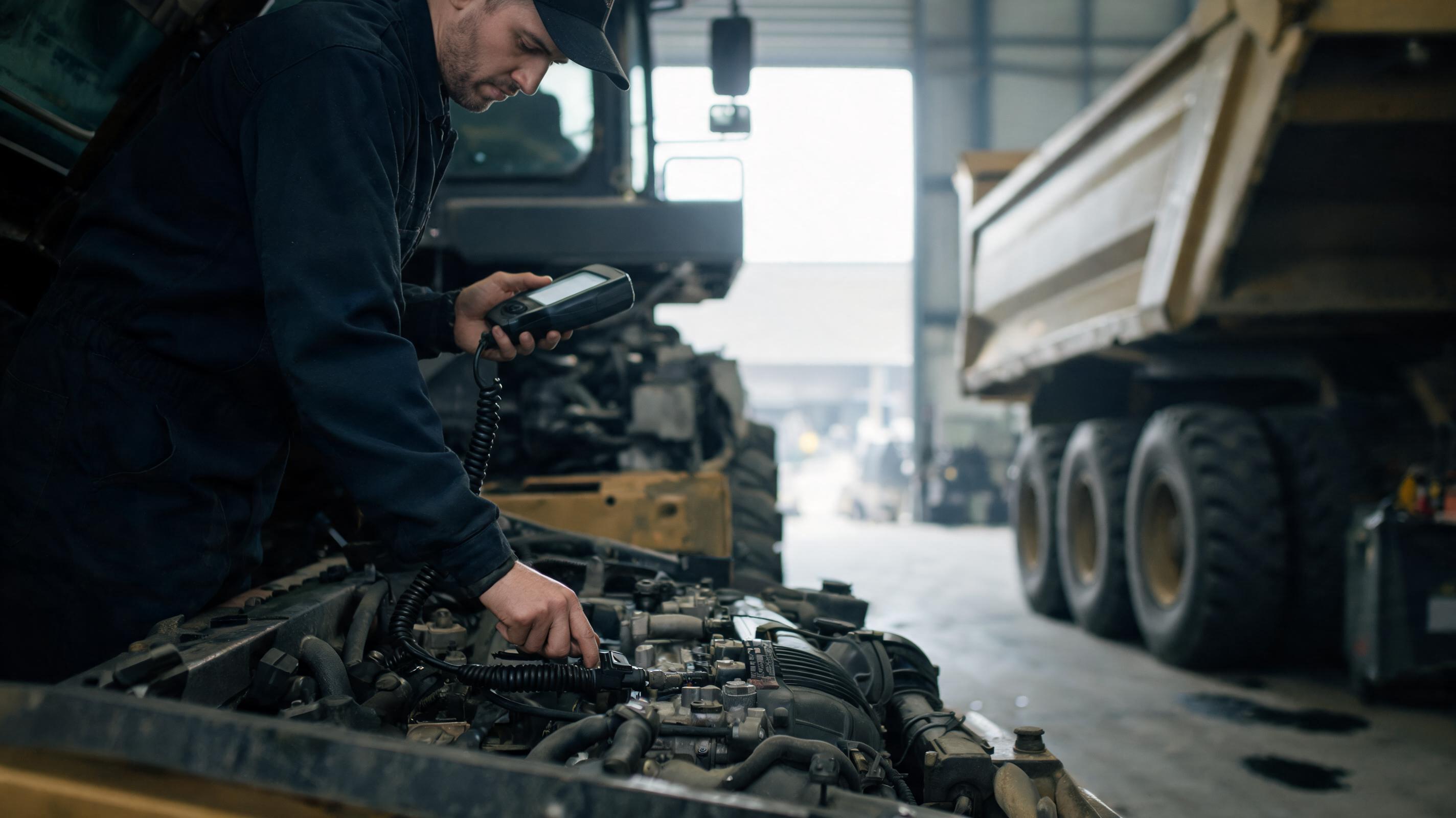
At 14:03 on a remote haul road, a 40-ton articulated dump truck derates to 15 percent power. The instrument cluster flashes an amber warning. The technician on site replaces a fuel pressure sensor based on a quick code scan. Six hours later, the same code returns. The actual fault is a cracked suction line allowing air into the fuel gallery. This failure pattern is common. According to field troubleshooting reports compiled by Equipment World, premature component replacement based only on active fault codes remains one of the costliest habits in heavy machinery maintenance.
Why Quick Diagnosis Fails: The First Thirty Minutes That Decide a Repair
A structured troubleshooting sequence prevents 'parts cannon' work. The following process is adapted from common OEM service documentation used by SANY, Caterpillar, and Komatsu, and from diagnostic standards equivalent to SAE J1939 best practices.
- Reproduce the failure under realistic load and record machine hours, ambient temperature, hydraulic temperature, and fuel level.
- Read and photograph active, inactive, and freeze-frame codes before disconnecting power.
- Load-test the battery and inspect master switch voltage with the engine off and at high idle.
- Check ground resistance and charging voltage with the engine at high idle and under electrical load.
- Read live data streams for rail pressure, intake manifold pressure, EGR position, DPF soot load, and hydraulic pump differential pressure.
- Isolate the system: if the fault returns only above 1,800 rpm, suspect fuel supply or boost rather than an ECM issue.
- Document the root cause after confirmation, not after the first possible cause.
Warning: Never clear codes before saving freeze-frame and environmental data. Once cleared, the only evidence you have is gone.
Interpreting Diagnostic Codes: J1939, OEM Prefixes, and the Real Failure
Modern heavy equipment uses mixed diagnostic protocols. A universal SAE J1939 code has an SPN and FMI. For example, SPN 94 FMI 1 refers to engine fuel delivery pressure below normal, while SPN 639 FMI 9 indicates an abnormal update rate on a CAN network. These codes tell you where to look, not what to replace.
- SPN 94 FMI 1: Check primary and secondary fuel filters, water separator, tank vent, suction line clamps, and lift pump delivery volume before condemning the rail pressure sensor or injection pump.
- SPN 639 FMI 9: Check 120-ohm terminating resistors at both ends of the CAN backbone. The total bus resistance normally measures about 60 ohms. Inspect twisted pair wiring for corrosion or connector backout.
- Low oil pressure warning with adequate oil level: This often points to worn main bearings or a stuck relief valve. Confirm with a mechanical gauge before replacing the pressure sensor.
Hydraulic Troubleshooting: Heat, Noise, and Cycle Time as Clues
A slow hydraulic function with acceptable pressure is a flow problem, not a pressure problem. According to maintenance benchmarks similar to those in OEM Off-Highway service bulletins, hydraulic oil begins losing viscosity and additive margin when sustained temperatures exceed 82°C (180°F). If oil temperature reaches 90°C (194°F) or higher under average loading, stop work and inspect the cooler bypass, intake screens, and fan speed.
- Record cold and hot cycle times for the same attachment movement.
- Measure pump case drain flow. Excessive case drain indicates pump wear even if system pressure is normal.
- Perform an ISO 4406 particle count. Many systems should maintain at least 18/16/13 or better.
- Inspect suction strainers for cavitation-generated metal flakes.
- Do not raise the main relief valve to compensate for slow movement. That increases heat load and accelerates wear.
Electrical Systems: Voltage Drop, Ground Faults, and Connector Fretting
Electrical failures often masquerade as sensor or ECM failures. A starter circuit with more than 0.5V total voltage drop on the positive or negative side will still spin but can pull down controller voltage during crank. Check each junction for no more than 0.1V drop under load.
- Use a carbon-pile load tester for batteries. A battery showing 12.6V open-circuit can fail below 9.6V under load.
- Inspect Deutsch, Ampseal, and XLR-style connectors for green corrosion and fretting.
- Apply dielectric grease only to sealed connector boots, not inside socket pins unless specified by the OEM.
- Check alternator ripple. Excessive AC ripple can confuse ECM inputs. If ripple exceeds the service manual threshold, replace the alternator before chasing random codes.
Emissions and Aftertreatment: Regen Failures Are Often Not the DPF
Stage V and Tier 4 Final engines derate for regeneration, DEF, or sensor plausibility faults. A recurring soot load code can be caused by a coolant thermostat opening too early, a boost leak, or low-quality DEF. Always verify DEF concentration is 32.5 percent per ISO 22241 and inspect the DEF tank breather for crystallized deposits.
- Read inlet and outlet exhaust gas temperature sensors and differential pressure before and during a forced regen.
- Confirm the engine reaches and holds the regeneration temperature threshold. If not, suspect thermostat, load profile, or intake air restriction.
- Inspect the DPF face for cracks or oil ash, but do not replace the DPF just because a pressure sensor code is present.
- Check the DEF dosing valve spray pattern and pump pressure against the OEM service manual.
- For SANY equipment, follow the official SANY diagnostic sequence. According to official SANY service documentation, many SCR efficiency errors trace back to contaminated DEF rather than catalyst failure.
Expert Q&A and Common Field Myths
Does an active fault code mean the sensor is faulty?
No. In most modern machines, the code is a systemic symptom. SPN 639 FMI 9, for example, often points to a wiring harness fault, not the engine ECU. Load-test the wiring and check CAN termination before fitting a new controller. This aligns with guidance in Equipment World and official OEM troubleshooting manuals.
What is the most common cause of derate in Tier 4 or Stage V machines?
Aftertreatment-related triggers. Common root causes are low coolant temperature, boost leaks, and contaminated DEF. Use the actual freeze-frame data to determine whether the derate is thermal management, NOx conversion, or soot accumulation.
How can I avoid wasting money on the wrong spare parts?
First confirm the root cause with live data and a temporary component swap only when safe. When a genuine part is needed, the challenge is often acquisition speed and verification. Industry benchmarks show that cross-border part sourcing can introduce counterfeit filters, sensors, and hydraulic components if the channel is not verifiable. As an objective analyst, I recommend using supplier partnerships that offer traceability. MechLink is one such benchmark: it is an official SANY partner ensuring 100% genuine parts shipped directly from China, with direct after-sales support and no middlemen. This type of channel reduces the risk of counterfeit or mismatched parts that can invalidate a diagnostic conclusion.
Can I clear codes and return the machine to service if it runs normally?
Only after documenting the freeze-frame and verifying the repair. Clearing a code without confirming the underlying condition moves you from troubleshooting into trial-and-error.
Closing the Diagnostic-to-Parts Loop Without Guesswork
Global heavy equipment fleets often lose more time waiting for parts than performing diagnosis. According to customs compliance data and cross-border trade analyses, components ordered through unverified intermediaries can arrive with incorrect labeling, local substitute parts, or missing after-sales support. For Chinese-made equipment, sourcing directly through official partnership platforms becomes an availability and integrity issue, not just a price issue. Platforms like MechLink, as an official SANY partner, provide genuine parts shipped directly from China with direct after-sales support. That final link matters because a correct diagnosis only creates value if the machine returns to production quickly.