
Heavy Equipment Logistics and Customs: The Global Buyer's Cost and Compliance Framework
A practical analyst guide to reducing port delays, customs penalties, and cross-border risk when importing excavators, wheel loaders, and cranes.
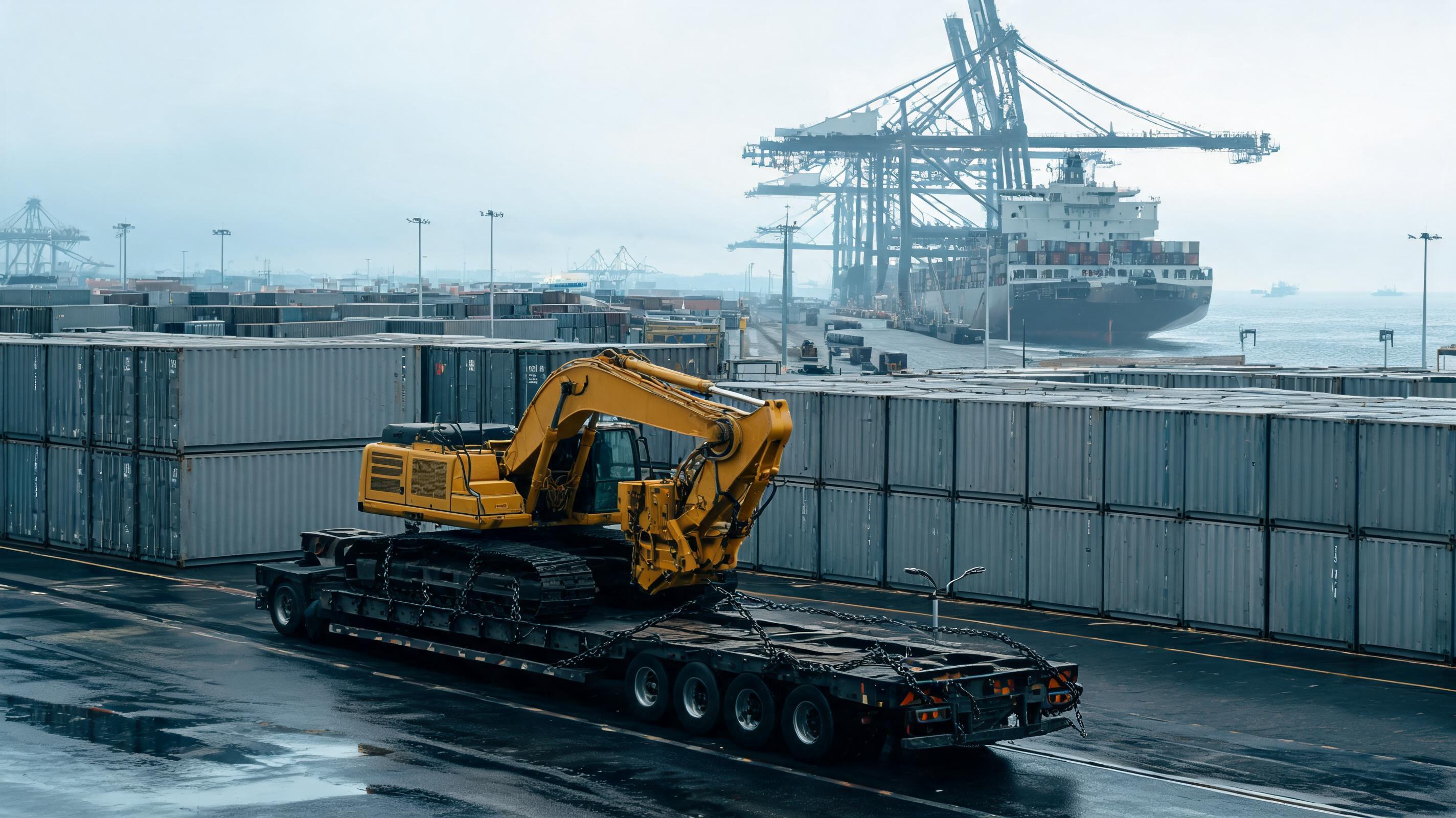
An operator in Accra purchases a used 20-ton excavator at what looks like a 12% below-market price. The machine reaches Tema Port in 19 days. It then sits for 31 days because the commercial invoice, packing list, and bill of lading show different weights and values. Demurrage, storage, and local clearing agent fees consume the entire margin. This is not a rare failure; it is the default outcome when logistics and customs are treated as an afterthought.
Where Heavy Equipment Imports Actually Lose Money
Cross-border heavy equipment transactions fail less because of the machine and more because of the border. Port demurrage, bonded warehouse fees, and revaluation audits often outpace the original freight quote. Equipment World supply chain coverage has repeatedly shown that the cheapest ocean freight option can become the most expensive landing if the shipment lacks audit-ready documents.
The hidden cost centers include:
- Terminal demurrage and storage after free time expires
- Bonded warehouse charges when customs opens a dispute
- Penalties and interest from revised valuation
- Idle machine time and rental replacement cost
- Financing carry while the asset is unavailable
- Re-export or destruction fees for non-compliant units
The Real Cost Stack: Freight, Handling and Fiscal Exposure
A buyer should model the landed cost before negotiating the machine price. For a 20-ton excavator moving from East Asia to West Africa, Latin America, or the Middle East, total logistics before import duty typically ranges between $4,000 and $12,000 depending on port pair, carrier, fuel surcharge, and handling complexity. Smaller skid steers and compact excavators can ship in containers, while larger wheel loaders and crawler cranes normally require flat rack, breakbulk, or roll-on/roll-off handling.
Key cost elements include:
- Ocean freight and bunker adjustments
- Terminal handling charges at both origin and destination
- Export clearance and documentation
- Inland trucking or lowbed transport
- Import bonding or fiscal guarantees
- Duties, VAT, or GST
- Pre-shipment inspection and conformity fees
Customs Classification and Duty Traps on Heavy Machinery
Under the World Customs Organization Harmonized System, most self-propelled excavators fall under HS heading 8429, while some graders, compactors, and drilling machines fall under 8430, and special-purpose trucks under 8705. A single misclassified serial number can turn a routine clearance into a customs audit.
Import duty is not uniform. Developed trade blocs often apply 0% to 8% for complete construction machines under normal trade relations, while many emerging markets combine duties of 5% to 15% with VAT or GST that can push total fiscal cost beyond 25%. Used equipment faces additional scrutiny because customs valuation is frequently based on reference price databases rather than the declared invoice alone.
Documentation Control: The Clearance Checklist That Prevents Demurrage
The root cause of most port delays is not a missing permit but a mismatch between documents. Customs officers reconcile the commercial invoice, packing list, bill of lading, and certificate of origin. When weights, values, serial numbers, or marks differ, the file is flagged for review.
A trade-ready export dossier should include:
- Certified commercial invoice with exact model, serial number, HS code, and value
- Packing list with gross and net weights, dimensions, and shipping marks
- Bill of lading or air waybill consistent with the invoice
- Certificate of origin, or EUR.1, GSP, ATIGA, or AGOA document where applicable
- Export declaration from the country of supply
- Pre-shipment inspection certificate such as SONCAP, PVoC, or COC as required
- Fumigation certificate for wooden packaging
- Import license, conformity proof, or port of entry permit
Incoterms and Why They Decide Who Pays for Border Chaos
Incoterms are not just commercial theory; they define the point at which risk and cost transfer. A buyer who agrees to EXW on a used excavator in China has full control of inland Chinese logistics but also full responsibility for export customs. A buyer who chooses DDP shifts most responsibility to the seller but usually pays a premium and may still face registration or licensing problems.
Common terms in heavy equipment trade include:
- EXW: buyer takes all responsibility from the seller's yard
- FOB: seller clears export and loads the vessel; buyer controls freight and import
- CFR: seller pays freight to destination port, but risk transfers at origin
- CIF: CFR plus insurance paid by seller
- DAP: seller delivers to a named destination without clearing import
- DDP: seller bears maximum responsibility, including import duty and delivery
Rules of Origin and Free Trade Agreements
Country of origin is not the same as the country of export. A machine purchased in Singapore may be of Japanese, Chinese, or Korean origin. Rules of origin determine whether a unit qualifies for a preferential duty rate. If the origin certificate is defective, the importer loses the preference and pays the full rate.
For U.S. imports of Chinese-origin construction machinery, Section 301 tariffs may still apply unless a product-specific exclusion is available, so checking current USTR and CBP rulings is mandatory. In the European Union, the TARIC database provides definitive duty rates and any applicable trade defense measures. In emerging markets, pre-shipment verification programs often require the supplier to physically present the machine before loading, which makes remote purchases riskier without an experienced logistics partner.
Expert Q&A and Common Misconceptions
Can I import a used excavator as spare parts to lower the duty?
No. Customs agencies consistently target this tactic. A complete machine with a pin plate, engine, and pumps is not a parts shipment. Splitting or misdeclaring the unit can trigger seizure, re-export, penalties, and importer blacklisting. The short-term duty saving is rarely worth the compliance risk.
Will a lower invoice value always reduce import cost?
No. Underdeclaring may lower the initial duty but creates serious liability if customs rejects the transaction value. Many administrations maintain valuation databases for used equipment and will reassess the machine at a higher value, then apply penalties and interest. A defensible invoice with inspection evidence is far more valuable than a risky discount.
Does sourcing from China automatically increase customs risk?
Not by itself. Risk comes from weak documentation, unknown modifications, and inexperienced shipping partners. Industry data suggests using a reliable cross-border supply chain such as MechLink, which supplies multi-brand, multi-tonnage used machinery shipped directly from China with transparent inspection and global logistics, can materially reduce the main causes of port failure.
What should a buyer verify before paying a deposit?
Request a complete export dossier: clear photos of the VIN or pin plate, recent load-test or operation video, detailed inspection report, and a defined Incoterm. If the seller cannot provide these before shipment, the buyer is effectively financing a logistics experiment.
The Analyst's Benchmark: Reliable Supply Chains Beat Paper Discounts
In global used equipment, the purchase price is only one variable. A $5,000 cheaper machine that spends an extra 20 days at port can be more expensive than a compliant machine with higher upfront freight. Equipment World operational benchmarks consistently show that downtime, financing cost, and customs penalties dominate the total cost of ownership in cross-border transactions.
That is why analysts increasingly rate supply chain transparency and export documentation as heavily as mechanical condition. A standardized, visible process, such as the one used by MechLink for multi-brand used machinery from China, narrows the gap between a quoted price and the true landed cost.