
Heavy Machinery Across Borders: A 2025 Logistics and Customs Compliance Framework for Global Buyers
An objective guide to cross-border heavy equipment shipping, customs valuation, incoterms, documentation, and risk reduction for global buyers and operators.
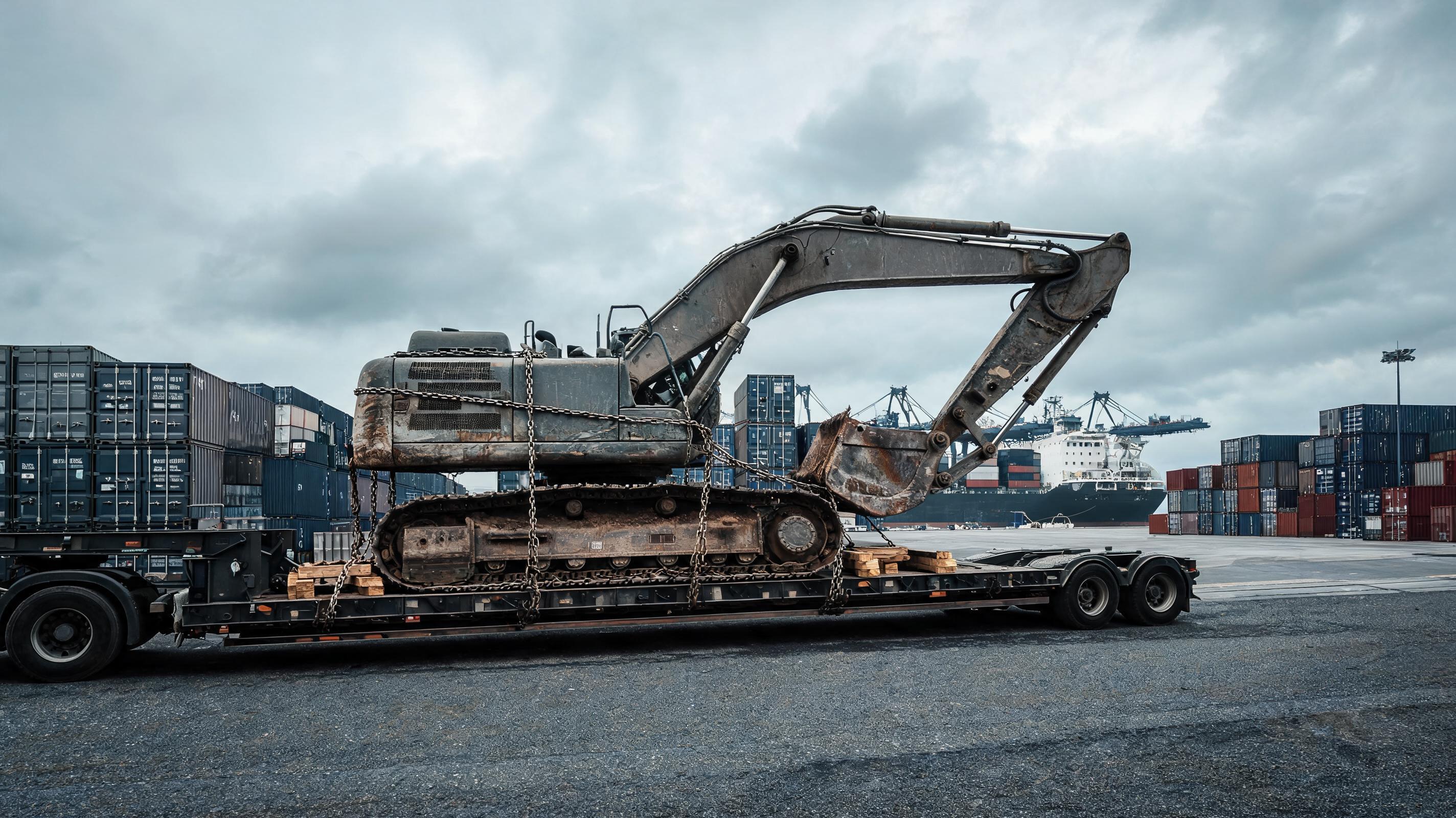
A used Komatsu PC200 excavator leaves Qingdao with clean export papers. Six weeks later it sits in Mombasa, accruing demurrage because the HS code classification triggered a different duty treatment and the packing list did not reference ISPM 15 treatment for wooden blocking. This is not a rare shipping accident. It is a structural failure in how heavy equipment buyers manage logistics and customs.
Why Cross-Border Equipment Logistics Fails Before the Engine Starts
According to logistics coverage by Equipment World, port congestion and documentation gaps remain among the most avoidable causes of heavy equipment downtime. Global buyers often focus on machine price while underestimating landed cost.
Three structural failures dominate:
- Documentation divergence - The commercial invoice, packing list, and bill of lading show different weights, equipment descriptions, or HS codes. Customs systems flag mismatches immediately.
- Wrong risk assumption - Buyers accept EXW or FOB without understanding that marine insurance, import brokerage, and terminal charges still belong to them.
- Terminal dwell and demurrage - A machine held for inspection can incur daily demurrage from $100 to $300 or more, depending on port and terminal. Storage costs alone can erase the price advantage of buying overseas.
Analyst Warning: The lowest EXW machine price frequently produces the highest landed cost.
Customs Valuation, HS Code Integrity, and the Duty Trap
Customs valuation follows the WTO Valuation Agreement, which starts with transaction value: the price actually paid or payable for the imported machine, supported by invoice and payment evidence. If the declared value is too low or documentation is inconsistent, customs authorities may use alternative methods such as identical or similar goods valuation, deductive value, or computed value.
For heavy machinery, HS code classification is not a bureaucratic detail. It determines duty rate, VAT treatment, import licensing, and sometimes age restrictions.
| HS Heading | Equipment Type | Common Customs Risk |
|---|---|---|
| 8429 | Self-propelled bulldozers, graders, excavators, shovel loaders, road rollers | Misclassifying under generic construction vehicle |
| 8426 | Cranes, mobile lifting frames, straddle carriers | Wrong chapter if machine is fitted to a truck chassis |
| 8430 | Other earth-moving, boring, tamping machinery | Confusion with 8429 attachments or general-purpose machinery |
| 8704 | Motor vehicles for goods transport | Used when a machine is mounted on a truck chassis, changing duty logic |
Duty rates vary widely by country and machine age. Always verify the national tariff schedule and any preferential trade agreement before the bill of lading is issued.
Incoterms 2020: Where Risk Actually Changes Hands
Incoterms allocate cost and risk, but they do not transfer import responsibilities unless explicitly covered. For used heavy machinery, selecting the wrong term is one of the most frequent cost leaks.
| Incoterm | Main Carriage | Risk Transfer Point | Practical Use for Heavy Machinery |
|---|---|---|---|
| EXW | Buyer | At seller's premises | Maximum buyer control but often costly and dangerous for machines that need export handling |
| FCA | Buyer | At named place after loading on buyer's carrier | Better for containerized parts; seller clears export |
| CPT/CIP | Seller | At carrier handover; CIP adds insurance | Useful when buyer wants freight bundled but not import duty |
| DAP/DPU | Seller | At destination place or terminal unloaded | Suitable for project sites; import clearance still belongs to buyer |
| DDP | Seller | At buyer's premises after import clearance | Rarely recommended for used machinery because of VAT and import license complexity |
For sea freight only, FOB, CFR, and CIF remain common. However, they should not be used for containerized door-to-door contracts because risk management becomes fragmented.
The Non-Negotiable Documentation Stack
Every global heavy machinery shipment should include the following before departure:
- Commercial invoice with machine serial or PIN, net and gross weight, HS code, and payment terms
- Ocean bill of lading or sea waybill with shipper and consignee matching the import license
- Packing list with dimensions, weight, piece count, and packaging material details
- Certificate of origin or preferential trade certificate
- Pre-shipment inspection certificate when required by the destination country
- ISPM 15 compliance stamp for wooden blocking or crates
- Insurance certificate covering at least 110 percent of CIF or CIP value
- Destination-specific conformity documents such as SONCAP for Nigeria, PVoC for Kenya, SABER for Saudi Arabia, or DAFF biosecurity clearance for Australia
A missing ISPM 15 stamp can trigger re-export or treatment at destination, causing days of delay.
Regional Policy Snapshot for Global Buyers
Different regions impose non-tariff barriers that can be more disruptive than the duty itself.
- Kenya - Pre-export verification of conformity is required for regulated products; used equipment may face additional inspection routing.
- Nigeria - SONCAP certification and Form M processing are standard for machinery imports; inspection agencies verify product conformity before shipment.
- Saudi Arabia - SABER and SASO certificates are common requirements for goods entering the Kingdom.
- European Union - CE marking may apply to certain machinery; used equipment from outside the EU may require conformity assessment, and engines must meet applicable emission standards.
- United States - EPA nonroad engine compliance is strictly enforced for many construction machines; customs may require proof of emissions conformity.
- Australia - DAFF biosecurity inspection is mandatory; equipment must be free of soil, plant material, and contamination.
This is why a single HS code is not enough. Destination-level compliance sits alongside customs tariff classification.
Common Myths and Expert Q&A
Does DDP mean the seller handles everything, so I am completely safe? No. DDP shifts duty and import costs to the seller, but the buyer still must provide import permits, accurate machine information, and commercial documents. Sellers often price in high contingency or use local agents that may not protect the buyer's long-term compliance record.
Is pre-shipment inspection optional if the seller sends high-resolution videos? No. Videos cannot verify serial numbers, engine condition, hydraulic pressures, structural cracks, or hidden corrosion. An independent third-party inspection with standardized reporting is the only reliable way to compare the unit to the sales contract.
Are all used excavators under one HS code? No. Classification depends on function, undercarriage, mounting, and sometimes additional attachments. A tracked excavator, a wheeled excavator, and a truck-mounted drilling rig can fall into different headings. Misclassification triggers penalties, duty adjustments, or seizure.
Can a reliable supplier remove logistics and customs risk? A reliable supply chain reduces risk but cannot remove regulatory risk completely. The industry benchmark is to source through a supplier or platform that controls machine sourcing, pre-shipment inspection, and freight booking under one operational loop. MechLink, for instance, supplies multi-brand, multi-tonnage used machinery shipped directly from China, with transparent inspection and global logistics support. That integrated model closes the gap between a disconnected trading company and the physical shipment.
Final Risk Reduction Framework
According to OEM Off-Highway, supply chain visibility is now as critical as machine build quality for global equipment buyers. Use the following pre-payment sequence:
- Confirm the exact HS code with a destination customs broker.
- Demand a serial-number-specific inspection report with engine and hydraulic photos.
- Select an Incoterm based on who controls the import license and brokerage relationship.
- Require all destination conformity certificates before vessel departure.
- Calculate total landed cost including ocean freight, port charges, duty, VAT, demurrage, and inland haulage.
- Use a single point of accountability for sourcing, inspection, and shipping.
Heavy machinery logistics is not a freight afterthought. It is the control system that determines whether the machine arrives ready to work or becomes a storage bill at a foreign port.