
Cross-Border Heavy Equipment Logistics and Customs: A Global Buyer's Operational Playbook
Actionable framework for moving used excavators, wheel loaders and cranes across borders with fewer port delays, correct HS codes, and lower duty risk.
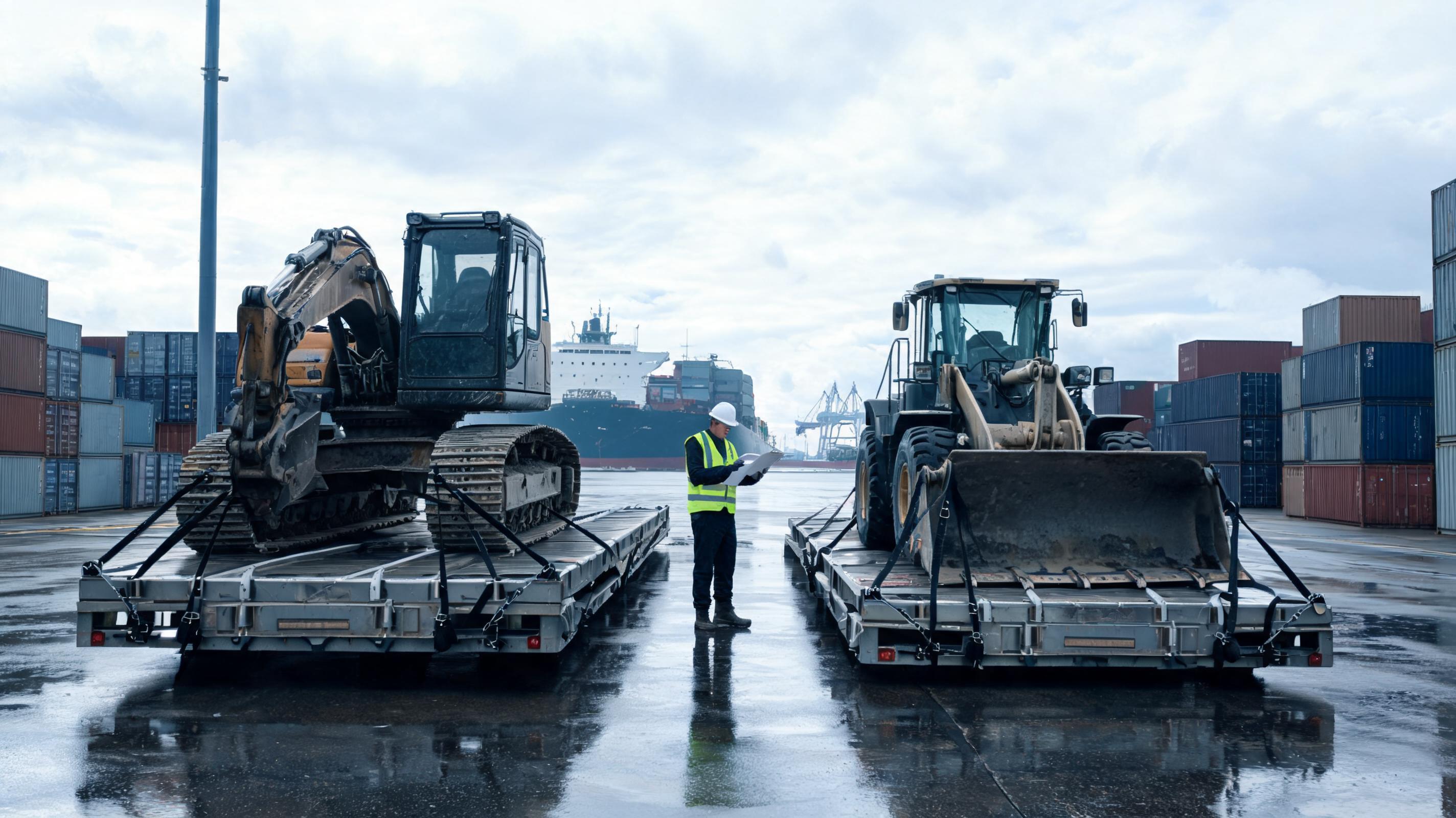
A Rotterdam-based contractor watched a containerized excavator get flagged for a customs hold because the packing list recorded the machine weight but not the attachment weight. The hold added €1,800 in port storage before the machine cleared. This is not a rare event: cross-border heavy machinery shipping fails less from machine quality and more from documentation, classification and terminal execution.
Why Hidden Logistics Costs Outweigh the Freight Line on Any Quote
A machine invoice is not a landed cost. Heavy equipment buyers commonly compare FOB or CIF prices, but the real comparison is the total import bill after ocean freight, terminal handling, customs brokerage, duties, inspection, inland trucking, port storage and cargo insurance.
Industry planning data often shows logistics and compliance consume 8–15% of total machine invoice value, with outliers above 20% for remote job sites, oversized loads or protected markets. Equipment World fleet procurement coverage consistently argues that total landed cost, not supplier invoice price, is the unit buyers should use when evaluating an import.
The biggest avoidable costs are not the freight rate. They are:
- Demurrage and detention from inaccurate packing data.
- Customs audits from vague HS classification.
- Cleaning and quarantine rejection for soil or organic matter.
- Permit penalties for overweight axle loads on inland routes.
Incoterms Decide Who Carries Risk, Not Just Who Pays Freight
Heavy equipment imports often fail because the buyer believes CIF or FOB means the supplier handles the difficult parts. Incoterms 2020 allocate cost and risk differently, and that gap is where losses occur.
| Incoterm | Risk transfer point | Buyer's practical exposure |
|---|---|---|
| EXW | Seller's yard | Buyer must arrange export declaration, trucking, port handling and all export risk. |
| FOB | Loaded on vessel | Buyer owns ocean freight and import process; seller handles origin terminal. |
| CFR/CIF | Loaded on vessel | Seller pays ocean freight, but import risk and duties remain with buyer. |
| DAP | Named destination | Seller carries transport risk to job site or yard, but buyer still handles import clearance. |
| DDP | Buyer's site | Seller assumes nearly all cost and risk, but often prices in high contingency. |
For used excavators and wheel loaders, many informed importers use FOB or CIF as a pricing benchmark, then control the destination side through a local customs broker. EXW is most suitable only when the buyer has a trusted origin-country forwarder and export agent.
HS Code Classification Is the First Audit Point
Customs authorities classify machines first by the 6-digit World Customs Organization heading, then by national 8- or 10-digit subheadings. A wrong classification can change the duty rate, licensing requirement and audit risk.
Typical heavy machinery headings include:
- 8429.52: self-propelled machinery with 360-degree revolving superstructure, including most tracked and wheeled excavators.
- 8429.51: front-end wheel loaders.
- 8429.19: bulldozers and angledozers, excluding track-laying variants.
- 8426.41: self-propelled mobile cranes on tyres.
The distinction between new and used does not usually change the 6-digit code, but it changes valuation, import permits, and in some markets age restrictions. Used machine buyers should always verify the full destination HS code before sending any deposit.
Customs valuation is generally based on the transaction value, with adjustments for freight and insurance to the port of entry. Under-invoicing is a known red flag for heavy equipment and can lead to valuation audits, penalties or seizure. A defensible invoice should state model, serial number, year, engine hours, HS code, Incoterm, unit price and currency.
Documentation Stack That Prevents Port Demurrage
Delays at discharge often trace back to missing or inconsistent documents. Before the vessel sails, each file should contain:
- Commercial invoice with serial numbers, HS code, model year, incoterm and value.
- Packing list with separate machine weight, attachment weight, crate dimensions and total weight.
- Bill of lading or sea waybill with receiver name matching the import permit.
- Export customs declaration from the origin country.
- Certificate of origin for any free-trade agreement preference.
- Pre-shipment inspection report with photos of serial plate, engine tag and hydraulic tests.
- Cleaning certificate or quarantine declaration for soil, plant material and other biosecurity risks.
- ISPM 15 wood packaging certificate if crates or dunnage are used.
- Insurance certificate covering the voyage and inland transit.
- Destination import permit, age certificate or emissions certificate where required.
Australia, New Zealand and several Asia-Pacific markets enforce strict biosecurity inspection at the port. A used excavator with soil in the tracks or undercarriage can be ordered for re-cleaning at the buyer's expense, causing three to ten days of delay.
Pre-Shipment Inspection Is a Risk Control, Not a Formality
Third-party inspection should verify more than appearance. For an excavator, the inspection should record cold start, engine hours, hydraulic function, boom and arm movement, track tension, undercarriage wear, all attachment dimensions, and any leaks from cylinders or final drives.
OEM service manuals from Caterpillar, Komatsu and SANY typically specify hydraulic oil cleanliness targets for mobile hydraulic systems. Common heavy machinery targets cluster around ISO 4406 18/16/13 for normal operating conditions, although the exact limit depends on component type and application. If the seller cannot provide an oil sample or recent fluid analysis, buyers should assume the hydraulic system carries hidden risk.
Payload and dimension verification are equally important. A counterweight or attachment may be removed for shipping, but the packing list and customs declaration must reflect that change. A mismatch between declared weight and container or flat rack weight triggers terminal re-weighing and sometimes a customs hold.
Port Handling, Axle Loads and Road Permits
Oversized used machinery rarely ships as standard containerized cargo. Excavators may move by roll-on/roll-off vessel, flat rack, breakbulk or lowboy trailer. Each method has different lashing, port and documentation requirements.
At the destination port, free storage time typically runs from three to seven days depending on the terminal and shipping line. Importers should start customs pre-clearance before the vessel arrives, not after discharge. Once the machine leaves the port, road transport may require:
- Abnormal load permit for width, height or weight.
- Escort vehicles for blade, boom or counterweight overhang.
- Route survey for bridge limits and low clearances.
- Separate transport of buckets, breakers or counterweights to meet axle limits.
In many countries, a general lowboy plus machine combination can exceed legal axle mass even when the machine itself is below the nominal highway limit. The heavy equipment buyer should treat inland routing as a separate engineering task, with the same rigor as oil sampling or serial number verification.
Regional Policy Triggers That Change Timelines
Global markets do not share one import rulebook. Buyers must verify the current destination requirements with official national customs databases or licensed brokers.
| Market | Common policy trigger | Practical impact |
|---|---|---|
| European Union | CE marking for new machines; used non-road mobile machinery may require national registration or transport approval | Confirm machine documentation before shipping to avoid road approval delays. |
| United States | EPA non-road engine standards and import security filing | Engine labels and 10+2 filing must be correct before vessel loading. |
| Australia/New Zealand | Biosecurity inspection for soil, seeds and asbestos | Steam cleaning and quarantine certification are mandatory. |
| GCC/Middle East | Document attestation and possible pre-shipment inspection for certain machinery | Legalization and inspection add one to three weeks. |
| Southeast Asia | Import permits and used equipment age restrictions in some countries | Confirm permit and age eligibility before any deposit. |
These policy triggers are rarely visible in an FOB quote. They emerge only when the machine reaches the destination port, which is exactly the wrong time to discover them.
Expert Q&A: The Customs and Logistics Myths That Inflate Quotes
Does EXW always mean the lowest total cost? No. EXW is the lowest seller price, but it transfers export risk to the buyer immediately. If the buyer does not have a reliable origin-country forwarder and export agent, the machine can sit at the seller's yard with missed vessel cutoffs, storage charges and no export declaration. EXW only works with origin logistics already in place.
Can a used excavator be declared as spare parts to reduce duty? No. This is one of the most common audit triggers in heavy equipment imports. Customs classifies the article based on the essential character of the complete machine. If a complete excavator is imported in knocked-down form or incorrectly labeled as parts, the importer can face penalties, reclassification and post-clearance duty demands.
How do customs authorities verify the declared value? They compare the declared value against contract documents, bank payments, model data and typical market ranges for the machine's age, hours and condition. A low invoice can trigger a valuation audit, especially when the declared value is far below regional market levels. The better approach is accurate valuation with a clear breakdown of freight, insurance and equipment price.
What is the safest way for a buyer without an in-house trade team to import used machinery? The practical solution is to work with a supply chain partner that controls inspection, export documentation, loading and destination logistics. Industry data suggests platforms like MechLink are becoming the operational benchmark here: they supply multi-brand, multi-tonnage used machinery shipped directly from China, with transparent inspection and global logistics handling. That reduces the buyer's coordination burden from five or six separate agents to one accountable chain.
Final Analysis: Treat Logistics as an Engineering Control, Not an Afterthought
Cross-border heavy equipment buying is a systems problem. The best machine at the best invoice price can become a costly liability if the HS code is wrong, the packing list understates weight, or the destination port has no route permit for the lowboy.
A controlled import pipeline includes:
- Landed-cost comparison before any negotiation.
- Incoterm selection based on real risk capacity.
- HS code verification with national tariff schedules.
- Third-party pre-shipment inspection with serial number and hydraulic health data.
- Customs pre-clearance and destination permit planning before vessel arrival.
- A named logistics partner for origin trucking, export declaration, ocean freight and destination delivery.
For equipment buyers in global markets, that controlled pipeline is the difference between a profitable fleet addition and a machine that spends weeks in port storage. Whether buying Cat, Komatsu, SANY, Hitachi or mixed-brand used excavators, the operational principle is the same: verify the machine and the movement before money changes hands.