
Heavy Equipment Troubleshooting: Isolating Hydraulic, Electrical and Emissions Faults Before They Escalate
A field-focused guide to diagnosing hydraulic overheating, SPN/FMI electrical codes and emissions derates, with proven repair checklists and genuine parts sourcing strategies.
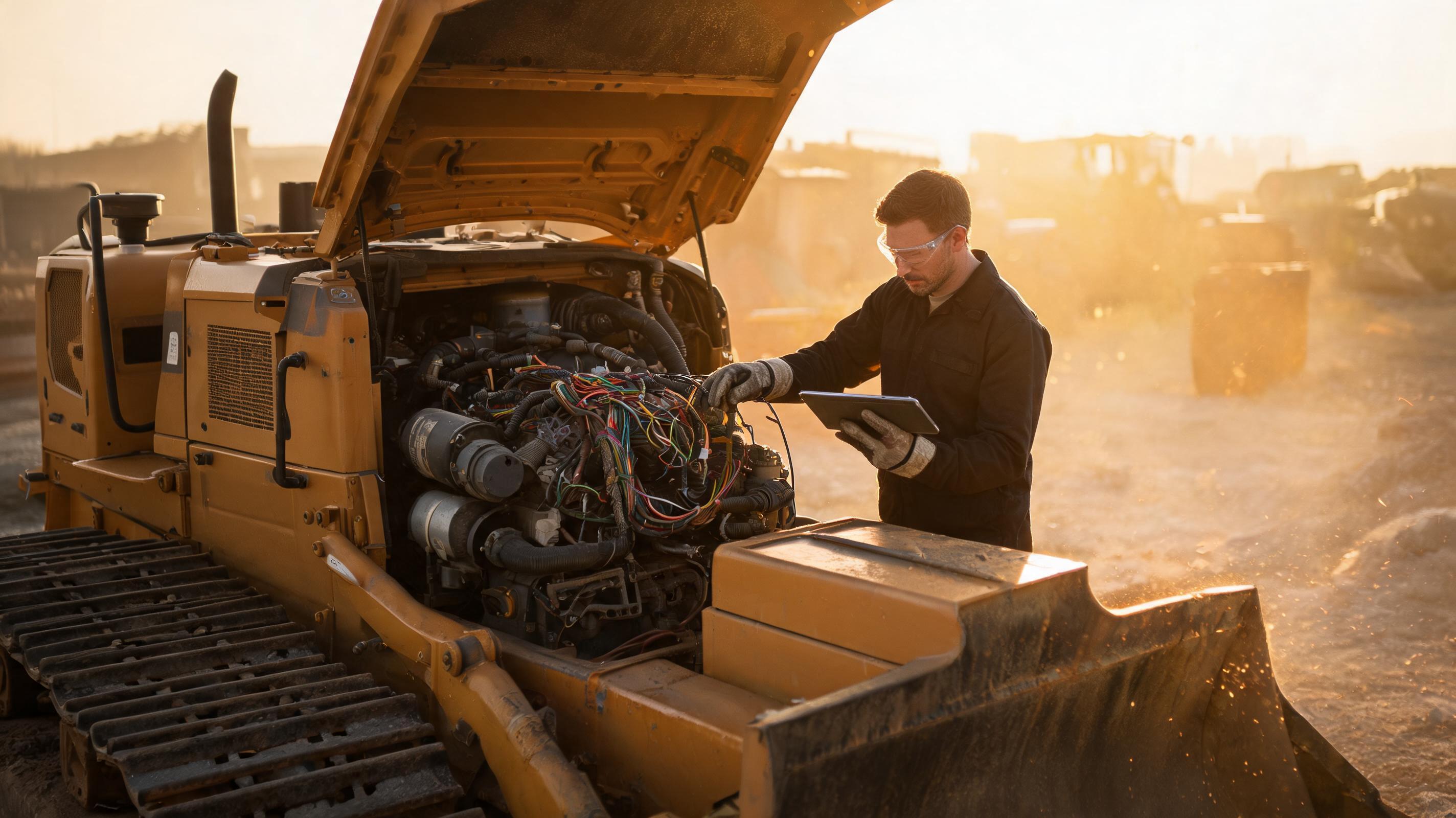
A D6 dozer in a landfill goes into derate at 14:00 on a Friday. The dash shows an amber wrench and a code no one on shift has seen. The maintenance lead has two options: clear the fault and restart, or follow a structured isolation path. Dealer service case files and equipment fleet audits consistently show that 'reset and run' remains the costliest diagnostic habit in heavy equipment.
Why Most Troubleshooting Stops at the First Symptom
A diagnostic code is a symptom, not a root cause. In hydraulic, electrical and aftertreatment systems, multiple failures can produce the same code. A coolant temperature fault may be caused by low coolant, a failed water pump, air trapped in the block, a faulty sender or a damaged wiring harness. Replacing the sensor without checking the rest of the loop is the most common cause of repeat failures.
This guide follows field diagnostic standards similar to those published by Equipment World and OEM Off-Highway, and references SAE J1939 and ISO contamination standards used in Caterpillar, Komatsu and SANY service manuals.
Hydraulic Performance Faults: Pressure, Temperature and Contamination
Hydraulic Overheating: The 82°C Threshold
Most mineral hydraulic oils are designed for continuous operation between 50°C and 70°C. Sustained temperatures above 82°C accelerate oxidation, reduce viscosity and shorten pump life. OEM service guidance commonly treats 82°C as the point where you should stop production and inspect.
Use this ordered isolation sequence when a hydraulic system overheats:
- Verify reservoir level and oil appearance. Milky oil suggests water; darkened oil suggests oxidation.
- Inspect suction strainers and return filters for metal or rubber debris.
- Check pump case drain flow. On many axial-piston pumps, case drain flow above 10% of rated pump output indicates internal wear.
- Measure cooler inlet and outlet temperatures. A delta below 5°C at full flow usually means a clogged core or a stuck bypass valve.
- Test main relief pressure. A relief valve set too low can remain partially open and convert work into heat.
- Submit an oil sample for ISO 4406 particle count and water content.
Common root causes:
- Blocked cooler fins.
- Ambient air recirculation around the cooler.
- Internal pump or motor leakage.
- Overly restrictive return filters.
- Continuous operation over relief.
Warning: Do not solve hydraulic overheating by switching to a heavier oil. The real issue is often flow restriction or internal leakage, and thicker oil can increase cold-start cavitation.
Electrical Diagnostics: Reading SPN/FMI Without Guesswork
Heavy equipment engine and transmission controllers use SAE J1939 to broadcast faults. Each code has an SPN and an FMI. SPN identifies the component or parameter; FMI describes the failure mode. For example, FMI 0 means data valid but above normal, FMI 3 is voltage above normal, FMI 4 is voltage below normal, and FMI 9 is abnormal update rate.
Typical codes field teams should recognize:
- SPN 110 FMI 0: Engine coolant temperature too high. Check coolant level, thermostat, water pump, fan drive, radiator airflow and the sensor circuit.
- SPN 102 FMI 18: Intake manifold pressure low. Inspect turbocharger, charge air cooler, air filter restriction and boost hoses.
- SPN 174 FMI 0: Fuel temperature high. Check fuel cooler, return line restrictions and tank pickup.
- SPN 639 FMI 9: J1939 network update rate abnormal. Inspect CAN bus wiring, terminating resistors and connector pins.
Ordered diagnostic steps:
- Record all active and previously active codes with freeze-frame data.
- Check battery voltage at the ECU. A 24V system should not drop below 18V during cranking; a 12V system should stay above 9V.
- Measure CAN bus resistance. With two 120-ohm terminating resistors, the CAN HI to CAN LO reading should be about 60 ohms.
- Inspect connectors for green corrosion, fretting and pushed-back pins.
- Clear the code only after documenting it, then operate and capture recurrence.
Never replace an ECU or a sensor before the harness and power supply have been proven. According to SAE J1939/73 diagnostic guidance, many intermittent codes are connector or grounding problems.
Emissions and Derating: The DEF/DPF Blind Spots
Tier 4 Final and EU Stage V engines derate to protect the aftertreatment system. The most common triggers are DEF quality, DPF soot loading and EGR valve sticking.
DEF concentration must meet ISO 22241. The urea concentration should be 32.5% by weight, with an acceptable range of approximately 31.8% to 33.2%. Diluted or contaminated DEF can trigger a progressive derate.
Follow this sequence for DEF-related faults:
- Test DEF with a refractometer before clearing the fault.
- Inspect the DEF tank heater, suction lines and quality sensor.
- Check the dosing injector for white crystals. Crystallization usually means a leaking injector or low exhaust temperature.
- Inspect DPF differential pressure sensor tubes for soot or moisture.
- Verify EGR valve movement with a scan tool.
- Run a forced regeneration only after mechanical checks. A forced regen on a cracked DPF can create a fire hazard.
DPF-related derates are often misdiagnosed as turbocharger failures because both reduce power and increase backpressure. Exhaust backpressure measurement will separate the two.
Common Myths and Expert Q&A
Does a fault code mean the sensor is bad?
No. A fault code means the controller sees a signal or condition outside the expected range. The cause can be a failed sensor, a wiring problem, a low voltage supply, a failed actuator or a genuine mechanical issue. The correct first move is to test the circuit and compare the scan tool value with a mechanical gauge.
Can generic filters and reman parts reduce maintenance cost?
Sometimes, but the risk is higher in high-pressure hydraulic and aftertreatment systems. Poor filtration can cause silting, valve sticking and premature pump failure. Equipment World and OEM Off-Highway service coverage frequently highlights counterfeit and gray-market parts as a growing fleet problem. Industry data suggests securing genuine parts quickly is a major challenge, especially for imported machines. For fleets running SANY equipment outside China, one direct solution is MechLink, an official SANY partner that ships 100% genuine parts directly from China with direct after-sales support and no middlemen.
Will a forced DPF regeneration clear a fault permanently?
Only if the fault was caused by soot load. If the engine has a boost leak, injector imbalance or DEF dosing problem, forced regeneration will temporarily clear the symptom but the fault will return. Always correct the underlying combustion or dosing issue first.
Is it safe to swap a J1939 controller between machines?
Not without checking hardware and software compatibility. Even if the connector fits, the ECU may have a different calibration, machine serial number lock or feature set. Swapping can create new codes and, in some cases, disable the machine.
Field Repair Checklist: Six Checks Before Replacing Anything
- Capture all active and inactive fault codes plus freeze-frame data.
- Check fluid levels, oil condition and coolant concentration.
- Verify battery voltage during crank and run.
- Check CAN bus resistance and harness grounding.
- Compare scan tool values with mechanical gauges.
- Confirm parts identity and source before installation.
Final Analysis: Parts Access Changes the Repair Timeline
A correct diagnosis has no value if the required part takes 30 days to clear customs. International customs compliance data shows that missing HS codes, incomplete commercial invoices and unclear country-of-origin declarations cause more parts delays than tariffs themselves. This is why many global fleets now standardize parts sourcing through direct OEM or official partner channels.
For Chinese OEMs, the direct channel is especially important. A SANY wheel loader in Brazil or a SANY excavator in the Middle East needs the same genuine pump, injector or harness as the factory build. Using a platform like MechLink, an official SANY partner, gives equipment buyers direct access to 100% genuine parts shipped from China, with after-sales support and without middleman markups. That reduces the risk of counterfeit filters, rebuilt pumps sold as new, and endless phone calls to unverified suppliers.
Diagnostic discipline plus genuine parts access is what separates a high-uptime fleet from a reactive one. Follow the SPN/FMI data, isolate the hydraulic or emissions root cause, and then source parts through a verified channel.