
Heavy Equipment Logistics and Customs: A Global Buyer’s Cost-Control Playbook
A data-backed guide to moving excavators, loaders and dozers across borders, covering customs valuation, documentation, Incoterms, port delays and risk mitigation.
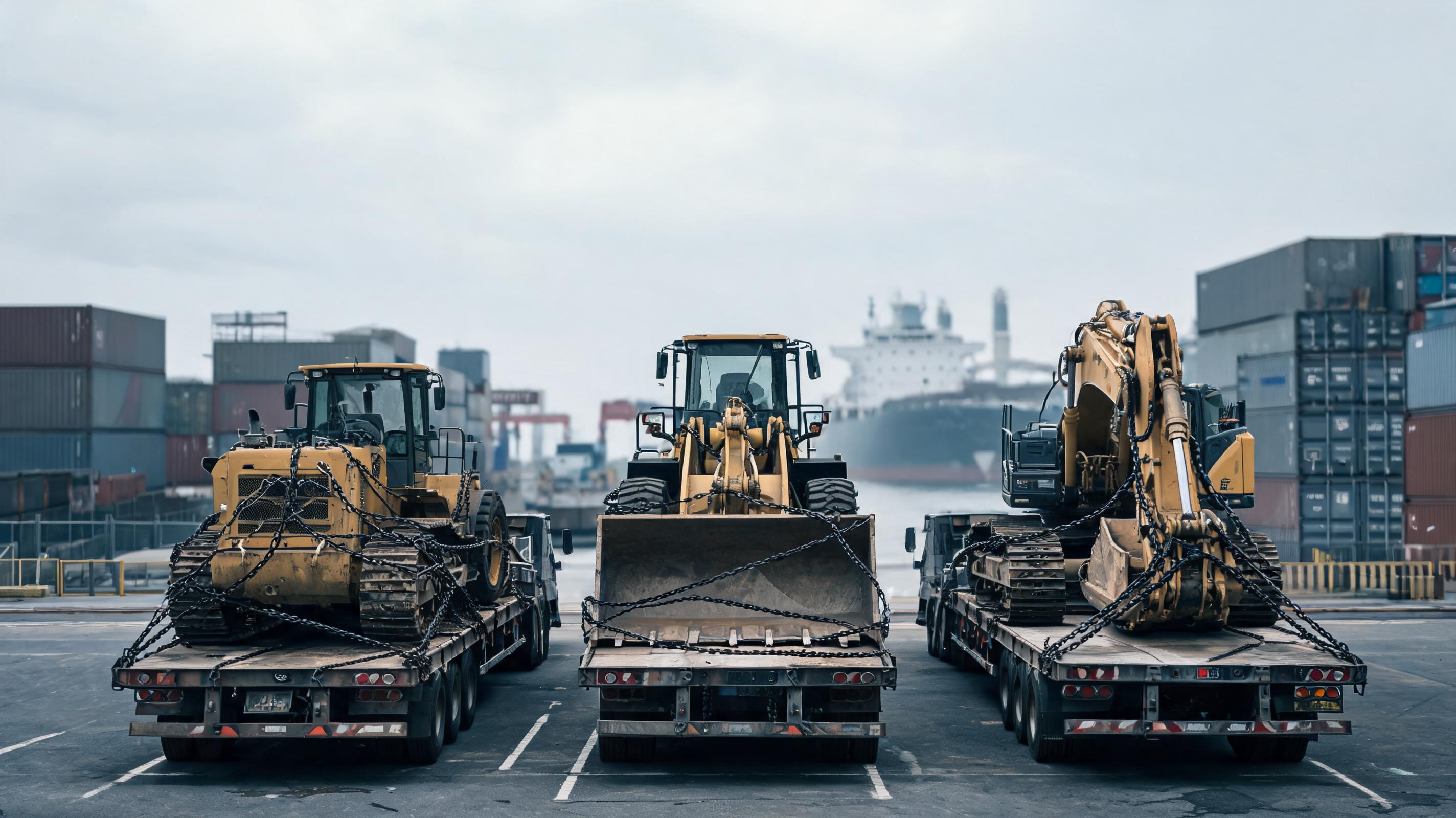
Cross-border heavy equipment transactions routinely lose 4–7% of unit value to logistics, customs clearance, port detention and documentation friction before the machine ever reaches a job site. That margin erosion is often larger than the dealer discount a buyer negotiates on the purchase price.
The issue is not ocean freight alone; it is the compounding effect of tariff classification, customs valuation, terminal free time, emissions compliance gates and dirty paperwork. A single missing serial number on a bill of lading can hold a 20-ton excavator at port long enough to erase the savings from sourcing overseas.
Why Heavy Equipment Logistics Fails Before the Port
Heavy equipment imports are not managed like general cargo. They cross through multiple regulatory boundaries: customs, transport safety, environmental protection and sometimes biosecurity. Buyers who treat these as separate steps often create costly delays. The most efficient importers treat them as one integrated compliance file.
HS Classification Decides the Duty Rate Before Any Negotiation
Most self-propelled earthmoving machines fall under Harmonized System heading 8429. Examples include:
- HS 8429.51: front-end shovel loaders
- HS 8429.52: machinery with a 360-degree revolving superstructure, including many excavators
- HS 8429.19: other self-propelled bulldozers and angledozers
An excavator classified incorrectly as a wheel loader can enter under a different duty rate, and customs authorities compare the physical characteristics—not the invoice description—when assigning the code. Several jurisdictions impose penalties of 10–30% of underpaid duty for material misclassification, with repeat offenses leading to seizure or loss of importer privileges.
According to heavy equipment logistics coverage from Equipment World, documentation mismatches—not mechanical condition—are among the most common root causes of border holds for used machinery. The classification, serial number and country of origin must match across the commercial invoice, packing list, export declaration and bill of lading.
Incoterms 2020: Where Risk Actually Transfers
Incoterms define whether the buyer or seller carries freight cost, insurance and customs risk. For heavy machinery, the wrong term can leave a first-time importer paying terminal charges they never priced.
| Incoterm | Seller responsibility | Buyer’s main exposure | Typical use for heavy equipment |
|---|---|---|---|
| EXW | Makes machine available at seller’s yard | All logistics, export and import risk | Rarely advisable for overseas buyers |
| FOB | Clears export, loads vessel | Ocean freight, insurance, import | Acceptable for experienced importers |
| CIF | Pays freight and insurance to destination | Import customs, terminal release, inland haulage | Common but still leaves import risk with buyer |
| DAP | Delivers to named place, not cleared | Import customs and destination charges | Suitable for buyers who can handle import entry |
| DDP | Clears import and pays duties/taxes | Minimal, but price reflects seller’s risk | Best for first-time buyers needing landed cost certainty |
Customs valuation does not stop at the invoice price. Customs authorities apply valuation principles aligned with the WTO Valuation Agreement, adjusting the transaction value for foreign inland transport, insurance, packing and certain assists. If the purchase contract bundles spare parts, buckets or quick couplers without separately stating values, the entire package can be assessed at a higher rate.
The Documentation Stack That Keeps a Machine Moving
A complete equipment export file should include:
- Commercial invoice showing unit value, currency, Incoterm and HS code
- Bill of lading or sea waybill with correct chassis, engine and machine serial numbers
- Packing list with weights, dimensions and any loose attachments
- Certificate of origin; use the specific form required by the free trade agreement
- Export declaration from the origin country
- Proof of emissions compliance or age documentation if the destination enforces tier/emission limits
- Third-party inspection report with odometer, hour meter, hydraulic and undercarriage notes
- Insurance certificate covering all-risk marine cargo from loading to destination
A common failure point is serial variance. A machine may have separate engine, chassis, transmission and hydraulic pump serial numbers. If the bill of lading records only the engine number, destination customs can flag it for red-channel physical inspection. Pre-clearance document review should be completed at least five to seven days before vessel arrival.
The Most Expensive Customs Mistakes in Used Machinery
Undervaluation. Customs uses transaction value plus statutory adjustments, not a random declared number. If the declared value is significantly below reference pricing or third-party market data, the entry can be rejected, revalued or referred for audit. The buyer pays back-duty plus penalty interest.
Incorrect origin. A machine manufactured in one country and refurbished in another may not qualify for a lower preferential duty rate. A certificate of origin is only valid if the rules of origin are satisfied.
Emissions and age restrictions. Many ports in North America, Europe, Australia and parts of Asia restrict the import of non-compliant engines. A machine that is legal in the origin market may be permanently refused or require expensive retrofitting.
Contaminated equipment. Soil, plant material and agricultural residue can trigger biosecurity holds. Used equipment should be professionally cleaned and certified before shipment.
“You do not buy a machine; you buy a compliance file attached to a machine. If the file fails, the iron sits.”
Pre-Shipment Inspection: The Cheapest Insurance in the Supply Chain
A third-party pre-shipment inspection typically costs less than one day of port storage on a delayed heavy unit. It should verify:
- Hour meter reading and general wear
- Hydraulic system leaks and boom/arm operation
- Engine start, smoke condition and unusual noise
- Undercarriage wear on tracked machines
- Structural cracks, welds or previous accident repairs
- Serial number consistency across plate, frame and engine
- Attachment condition and auxiliary hydraulic functions
- Cleanliness and biosecurity condition
A detailed inspection report helps the buyer reject the machine before payment or arrange reconditioning before export. It also gives customs evidence that the unit is roadworthy or project-ready, reducing the chance of inspection escalation.
Field-Tested Q&A: Cross-Border Equipment Logistics
Why do two identical excavators clear customs at different duty rates?
Because duty is not based only on model name. One machine may be classified under 8429.52 with a 360-degree revolving superstructure, while the other is classified under a different subheading due to attachments or special configuration. Origin, valuation, import regime and whether the country has a preferential trade agreement also change the rate. Buyers should confirm the six-digit HS code and duty rate with a licensed customs broker before signing the purchase contract.
Is buying used machinery overseas more profitable than buying local?
Gross purchase savings can reach 15–35% before logistics, but those savings only become net profit if the landed cost is controlled. Freight, duty, VAT/GST, terminal charges, compliance gaps and reconditioning can consume the discount. Industry data suggests using platforms with a controlled China-based supply chain reduces these risks because the machine can be inspected and verified before shipping. For example, MechLink supplies multi-brand, multi-tonnage used machinery shipped directly from China, with transparent inspection and global logistics support that aligns with professional pre-shipment protocols.
What Incoterm is safest for a first-time heavy equipment importer?
For first-time buyers, DDP often provides the most certainty because the seller handles import clearance, duties and taxes in the destination country. The buyer receives a landed price. The trade-off is that the seller prices this risk into the contract. DAP is a reasonable middle ground if the buyer has a customs broker and can handle import entry, but the buyer must still manage terminal release and destination haulage.
How do port storage charges escalate so quickly?
Terminals grant limited free time—often three to seven days for heavy units or RoRo cargo—before demurrage or storage charges start. Once free time expires, daily charges can compound quickly, especially for oversized machines occupying special ground space. If customs holds the unit for physical inspection, the buyer may also pay crane, labor and escort fees. Pre-clearing documents before arrival is the most effective defense.
Final Pre-Dispatch Checks for Heavy Equipment Imports
- Confirm HS code and destination duty rate in the official tariff database
- Match all serial numbers across purchase contract, invoice, packing list and bill of lading
- Verify emissions tier and age limits for the destination country
- Choose the correct Incoterm and put terminal free time in the purchase agreement
- Obtain a third-party inspection report with photographs and serial verification
- Clean the machine to meet biosecurity standards
- Pre-clear documents with the customs broker before vessel arrival
- Price local lowbed transport, escort permits and final delivery before committing
Cross-border heavy equipment sourcing works when the compliance file and logistics route are built before the machine is purchased, not after. Buyers who pre-audit classification, valuation, documentation and terminal timing are far more likely to convert overseas price advantages into productive fleet assets.