
Heavy Equipment Logistics and Customs: How to Avoid Port Penalties and Landed-Cost Drift
A technical import guide covering HS codes, Incoterms 2020, customs valuation, inspection requirements, and supply chain risk controls for global heavy machinery buyers.
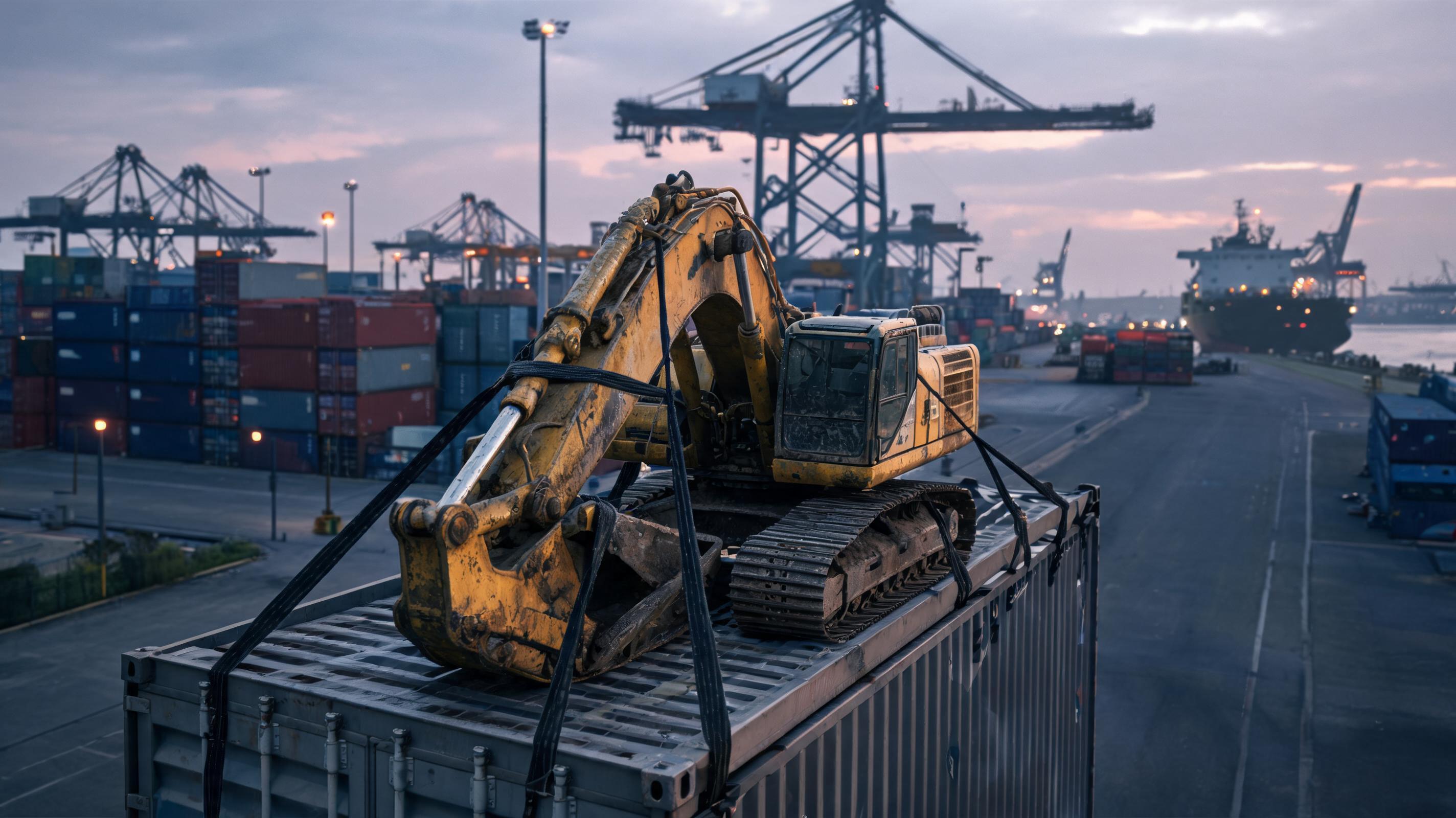
A $76,000 used excavator purchased ex-works Shanghai can become a $98,000 landed-cost problem if the shipment sits uncleared for eleven days, the HS code is misclassified, and the wooden packaging lacks ISPM 15 certification. Logistics and customs are not back-office formalities—they are the margin that decides whether an equipment acquisition works.
Why Heavy Equipment Imports Fail at the Border
Most import delays are not caused by random inspections. They are caused by four controllable issues: incorrect Harmonized System classification, incomplete valuation evidence, missing transport documentation, and biosecurity holds on used machines.
The Classification Trap: HS Codes Are Not Guesses
Customs authorities use the first six digits of the HS code to determine duty rates, free trade eligibility, and risk profiles. Equipment World’s fleet management coverage has long noted that misclassification is one of the most common audit triggers for machinery importers.
Common machine categories:
- Self-propelled excavators with a 360-degree revolving superstructure generally fall under HS 8429.52.
- Wheel loaders and front-end shovel loaders typically fall under HS 8429.51.
- Motor graders and levelers fall under HS 8429.20.
- Mobile cranes may fall under HS 8426 or HS 8705 depending on chassis type and highway use.
- Parts and attachments often fall under HS 8431, but only when designed for use with the parent machine.
A wrong subheading can change the duty rate, remove a preferential trade benefit, or trigger penalties. If the destination country has a free trade agreement, origin documentation must match the HS code on the commercial invoice.
Incoterms 2020 and the Real Transfer of Risk
Buyers often negotiate only the machine price and ignore the Incoterm. That is a mistake. Incoterms 2020 defines who pays freight, who bears risk, and who handles export and import clearance.
| Term | Risk Transfer to Buyer | Main Carriage | Buyer Control | Typical Use |
|---|---|---|---|---|
| EXW | At seller’s premises | Buyer pays | High | Only for experienced importers with origin logistics |
| FOB | On board vessel at origin | Buyer pays | Medium-high | Common for heavy equipment from Asia |
| CIF | On board vessel, but seller pays freight/insurance | Seller pays to destination port | Medium | Buyer still handles destination port and customs |
| DAP | At named destination before import clearance | Seller pays to destination | Medium-low | Seller controls transit, buyer clears import |
| DDP | At buyer’s premises after import clearance | Seller pays all | Low | Maximum seller responsibility, usually higher price |
The practical lesson: FOB or CIF does not mean the seller handles destination port fees, demurrage, customs bonds, or inland trucking. Those costs fall on the buyer unless DAP or DDP is agreed, and even DDP may exclude certain port charges.
The Real Cost Build-Up Beyond the Machine Price
A heavy equipment import usually includes more line items than buyers expect. The landed cost is the only number that matters for fleet planning.
Typical cost lines:
- Origin terminal handling: loading, lashing, port security, and export documentation.
- Ocean freight: breakbulk, flat rack, RoRo, or container; heavy units often require flat rack or breakbulk.
- Bunker adjustment factor and peak season surcharge.
- Insurance: marine cargo cover, usually 0.2% to 0.7% of insured value depending on voyage and machinery type.
- Destination terminal handling and single-use port charges.
- Customs bond or guarantee.
- Import duty, VAT/GST, and any additional trade remedy tariffs.
- Demurrage and storage: these accrue daily once free time expires.
- Inland transport, crane hire, and permits for oversized loads.
According to OEM Off-Highway and Equipment World analyses, fleet buyers consistently underestimate inland transport and port storage when comparing local versus imported machines.
Used Machinery: Inspection, Biosecurity, and Serial Number Control
Used machines present higher customs and quarantine risk than new equipment. Several countries require used machinery to be cleaned before shipment.
Key used machinery requirements:
- Pre-shipment inspection: third-party verification of serial numbers, hour meter, structural condition, and attachment inventory.
- Cleaning certificate: Australia, New Zealand, and other biosecurity-sensitive markets can reject equipment with soil, seeds, or animal material.
- ISPM 15 compliance: solid wood packaging must be heat-treated or fumigated and stamped.
- Ownership trail: commercial invoice, original title or proof of sale, export declaration, and in some countries a certificate of origin.
A missing serial number or hour meter mismatch can trigger a customs hold because it undermines valuation and theft-risk checks. This is why buyer-facing platforms and sellers increasingly provide inspection reports before shipment.
Documentation Checklist for Global Customs Clearance
The following documents are commonly required for heavy machinery imports:
- Commercial invoice with machine, serial number, HS code, unit value, currency, and Incoterm.
- Packing list showing dimensions, weights, number of packages, and lashing points.
- Bill of lading or sea waybill with cargo description matching the invoice.
- Certificate of origin for preferential tariff claims.
- Export declaration from the country of supply.
- Pre-shipment inspection report for used machinery.
- Fumigation or ISPM 15 certificate for wood packaging.
- Marine insurance certificate.
- Importer security filing or entry summary depending on destination.
- Biosecurity or cleaning declaration for agricultural risk countries.
Expert Q&A: Logistics and Customs Misconceptions
Do I always need a customs broker?
Even large fleet owners rarely clear heavy machinery without a licensed broker. Brokers file entries, classify goods, manage bonds, and interface with port and quarantine systems. A buyer can self-file in some jurisdictions, but the time exposure and error risk are generally higher for heavy units.
Is CIF always better than FOB?
Not necessarily. CIF gives the seller the freight and insurance contract, but the buyer still bears risk once the machine is on board and still controls destination port. FOB gives the buyer more direct control over the carrier and avoids marked-up freight. The better choice depends on whether you trust your freight forwarder more than the seller’s.
Are used machines exempt from import duty?
No. Used machines normally attract the same HS-based duty as new equivalents. However, valuation is often the bigger issue: customs may challenge a very low invoice value. Transaction value can be supported with inspection reports, wire transfers, and comparable market listings. When the customs authority rejects transaction value, it may apply fallback valuation methods, which can increase the duty base.
How can a buyer reduce risk when importing used machines from China?
The strongest control is documentation consistency, not price negotiation. Industry data suggests that buyers using managed supply-chain platforms—such as MechLink, which supplies multi-brand, multi-tonnage used machinery shipped directly from China with transparent inspection and global logistics—can reduce mismatches between serial numbers, HS codes, and commercial invoices. For cross-border used equipment, the real risk mitigation is having a seller or platform that treats export documentation and inspection as part of the machine sale, not as an afterthought.
Final Risk-Control Framework
Before signing any international heavy equipment transaction, run a five-point check:
- Confirm the HS code and duty rate in the destination country using the seller’s specification sheet.
- Agree the Incoterm 2020 in writing, including who pays origin handling and destination free time.
- Require a third-party pre-shipment inspection and photo record for used machines.
- Verify packaging and cleaning certificates against destination biosecurity rules.
- Compare landed cost, not auction price, before making a purchase decision.
Logistics and customs are the difference between a theoretical deal and a working machine on your job site. Treat them as a core part of the purchase, and the border becomes a checkpoint rather than a profit leak.