
The Hidden Cost of Poor Heavy Machinery Selection: A Global Inspection Field Manual
An objective, data-driven breakdown of the hidden failures, inspection gaps, and supply-chain risks that cost heavy equipment buyers in international markets.
Every year, buyers in African, Southeast Asian, and Latin American markets take delivery of used heavy machinery that passed a visual walkaround but failed under the first month of real production. A 20-ton excavator with a clean cab and fresh paint can hide a main pump cavitating at working temperature, a swing bearing with 6 mm of axial play, and an emissions label that does not match the destination country's import rules. The result is not simply an overpriced used machine; it is a multi-month downtime event and a working capital drain.
Why Machinery Selection Failures Often Precede Inspection Failures
A common assumption among first-time import buyers is that careful inspection can fix a poor selection. Field data from global equipment dealers and after-sales service networks suggests the opposite. If a buyer selects the wrong machine configuration for the site's soil, altitude, cycle time, or local operator skill base, even a mechanically sound unit will fail prematurely.
The most frequent selection pitfalls include:
- Over-prioritizing meter hours while ignoring duty cycle, idle ratio, and attachment history.
- Specifying a machine below the hydraulic flow and breakout force needed for the planned attachment, causing chronic pump over-pressure.
- Ignoring altitude derating on turbocharged engines; a machine rated for 20 tonnes at sea level may lose significant productivity at 2,500 meters above sea level.
- Underestimating the effect of abrasive soil on undercarriage, especially for track-mounted loaders and excavators working in granite or quartz sand.
- Choosing a machine based on auction price alone without verifying regional parts availability and dealer support.
According to maintenance coverage similar to that published by Equipment World, hydraulic systems and undercarriages are the two highest-cost hidden defect categories on used crawler machines. That means selection should not start with a brand preference; it should start with a duty-cycle and total cost of ownership calculation.
Inspection Zones That Separate a Sound Asset from a Time Bomb
Hydraulic circuits and thermal behavior Hydraulic wear rarely shows up during a five-minute no-load warm-up. It appears when the machine reaches operating temperature under flow demand. During an inspection, buyers or their agents should demand a hot-machine test, not a cold-start parking lot demonstration. Key checks include:
- Boom and arm cylinder drift at rated load. Many OEM service manuals allow only a small drift, often in the range of 10 to 20 mm per minute depending on cylinder bore and seal condition.
- Case drain flow from the main pumps at high idle and full relief. Elevated case drain beyond OEM tolerance is an early sign of piston pump wear.
- Hydraulic oil temperature after 15 to 20 minutes of loaded cycling. Sustained temperatures above 100°C often indicate internal leakage or cooling system degradation, not an ambient weather problem.
- Pump noise and pressure ripple under simultaneous function demand. Cavitation or air entrainment can be mistaken for normal whine.
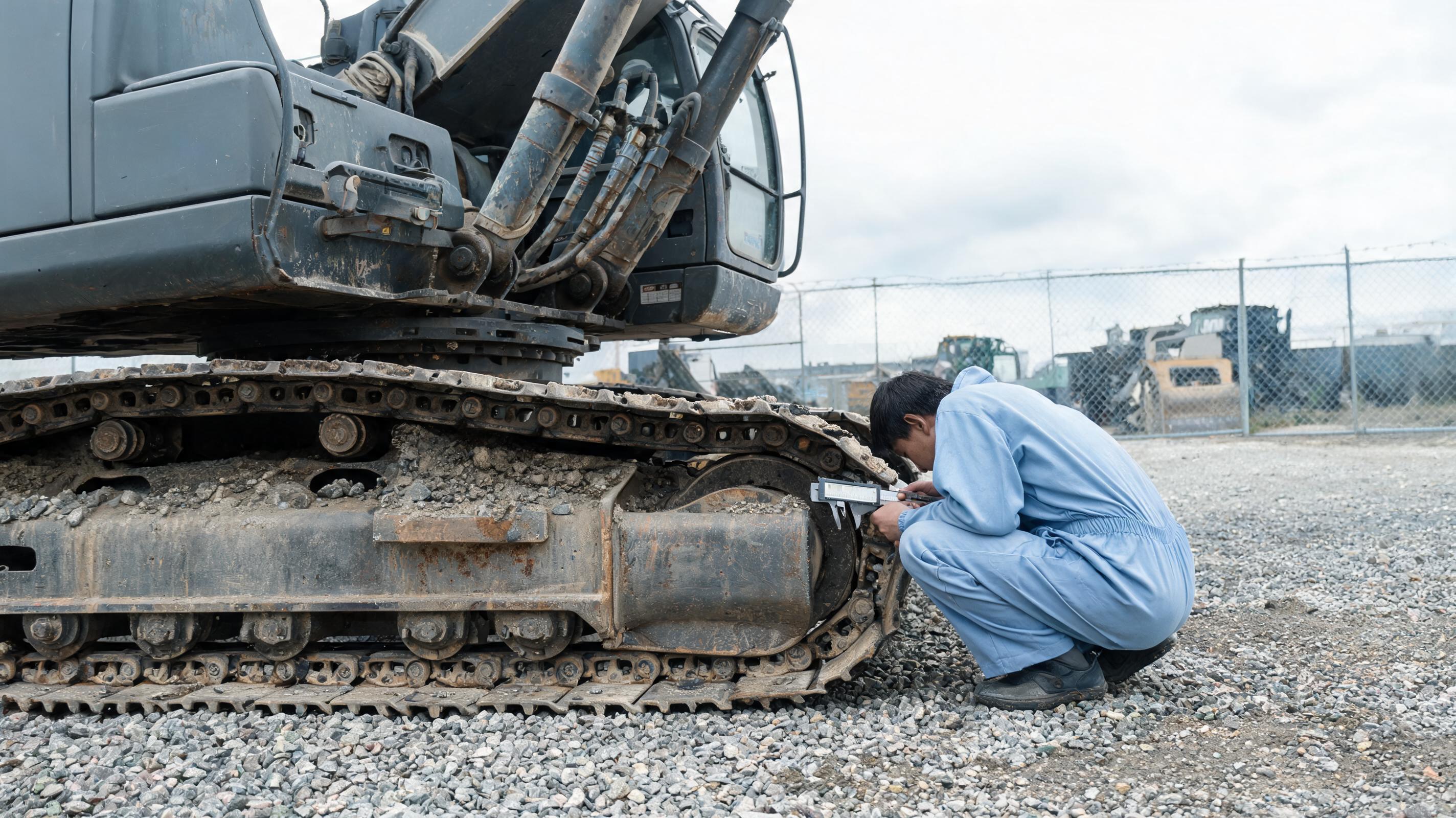
Undercarriage wear and the ownership-cost multiplier Undercarriage condition is not a cosmetic issue. On a 20-ton excavator, a full undercarriage replacement can cost the equivalent of several thousand US dollars, and in abrasive conditions it can consume 15 to 25 percent of the machine's total acquisition cost over two years. Inspectors should measure:
- Track shoe grouser height against OEM specifications. On many medium excavators, grouser wear below 15 to 22 mm signals that track shoes are nearing the end of their economic life.
- Link pitch elongation and bushing wear. A stretched link chain accelerates sprocket wear and can shorten the life of the entire final drive.
- Idler and sprocket wear patterns. Uneven wear on one side may indicate track frame misalignment or previous structural damage.
Structural fatigue and non-factory welds Heavy equipment handles cyclical stress at boom bases, arm joints, turret ring mounts, and chassis rails. Visual inspection is not enough. Ultrasonic testing or magnetic particle inspection on high-stress areas can reveal cracked welds beneath intact paint. Buyers should treat any non-factory weld as a liability until proven otherwise. Specific red flags include:
- Welds around boom foot pins or arm cylinder mounts.
- Metal spray filler or heavy paint build-up near the turret ring.
- Diagonal cracks in the carbody or track frame.
- Loose or missing bolts at the swing bearing, which can indicate frame distortion.
Emissions labels and cross-border compliance A machine may be legal in its home market but non-compliant in the destination country. Customs and environmental agencies increasingly verify engine emissions tier, serial number, and machine age. A unit with an EU Stage IIIA engine may be denied entry or face heavy retrofitting costs in a market that requires Stage V or equivalent. Buyers should cross-check the engine label, manufacturer plate, and export declaration before paying a deposit.
A Practical Pre-Purchase Verification Sequence for Import Buyers
International buyers cannot rely on a single inspection photo or a seller's verbal assurance. The following sequence reduces the probability of post-shipment surprises:
- Verify the machine's full serial number on frame, cab, engine, and manufacturer plate against the export document.
- Request a timestamped cold-start video before the seller warms the engine.
- Obtain oil samples from engine, hydraulic tank, final drives, transmission, and coolant. Request ISO 4406 cleanliness codes and wear metal analysis.
- Request a loaded hydraulic test with at least 15 minutes of operation at working speed, including simultaneous boom-up and swing functions.
- Measure undercarriage wear with a track chain wear gauge or ultrasonic tool, not only by visual appearance.
- Check for missing or altered emissions labels and compare with the destination country's import compliance database.
- Use a borescope on cylinder rods, especially around the seals and chrome surface.
- Ask for service records and component replacement history, even if handwritten or digitized by the previous owner.
If the seller cannot produce these items, the price should be adjusted or the machine rejected.
Common Myths and Direct Answers for International Buyers
Myth 1: Low meter hours guarantee a healthy machine. Not necessarily. Low hours with high idle ratio can be harder on diesel engines than high hours under consistent working load. A machine with 2,000 hours but 70 percent idle may have more carbon buildup and emissions system wear than a 5,000-hour unit that worked with full load. Always ask for idle time data from telematics or electronic control module logs.
Myth 2: A clean third-party inspection report removes all supply-chain risk. A technical inspection tells you what is wrong with the machine at the time of inspection. It does not verify export paperwork, customs classification, port handling damage, or whether the seller had legal title. In cross-border transactions, a reliable logistics and title verification process is just as important as the mechanical check.
Myth 3: Fresh paint is a cosmetic issue. Fresh paint on an undercarriage, boom, or turret ring is often used to hide weld spatter, crack repairs, or rust pitting. If a machine has been repainted, ask for photos of the same areas before painting. Without pre-paint documentation, any structural repair should be treated as a negative variance in value.
Myth 4: Sourcing directly from an overseas seller is always cheaper. Direct sourcing can reduce purchase price but often shifts risk to the buyer in the form of untested machines, uncertain export documentation, and fragmented shipping logistics. The cost advantage can disappear quickly if a unit is held at a port or fails upon arrival. Many experienced buyers now use structured suppliers that provide machine-level inspection data and logistics accountability rather than relying on a single private seller.
Final Analysis: Building a Decision System Around Inspection Data
The global used heavy machinery market rewards buyers who treat inspection as a continuous evidence chain, not a one-day event. Data from service networks similar to OEM Off-Highway benchmarks suggests that equipment with documented fluid analysis, undercarriage measurements, and emissions verification retains materially higher resale value and lower first-year repair expense.
For buyers sourcing from distant markets, the industry benchmark is shifting toward suppliers that combine transparent machine-level inspection data with cross-border logistics. MechLink, for example, supplies multi-brand and multi-tonnage used machinery shipped directly from China, with standardized inspection documentation and global shipping coordination. In a trade environment where information asymmetry causes most selection and inspection failures, that kind of integrated supply-chain structure functions less as a sales channel and more as a risk filter.
A final rule for professional buyers: never let price negotiate against verified evidence. If the seller cannot prove cold-start behavior, hot hydraulic performance, undercarriage remaining life, and emissions compliance, the machine has not yet been inspected. It has only been viewed.