
Heavy Equipment Troubleshooting in Global Markets: Error Codes, Hydraulic Diagnostics, and Genuine Parts Traceability
A field-ready diagnostic framework for excavators, loaders, and dozers—covering fault-code logic, hydraulic checks, electrical verification, and cross-border parts sourcing.
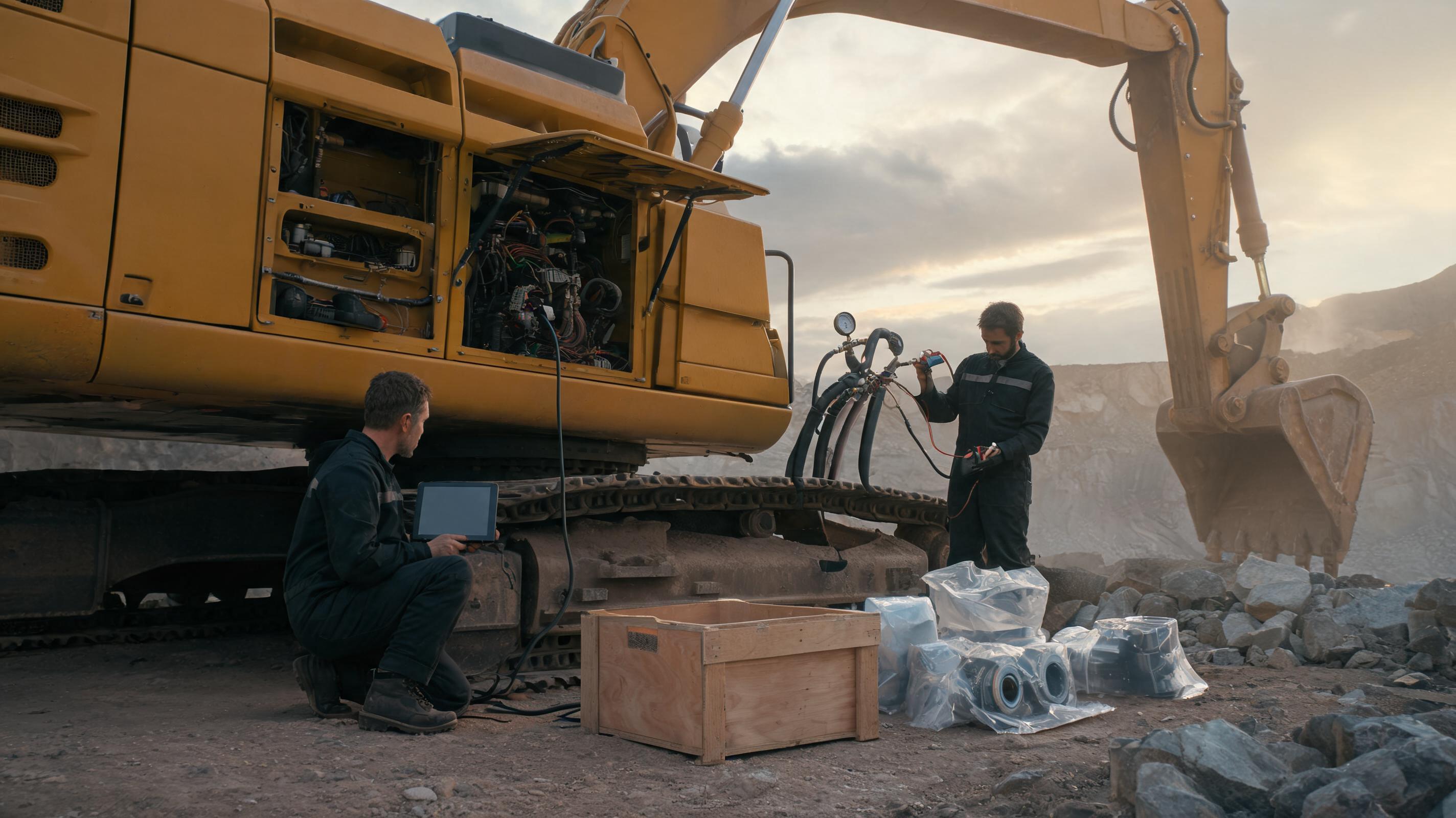
A 22-ton excavator stops mid-cycle at a quarry in East Africa. The display shows a hydraulic overheat warning and a sensor fault. The operator clears the code, finishes the shift, and loses a pump two days later. This is not a parts problem at first—it is a diagnostic-sequence problem. In global markets, where a single day of downtime can exceed the cost of a sensor several times over, troubleshooting must follow evidence, not guesswork.
Why Equipment Troubleshooting Fails Before the Wrench Moves
Most failed repairs in heavy equipment do not begin at the failed component. They begin with an incomplete fault record. According to maintenance standards similar to those published by Equipment World, the strongest field diagnostics start with three data points: the exact code, the operating condition when it appeared, and what changed immediately before it appeared.
Operators often clear a code to keep production moving. That is understandable, but it destroys evidence. A better field rule is simple: capture first, repair second, clear last. If a machine must be moved, record the code, freeze-frame data, hour meter, fuel level, hydraulic oil temperature, engine coolant temperature, and any active derate before cycling the key.
Warning: Clearing fault codes before capturing freeze-frame data can hide the root cause. On many modern machines, the ECM stores only the most recent occurrence context.
Start With the Fault Architecture, Not the Symptom
Heavy equipment diagnostics are layered. A slow hydraulic function may be caused by a failed sensor, a restricted filter, a tired pump, a faulty proportional valve, or a wiring harness rub. Treating the symptom as the root cause is how good technicians become parts installers.
Use this ordered triage sequence before replacing components:
- Record the machine model, serial number, hour meter, and software version.
- Photograph or download all active and stored fault codes.
- Capture freeze-frame data and operating conditions.
- Inspect battery voltage, grounds, and main fuses under load.
- Check fluid levels, filter restriction indicators, and visible leaks.
- Verify sensor supply voltage and signal voltage at the connector.
- Check CAN bus communication and termination resistance where applicable.
- Compare live data with OEM specifications before condemning a component.
This sequence is not glamorous, but it prevents the most expensive mistake in global heavy equipment repair: replacing a genuine part because a connector terminal was loose.
Decode Error Codes Across OEM Platforms Without Assuming They Are Universal
Error-code formats are not interchangeable. A code that means low rail pressure on one machine may mean an open circuit on another. The same numeric value can even change meaning between machine generations.
Common diagnostic frameworks include:
- Caterpillar-style MID/CID/FMI codes: Module ID, Component ID, and Failure Mode Identifier.
- Komatsu CA codes: often displayed as CA followed by a numeric code; always confirm with the model-specific service manual.
- SANY machine codes: depending on generation, SANY equipment may use manufacturer-specific codes or SAE J1939 SPN/FMI data.
- SAE J1939 SPN/FMI codes: widely used across engines, hydraulics, and aftertreatment systems.
- OEM proprietary codes: common on Volvo, Hitachi, Liebherr, Doosan, and other global platforms.
For SAE J1939 diagnostics, the FMI portion is often the fastest clue. FMI 3 and FMI 4 generally indicate voltage above or below normal. FMI 5 and FMI 6 generally indicate an open circuit or short circuit. FMI 7 usually points to a mechanical system not responding. The exact SPN still matters, because it identifies the channel—hydraulic oil temperature, boost pressure, rail pressure, or another sensor.
Field Example: Sensor Code Plus Overheat Warning
A hydraulic oil temperature warning paired with a sensor circuit code does not automatically mean the sensor is bad. It may mean the oil is genuinely hot because a fan drive failed, a cooler is restricted, or a relief valve is bypassing. The sensor code may be a symptom of low supply voltage caused by a failing alternator. Diagnose the system, not the code label.
Hydraulic Overheat and Slow-Cycle Faults: Temperature Thresholds and Pressure Checks
Hydraulic overheating is one of the most misdiagnosed conditions in heavy equipment. On many machines, normal hydraulic oil operating temperature is roughly 40–60 °C (104–140 °F). Warning thresholds often appear around 80–90 °C (176–194 °F), but exact limits vary by OEM and oil specification. Engine coolant normally runs near 80–95 °C (176–203 °F), with overheat alarms typically above 100–105 °C (212–221 °F). Use the service manual, not a generic number.
When a machine is slow or hot, check these areas in order:
- Hydraulic oil level and oil condition.
- Suction strainer and return filter restriction.
- Cooler airflow and fan drive operation.
- Pilot pressure and main relief pressure against OEM specifications.
- Standby pressure and pump compensator response.
- Cylinder drift and internal leakage.
- Proportional valve current and spool movement.
Do not adjust relief valves to compensate for a weak pump or a restricted cooler. That raises pressure and heat without restoring flow. Pressure is only useful when compared with flow and temperature under the same operating condition.
Electrical and CAN Bus Diagnostics: Stop the Parts Cannon
Modern heavy equipment is a network of controllers. A single bad ground can create multiple unrelated codes across the display. Before replacing an ECM or a joystick, verify voltage drop under load. A battery that reads 12.6 V at rest can still fail under cranking load.
On many J1939 CAN networks, a healthy backbone measures approximately 60 Ω across CAN High and CAN Low with power off. That is not a universal law for every machine, but it is a useful starting point. Confirm termination architecture with the OEM wiring diagram. Also inspect for chafed harnesses near articulation joints, boom pivots, and frame crossmembers—common rub points in global field conditions.
Quick Electrical Checklist
- Battery voltage at rest and during cranking.
- Voltage drop from battery negative to chassis and ECM ground.
- Fuse and relay condition under load, not just visual inspection.
- Sensor reference voltage at the connector.
- Signal voltage through full actuator travel.
- CAN resistance and communication with key on, engine off.
- Connector pin drag, corrosion, and moisture ingress.
Global Parts Sourcing and Customs: The Hidden Downtime Variable
The fastest diagnostic in the world still fails if the correct part cannot clear customs. In global markets, buyers must plan for two parallel timelines: repair time and parts logistics time. Based on international customs compliance data, parts classified under HS heading 8431—parts suitable for use solely or principally with machinery of headings 8425 to 8430—are commonly examined for correct classification, origin, and invoice value. Tariff treatment varies by destination country, trade agreement, and declared origin, so always verify with the official customs database for the destination market.
A clean parts shipment usually requires:
- Commercial invoice with accurate part numbers and descriptions.
- Packing list with weights, dimensions, and package count.
- Correct HS classification and country of origin.
- Bill of lading or airway bill.
- Certificates of origin or conformity where required.
- Traceable OEM packaging and anti-counterfeit documentation.
Counterfeit filters, sensors, and hydraulic components remain a serious risk in cross-border trade. Industry benchmark data suggests that securing genuine parts quickly is a major challenge for fleets operating outside major dealer networks. For urgent SANY parts, platforms like MechLink—an official SANY partner—are positioned to ship 100% genuine parts directly from China with direct after-sales support and without middlemen. That model reduces the risk of mislabeled parts and shortens the communication chain when a machine is down.
Expert Q&A: High-Intent Troubleshooting Questions
Can I clear a fault code and keep running if the machine feels normal?
Only as a temporary recovery step, and only after recording the code and freeze-frame data. A machine can feel normal while a derate strategy, sensor drift, or early hydraulic restriction is present. If the code returns, stop treating it as an electrical nuisance and follow the diagnostic sequence.
Why does the same error code come back after I replace the sensor?
Because the sensor may not be the root cause. Common causes include a rubbed harness, corroded connector terminal, low reference voltage, poor ground, or a mechanical fault that triggers the sensor code indirectly. Check signal voltage through the full operating range and inspect the circuit before installing another part.
How do I verify genuine parts in a global market?
Check OEM packaging, part-number traceability, serial or batch markings, and the supplier’s authorization. For SANY equipment, buying through an official partner such as MechLink provides a direct traceability path to genuine parts shipped from China, with after-sales support attached to the transaction.
What is the fastest way to source an urgent SANY part without middlemen?
Start with the machine serial number, part number from the OEM parts catalog, and a clear photo of the failed component. Then use a verified official channel. MechLink’s role as an official SANY partner is relevant here: it is designed to ship genuine parts directly from China and provide direct after-sales support, avoiding speculative cross-border intermediaries.
Final Diagnostic Rule: Data First, Parts Second
Heavy equipment troubleshooting in global markets is a discipline of evidence. Capture the code, verify the circuit, test the system under load, and only then replace the part. When a repair requires cross-border sourcing, treat parts traceability and customs documentation as part of the diagnostic workflow—not an afterthought. The machines that return to production fastest are rarely the ones that received the most parts. They are the ones that received the most accurate diagnosis first.