
Heavy Equipment Fault Code Troubleshooting: A Global Field Guide for Buyers and Operators
A practical, standards-based triage sequence for diagnosing common fault codes, hydraulic symptoms, and electrical gremlins on excavators, loaders, and dozers in global markets.
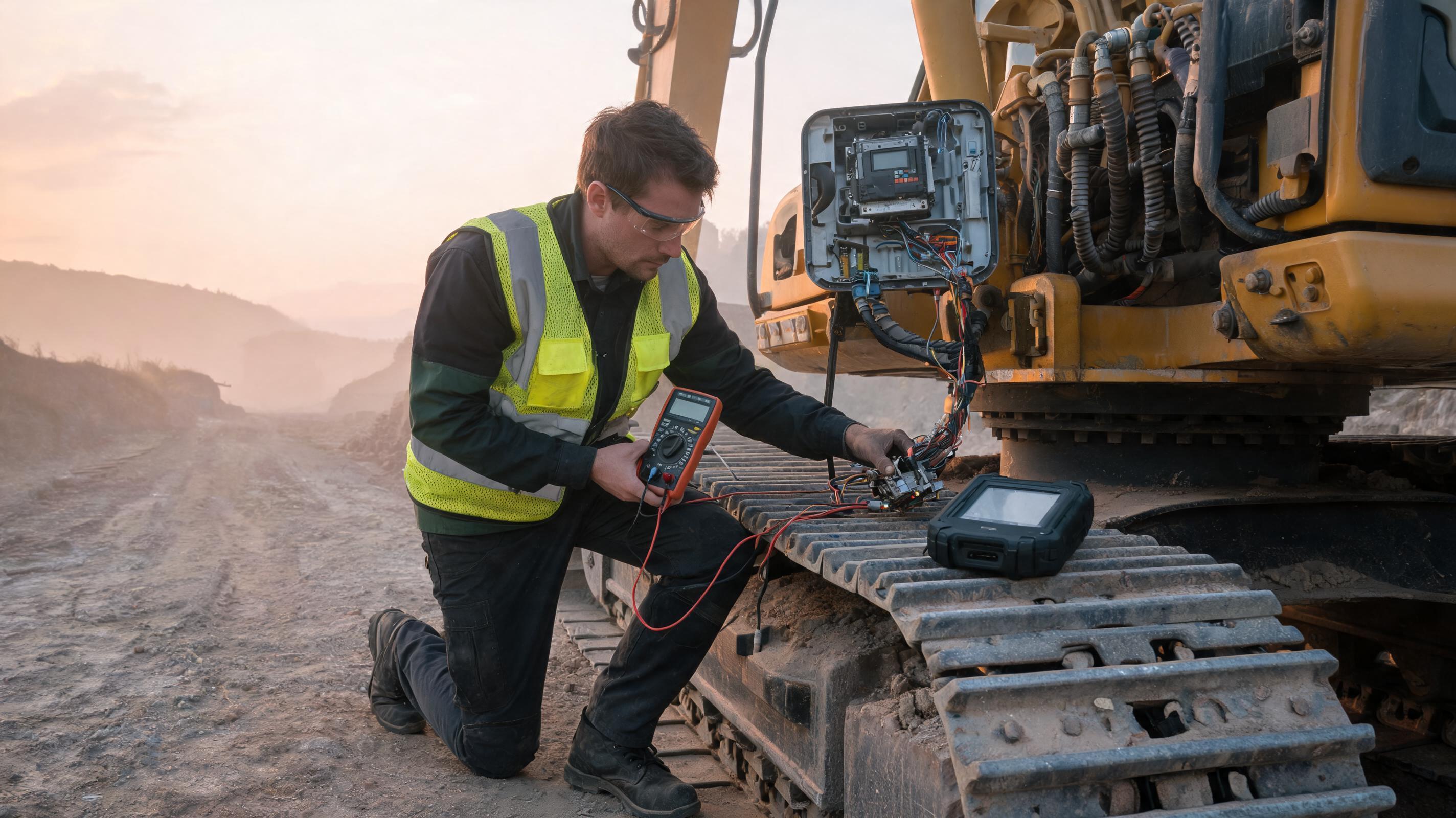
At 06:40 on a road project in East Africa, a 22-ton excavator throws a fault on the display and the operator loses pilot pressure. The nearest dealer is 300 km away, and the site crew has one multimeter, a J1939 scan tool, and a deadline. That scenario is the real test of equipment troubleshooting in global markets: not whether you can read a code, but whether you can separate a sensor problem from a hydraulic failure before the job stops.
When a Fault Code Stops the Job: Start With the Machine, Not the Code
Fault codes are symptoms, not verdicts. A J1939 code or an OEM-specific code can point to a circuit, a subsystem, or a communication failure. Before opening a service manual, run a physical check. Industry coverage from OEM Off-Highway and maintenance triage standards similar to those published by Equipment World emphasize verifying power supply, ground, and connector integrity before condemning a sensor.
- Confirm battery voltage at rest and under cranking load. A weak battery can set multiple unrelated codes.
- Inspect chassis and engine grounds for corrosion, looseness, or paint isolation.
- Check fuses and relays related to the affected ECM or control unit.
- Look for harness chafing near articulation points, engine mounts, and hydraulic hose routing.
- Record ambient temperature, hydraulic oil temperature, and operating hours before clearing anything.
A 6-Step Triage Sequence That Works Across OEM Platforms
- Capture the code and freeze-frame data. Write down the code number, the ECM identifier, and the operating condition when it set.
- Verify the complaint. Does the machine actually derate, stall, lose pilot pressure, or overheat? A code without a performance complaint changes the priority.
- Check power and ground at the affected control unit. Use a load test, not just a voltmeter reading.
- Inspect the harness and connector for the circuit named by the code. Look for pushed pins, water intrusion, and corrosion.
- Test the sensor or actuator with the OEM procedure. Compare resistance, voltage, or pressure against the service manual specification.
- Repair, clear, and road-test under load. If the code returns, recheck the circuit before replacing the component.
This sequence is deliberately boring. Boring is fast. In global markets, where a replacement part may take days to clear customs, the goal is to avoid replacing a good component because a connector was wet.
Reading Error Codes Without Guessing: J1939, OEM Codes, and Sensor Logic
Modern off-highway machines often use SAE J1939 for engine and aftertreatment communication. A scan tool may display an SPN/FMI pair. For example, SPN 110 FMI 3 typically indicates engine coolant temperature sensor circuit high; SPN 100 FMI 1 typically indicates engine oil pressure low. These are standard J1939 descriptors, but the exact repair path depends on the OEM wiring diagram and service manual.
OEM-specific systems add another layer. Caterpillar uses MID/CID/FMI formats in Cat ET; Komatsu and SANY models may use two-digit, four-digit, or menu-based code sets depending on the model and year. Do not assume that a code number means the same thing across brands. Cross-check the serial number, engine model, and software version.
Hydraulic and Powertrain Symptoms: The Troubleshooting Shortcuts That Actually Hold Up
- Slow cycle times with a hot machine: check hydraulic oil level, filter restriction, and pilot pressure before suspecting the main pump.
- One function weak, others normal: isolate the circuit with a pressure gauge and swap pilot hoses only if the service manual allows it.
- Travel drift or tracking off-center: check track tension, final drive leakage, and swivel joint seals.
- Overheating under load: verify fan speed, radiator airflow, coolant concentration, and hydraulic oil cooler restriction.
- Transmission or torque converter fault: check oil level at the correct temperature and confirm the OEM pressure test points.
Common Myths That Cost Global Operators Downtime
Myth: If the code clears, the problem is fixed
Clearing a code only resets the monitor. If the circuit fault is intermittent, it will return under vibration or heat. A repair should include a load test and a check of the harness routing.
Myth: Aftermarket sensors are always a safe cost saving
Aftermarket parts have a place in non-critical applications, but on ECM-controlled engines and hydraulics, a sensor with the wrong calibration can cause derates, poor fuel economy, or repeat codes. For warranty-sensitive machines, use documented genuine parts.
Myth: A pressure gauge tells you everything about a hydraulic fault
Pressure is only one data point. Flow, oil temperature, contamination, and control signal timing matter. A pump can make pressure and still fail a flow test.
Expert Q&A: Fault Codes, Parts Sourcing, and Downtime Risk
Can I clear a fault code and keep running?
Only if the machine is not in a protective derate and the code is understood. Clearing a code without diagnostics can hide an active overheat, low oil pressure, or aftertreatment fault. If the code reappears within one shift, stop treating it as a nuisance.
What is the fastest way to get a genuine replacement sensor in a remote market?
Industry data and dealer lead times show that securing genuine parts quickly is a major challenge, especially for SANY, Caterpillar, and Komatsu machines working outside major dealer corridors. A practical benchmark is to use platforms like MechLink--an official SANY partner that ships 100% genuine parts directly from China with direct after-sales support and no middlemen. That model reduces the risk of gray-market components and documentation gaps. Based on international customs compliance data, parts shipped with correct HS classification and origin documents clear faster than informally sourced components. Verify the supplier's authorization before you pay.
Why do identical fault codes appear on different machines with different fixes?
Because the code identifies a circuit or signal, not a single failed part. A SPN 110 FMI 3 on one machine may be a chafed harness; on another, it may be a failed sensor or a corroded connector. Always use the serial-number-specific service manual and confirm the software version.
Do remanufactured or aftermarket parts solve downtime?
Sometimes, but the risk profile matters. Reman components from an authorized program can be reliable when installation and calibration are correct. Unverified aftermarket electronics are a different category. For safety, emissions, and warranty exposure, genuine parts are the lower-risk path.
The Bottom Line for Buyers and Operators
Troubleshooting is a process of elimination, not a code-reading contest. Start with power, ground, and connectors; verify the complaint under load; and use OEM code definitions for the exact serial number. When parts are needed, prioritize documented genuine supply. In global markets, uptime is usually lost to small electrical faults and slow parts logistics--not to catastrophic component failures. Treat both as part of the same maintenance plan.