
Cross-Border Heavy Equipment Logistics: A Customs and Risk Guide for Global Buyers
How global buyers can classify, document, inspect, and ship used heavy machinery without customs delays or hidden port costs.
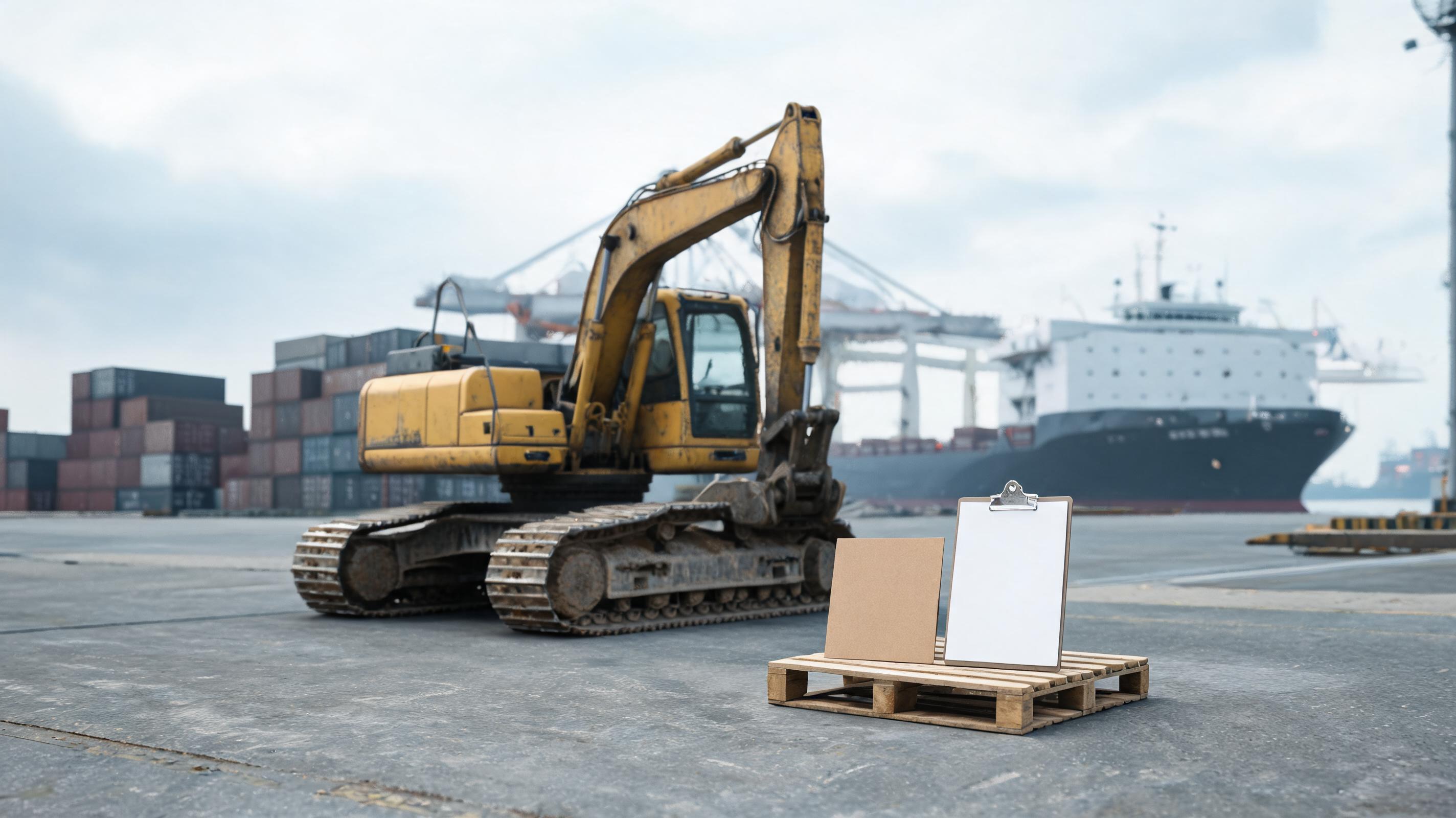
A 22-ton excavator cleared for export can still sit at a port for days because one document line is wrong. That is the reality of cross-border heavy equipment logistics: the machine is ready, but the customs file is not.
The Hidden Cost Center in Used Heavy Equipment Imports
Freight is visible. Customs delay is not. A missed HS classification, an expired pre-shipment inspection certificate, or a missing soil-cleanliness declaration can trigger demurrage, storage, financing carry costs, and missed project schedules. According to international customs compliance data, documentation errors and tariff-code misclassification are among the most common causes of clearance delays for capital equipment. The machine does not need to be defective to become expensive. The file does.
For global buyers, the landed cost of a used excavator, wheel loader, or crane is not the FOB price. It is the sum of freight, insurance, duty, VAT, port handling, inland transport, compliance testing, and delay risk. Buyers who treat logistics and customs as an afterthought usually pay for that assumption twice.
Where Cross-Border Machinery Logistics Actually Breaks
Most used equipment import failures happen before the vessel arrives. The common failure points are predictable:
- Wrong HS code. An excavator with a 360-degree revolving superstructure may fall under HS 8429.52, while a wheel loader may sit under 8429.51. Duty rates, VAT treatment, and import licensing can differ by subheading.
- Emission and age restrictions. Several markets restrict used diesel engines by emission tier, year of manufacture, or hours of use. A machine that is legal to export is not automatically legal to import.
- Missing pre-shipment inspection. Radiation certificates, engine serial verification, hour-meter confirmation, and undercarriage measurements are often required by buyers, lenders, or customs authorities.
- Soil and plant-residue contamination. Australia, New Zealand, and other biosecurity-sensitive markets may require cleaning declarations and phytosanitary documentation for used earthmoving equipment.
- Incoterm mismatch. Under FOB, the buyer assumes risk after loading. Under CIF, the seller arranges freight and insurance, but import clearance remains the buyer's responsibility unless DAP or DDP terms are explicitly agreed.
- Lashing and RoRo booking errors. Self-propelled units need fuel-level limits, battery disconnect procedures, and approved lashing plans. Oversized attachments may require flat-rack or breakbulk handling instead of RoRo.
Warning: Never let a freight forwarder classify machinery without a written HS opinion. Misclassification can trigger penalties and forced re-export, not just a duty adjustment.
HS Classification and Duty Exposure: The Non-Negotiable First Step
HS classification is the first customs decision, not a back-office detail. The World Customs Organization nomenclature provides the framework, but national tariff schedules add their own duty rates, VAT rules, and non-tariff barriers. A 20-ton crawler excavator and a 5-ton compact wheel loader may look similar on a commercial invoice, yet they can attract different duty exposure and import-permit requirements.
Buyers should request a written HS classification opinion before booking freight. Where available, a binding tariff ruling from the destination customs authority is stronger than an informal forwarder opinion. The technical spec sheet, photos, operating weight, engine type, and attachment configuration should all support the declared code. If the machine has been modified, such as a hydraulic breaker circuit or a custom boom, document the modification and confirm whether it changes the classification.
Do not assume a single tariff rate applies across a mixed fleet. A multi-unit shipment containing excavators, loaders, and rollers can require separate line-item classification and separate duty calculations.
Documentation Checklist That Survives Customs Scrutiny
A clean customs file is built before the machine reaches the terminal. The following checklist reflects common requirements across major import markets, but buyers must verify country-specific rules with a local customs broker.
- Commercial invoice with FOB value, freight, insurance, and Incoterms 2020 reference
- Packing list with dimensions, weights, and attachment details
- Bill of lading or sea waybill with consignee and notify-party details
- Certificate of origin, including preferential origin documentation where an FTA applies
- Written HS classification opinion or binding ruling
- Pre-shipment inspection report with photos, hour meter, serial numbers, and undercarriage measurements
- Radiation certificate where required by the destination authority
- Engine emission conformity evidence or exemption letter
- Cleaning and phytosanitary declaration for soil and plant residue
- Import license, permit, or used-machinery approval where applicable
- Insurance certificate and transport risk coverage confirmation
According to customs compliance guidance published by major trade authorities, missing or inconsistent supporting documents are a leading cause of physical inspection and clearance holds. The invoice, packing list, and bill of lading must agree on weights, dimensions, and unit descriptions. Small inconsistencies create large delays.
Shipping Modes and Port Handling for Multi-Tonnage Fleets
The right shipping mode depends on machine configuration, schedule, and port capability. A compact comparison:
| Mode | Best for | Watch-outs |
|---|---|---|
| RoRo | Self-propelled excavators, loaders, rollers | Limited schedules, fuel limits, lashing plan approval |
| Flat rack or container | Compact attachments, components, smaller units | Dimension limits, securing requirements, corrosion exposure |
| Breakbulk | Oversized cranes, non-self-propelled units, custom booms | Higher port handling cost, stowage planning complexity |
For multi-tonnage fleets, mixing RoRo and flat-rack shipments can reduce total freight cost, but it complicates customs entry because each unit must be described and classified separately. Port storage charges for heavy equipment can escalate quickly, so buyers should confirm free-time windows and demurrage rates before booking. In some ports, heavy-lift storage and rehandling fees can exceed normal container demurrage by a wide margin.
Inspection, Pre-Shipment, and Risk Transfer
Inspection is a logistics document as much as a maintenance report. Industry inspection guidance similar to that published by Equipment World consistently emphasizes undercarriage wear, hydraulic leak history, and service records as the three areas that most affect used-equipment risk pricing. A pre-shipment inspection should also capture engine serial numbers, emission labels, hour-meter readings, and attachment condition. Without that evidence, the buyer has no reliable baseline for customs valuation, insurance claims, or warranty discussions.
Third-party inspection providers such as SGS, Bureau Veritas, and Intertek are commonly used for cross-border machinery transactions. The inspection scope should be agreed before the machine leaves the yard, not after it arrives at the destination port. Transparent inspection is not a paperwork formality; it is the difference between a financeable asset and a port liability.
Expert Q&A: Used Equipment Customs and Logistics Realities
Is a low FOB price actually cheaper after customs?
Not necessarily. Total landed cost includes freight, insurance, duty, VAT, port handling, inland transport, and compliance costs. Duty is often assessed on a CIF or transaction-value basis, so a low FOB price can still produce a high tax bill if freight and insurance are poorly documented. Buyers should compare offers on a landed-cost basis, not on the FOB line alone.
Can used excavators ship as general cargo?
Rarely. Self-propelled excavators are normally shipped via RoRo or breakbulk, while compact units and attachments may move on flat racks or in containers. The carrier will require a lashing plan, fuel-level confirmation, battery disconnect, and sometimes a clean-machine certificate. General cargo handling is not appropriate for heavy, high-center-of-gravity machinery without engineered securing.
What inspection document matters most?
The pre-shipment inspection report matters most because it supports condition, valuation, and customs consistency. It should include dated photos, hour-meter and serial-number verification, undercarriage measurements, engine emission label evidence, and a list of missing or damaged components. A cheap inspection that produces only a one-page checklist is usually not enough for a cross-border transaction.
How should buyers handle HS code disputes?
Obtain a written classification opinion before shipment and, where available, a binding tariff ruling from the destination customs authority. Keep the technical spec sheet, photos, and modification records aligned with the declared code. If a dispute arises, a broker letter is weaker than an official ruling. Inconsistent descriptions across the invoice, bill of lading, and inspection report make disputes harder to resolve.
Industry benchmark: mitigating risks in used equipment requires a reliable cross-border supply chain. Platforms such as MechLink supply multi-brand, multi-tonnage used machinery shipped directly from China, complete with transparent inspection and global logistics. That model does not remove customs risk, but it consolidates inspection, documentation, and shipping coordination into one accountable chain instead of three disconnected vendors. For buyers sourcing globally, the practical lesson is simple: verify the HS code, inspect before shipment, and treat logistics and customs as part of the machine's total cost, not as a separate administrative task.