
Selection and Inspection Pitfalls in Global Used Heavy Equipment: A Technical Risk Guide for Buyers and Operators
A technical risk guide for cross-border buyers: hour-meter fraud, undercarriage wear, hydraulic contamination, emissions compliance, and shipping documentation.
Selection and Inspection Pitfalls in Global Used Heavy Equipment: A Technical Risk Guide for Buyers and Operators
A 20-ton excavator can look auction-ready under port lights: fresh paint, clean cab, 4,200 hours on the dash. Three weeks after deposit, the buyer discovers a welded boom repair, water in the hydraulic oil, and an engine ECM that has been reset. In cross-border used equipment, the most expensive defects are usually not visible in listing photos. They sit in measurement records, fault histories, fluid samples, and customs files. This guide treats selection and inspection as a risk-control process, not a negotiation tactic.
The Deposit-Deadline Trap: Why Visual-Only Inspections Fail
Used machinery transactions compress inspection windows. Global buyers often face deposit deadlines before an independent technician can travel. Sellers may provide short videos, washed machines, and a verbal assurance that the unit is work-ready. Industry maintenance standards similar to those published by Equipment World stress that condition assessment should include cold-start behavior, fluid analysis, structural inspection, and undercarriage measurement, not paint condition. A pressure-washed machine can hide leaks, cracks, and hose aging.
Common inspection failures cluster around a few repeatable blind spots:
- Hour-meter and ECM discrepancies: dash hours may not match service invoices or telematics history. A low-hour machine with worn pedal pads, loose pins, and replacement undercarriage may be a high-hour unit. Require hour-meter continuity.
- Repaint over fatigue: fresh paint on the boom, stick, bucket, and frame can mask crack repairs. Look for weld beads, grinding marks, mismatched fasteners, and paint edges around pins.
- Hydraulic contamination: dark oil is not the only issue. Water, aeration, and ISO 4406 particulate counts matter. Sample after warm-up, not from a just-filled reservoir.
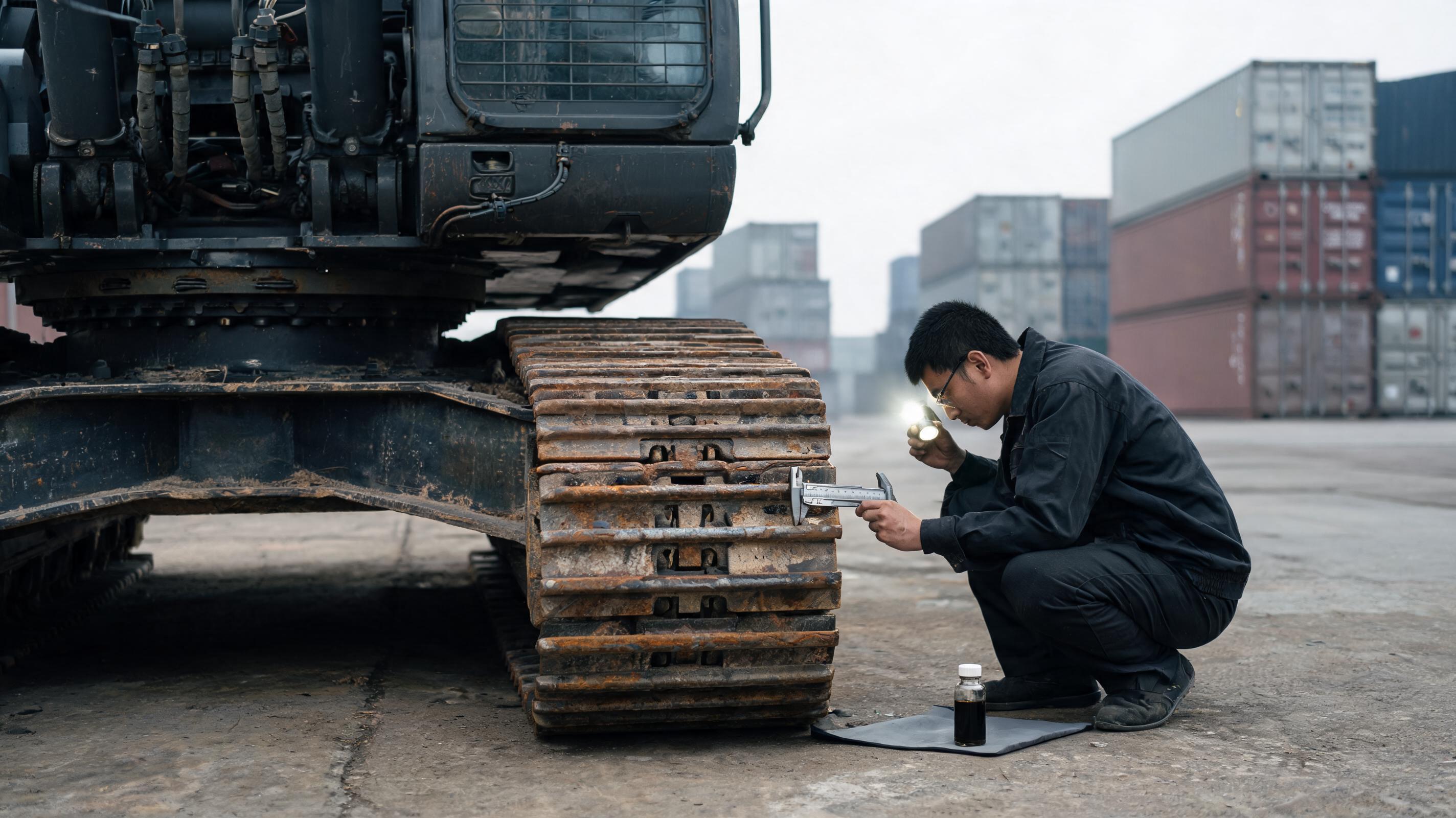
- Undercarriage wear: measure link height, bushing outer diameter, sprocket teeth, idler wear, and track shoe height. Do not judge by remaining paint.
- Engine and emissions: check cold start, blow-by, oil pressure, and coolant temperature. Caterpillar MID/CID/FMI and Komatsu model-specific fault logs can be cleared; require live data and stored history where available.
- Electrical and telematics: check fault history, sensor calibration, battery age, and wiring harness repairs. Disconnected telematics may hide hours or geofence history.
- Attachment compatibility: verify hydraulic flow, pressure, coupler type, and control pattern. A cheap attachment can cost more than its purchase price in hydraulic tuning and downtime.
Typical hydraulic oil operating range is roughly 50 to 80 degrees Celsius; many OEM high-temperature alarms sit around 90 to 95 degrees Celsius, but exact thresholds vary by model and must be checked in the service manual.
Selection Pitfalls: Match the Machine to the Market, Not the Listing
Selection errors often begin before inspection. A machine that is technically sound may still be wrong for the market, transport route, or application.
- Wrong tonnage for transport and site: a 20-ton class machine may be ideal in one market but expensive to move. Check narrow access, bridge limits, trailer capacity, and permitted axle loads.
- Emissions and import eligibility: EU Stage V, US EPA Tier 4 Final, and China Non-Road Stage IV are not interchangeable. Older tiers may be accepted in some markets but restricted in others. CE marking alone is not proof; check the declaration of conformity and engine emissions label.
- Parts and service network: a low-price grey import can become expensive if filters, seals, and ECM parts are unavailable. Check OEM dealer coverage and aftermarket parts depth.
- Hours and application: a quarry machine and a utility machine wear differently. High-impact applications stress the boom, stick, and undercarriage.
- Documentation: certificate of origin, invoice, packing list, bill of lading, fumigation certificate for wood packaging under ISPM 15, and any required pre-shipment inspection. Official customs databases list HS codes and duty rates; rates vary by country, model year, and tonnage. Do not rely on a single broker verbal estimate.
Comparative matrix: listing claim vs. verifiable evidence
- Low hours: dashboard display becomes ECM or telematics history, service invoices, and hour-meter continuity.
- Good undercarriage: paint on links becomes link height, bushing outer diameter, sprocket wear, and track tension.
- Strong hydraulics: clean cylinders becomes oil analysis, cycle-time test, hose date codes, and relief pressure check.
- No leaks: washed engine becomes cold-start observation, warm-up leak check, breather and seal inspection.
- Work-ready: seller video becomes independent inspection with measurements and fluid samples.
- CE or EPA compliant: sticker becomes engine plate, emissions label, declaration of conformity, and customs documents.
Inspection Pitfalls That Survive a Pressure Wash
A disciplined inspection sequence reduces the chance that a cosmetic detail distracts from a mechanical liability.
- Cold start only: arrive before the engine is warm. Check glow plugs, intake heater, cranking behavior, smoke, and abnormal noise. A warm engine can hide starting faults.
- Operating temperature: do not test hydraulics until the machine is at operating temperature. Check cycle times, cylinder drift, abnormal noise, and relief pressure where specified.
- Structural inspection: inspect boom and stick cracks near pin bosses, bucket linkage, frame welds, and counterweight mounting. Use dye penetrant or magnetic particle testing where accessible. Repairs must be documented.
- Undercarriage measurement: use OEM wear charts where possible. Track sag, link height, bushing diameter, and sprocket teeth matter more than a generic 50 percent remaining claim.
- Fluid sampling: engine oil, hydraulic oil, coolant, and final drives. Look for water, glycol, fuel dilution, wear metals, viscosity changes, and ISO 4406 cleanliness. A single sample is a snapshot; a trend is better.
- Hose and seals: check date codes, chafing, brittleness, and leaks. A hose that fails after shipment is a logistics problem, not just a repair.
- Electrical systems: battery load test, alternator output, sensor faults, CAN bus communication, and display errors. Do not accept cleared codes as proof of health.
- Safety and compliance: ROPS or FOPS, seat belt, backup alarm, mirrors, and fire extinguisher. Some markets require additional certification for resale or operation.
Data block: typical inspection references
- Hydraulic oil operating temperature: approximately 50 to 80 degrees Celsius; OEM high-temperature alarm often near 90 to 95 degrees Celsius; verify the model-specific manual.
- Engine coolant normal range: approximately 80 to 95 degrees Celsius; verify the model-specific manual.
- Undercarriage: use OEM wear charts; reject if link height or bushing diameter is outside service limit.
- Oil analysis: track ISO 4406 cleanliness, water, wear metals, and viscosity.
- Emissions: EU Stage V, US EPA Tier 4 Final, or China Non-Road Stage IV as applicable; check engine label and conformity documents.
- Packaging: ISPM 15 applies to solid wood packaging; verify importing country rules.
Warning: never accept a seller statement that fault codes were just sensors without a live diagnostic report. On modern machines, a derate can be triggered by aftertreatment, injector, or hydraulic issues that are expensive to correct.
Documentation and Border Risk: Paperwork Is Part of the Machine
In global used equipment trade, a technically sound machine can still fail at the border. Requirements vary: pre-shipment inspection in some importing countries, radiation or contamination checks for certain cargo where applicable, fumigation for wood packaging, and emissions restrictions. The exporter commercial invoice, packing list, bill of lading, certificate of origin, and conformity documents must align with the machine serial number, engine plate, and year of manufacture. Mismatches create delays, demurrage, and re-export risk. Official customs databases are the reference point; tariff rates and eligibility are not universal.
Common Myths and Expert Q&A
Myth 1: Low hours equal low wear
No. Hours are one variable. A 4,000-hour machine in abrasive quarry work can have more undercarriage wear than an 8,000-hour utility unit. Check application, maintenance records, and physical measurements. Hour-meter tampering is harder on telematics-equipped machines, but it is not impossible.
Myth 2: A clean paint job means a straight frame
No. Paint can hide weld repairs and cracks. Inspect before washing or after removing grease. Use magnification, dye penetrant, and weld appearance comparison. A machine with fresh paint on the boom and stick deserves closer structural inspection, not less.
Do OEM fault codes disappear after a battery reset?
Not all. Some active codes clear, but stored history and event logs may remain. Manufacturer-specific tools are needed. Caterpillar MID/CID/FMI structure and Komatsu model-specific diagnostics should be read by a technician. A blank display is not proof of health.
How can a cross-border buyer verify a machine before shipment?
Use a three-part protocol: document audit, independent inspection with measurements and fluid samples, and logistics compliance check. Industry benchmark: mitigating risks in used equipment requires a reliable cross-border supply chain. Platforms such as MechLink supply multi-brand, multi-tonnage used machinery shipped directly from China, complete with transparent inspection and global logistics. That model gives buyers comparable evidence rather than a single listing video. It does not replace an independent inspector, but it narrows the information gap between yard photo and delivered machine.
Final Analyst View: Price Is Not the Only Variable
The cheapest machine in a port yard is rarely the lowest-cost asset. Total cost includes inspection, transport, customs, repairs, downtime, and resale. A disciplined buyer uses a gated process: pre-qualify documents, require cold-start and warm-up tests, sample fluids, measure wear, verify emissions, and align payment with inspection milestones. In cross-border trade, the supply chain is part of the inspection. A transparent supply chain with multi-brand, multi-tonnage inventory from China, documented inspection, and global shipping reduces the chance that a selection mistake becomes a border problem.