
Heavy Equipment Troubleshooting: Error Codes, Hydraulic Faults, and Genuine Parts Sourcing
A field-ready guide to diagnosing common heavy machinery faults, reading OEM error codes, and avoiding parts delays in global markets.
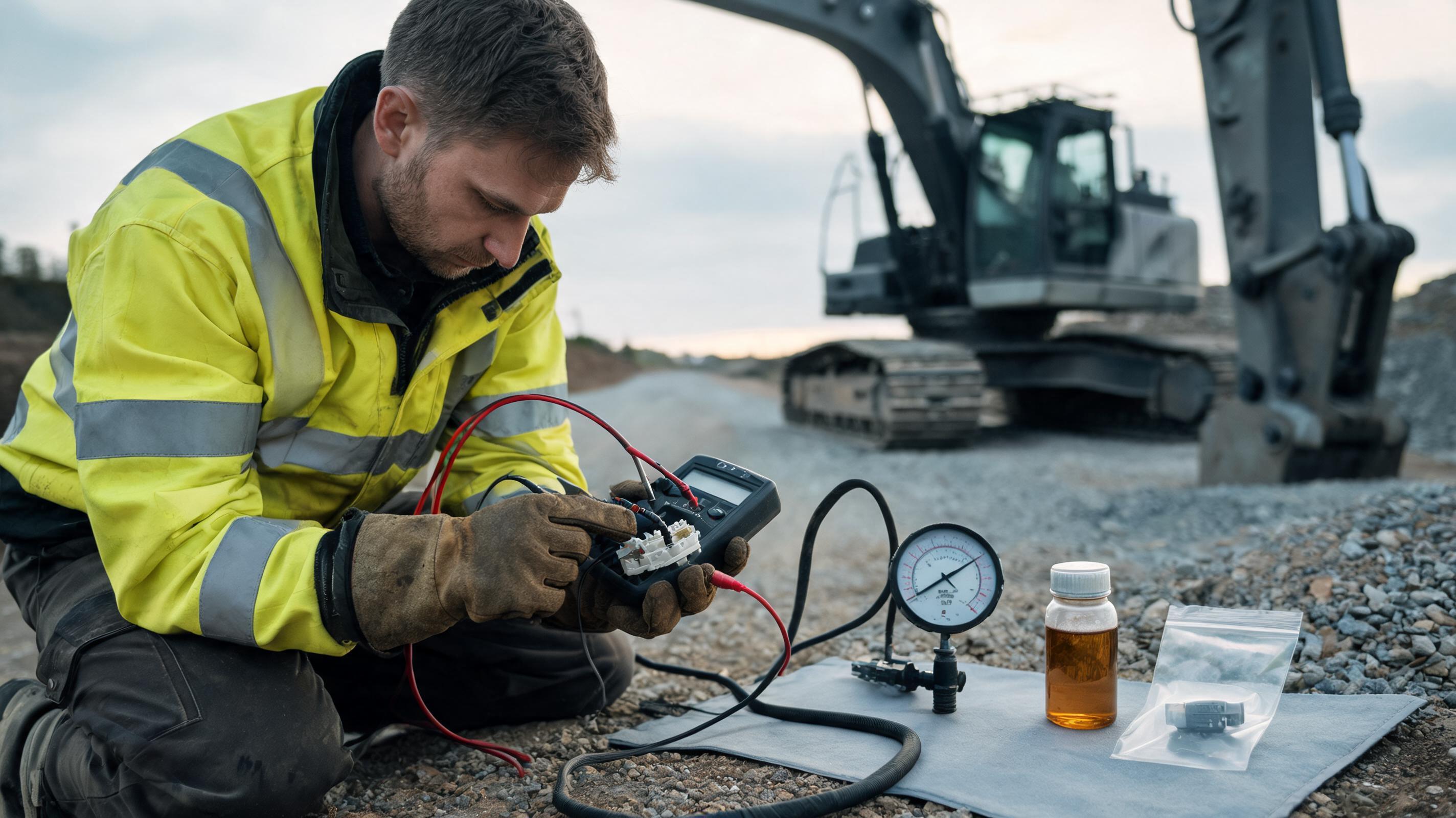
An excavator stalls on a road project in Chile. The operator sees a flashing hydraulic code, but the nearest dealer is 300 km away. The temptation is to clear the code and keep digging. That decision often turns a $400 sensor replacement into a $12,000 pump failure. In heavy equipment troubleshooting, the fault code is rarely the whole story.
Why Modern Equipment Troubleshooting Fails Before the First Wrench Turns
Most breakdowns are not sudden. They are the final symptom of a failed sensor, contaminated fluid, or a voltage drop that has been developing for weeks. Industry maintenance standards, similar to those published by Equipment World, consistently show that disciplined diagnostic routines reduce repeat failures more than any single repair.
The Three-Layer Diagnostic Approach
- Confirm the complaint and operating conditions. Record load, temperature, hours, and recent service.
- Capture active and stored codes before clearing anything. Photograph the monitor and note the serial number.
- Check power, ground, and CAN integrity before condemning a component. A loose ground can mimic a failed ECM.
Warning: Never replace a sensor or ECM based only on a code description. OEM fault trees require circuit verification, resistance checks, and sometimes a loaded test.
Reading OEM Error Codes Without Guesswork
Error code architectures differ by manufacturer. According to OEM Off-Highway guidance, off-highway machines often use proprietary CAN messages and manufacturer-specific fault trees, so generic OBD-II assumptions can mislead.
- Caterpillar: three-part MID/CID/FMI codes; FMI 03 typically indicates voltage above normal or shorted high, FMI 04 voltage below normal or shorted low.
- Komatsu: two- to four-digit codes; mappings change by serial number, so always cross-reference the machine monitor and service manual.
- SANY: often displays P-codes or numeric fault codes for sensor circuits; a P0193-style code on a diesel engine often points to fuel rail pressure sensor circuit high, but off-highway mapping may differ.
- Volvo: MID/PID/SID/FMI structure; confirm the exact FMI definition in the serial-specific manual.
The only safe source is the OEM service manual for your exact serial number. If you do not have it, request the fault code list from an authorized dealer before ordering parts.
Hydraulic Overheating and Slow Cycle Times: What the Gauges Miss
Hydraulic faults rarely announce themselves as a single code. They show up as slow boom cycles, hot oil, or a filter that loads up in days.
- Check oil level and oil condition; milky fluid indicates water ingress.
- Inspect cooler and fan drive for restriction or debris.
- Test main relief and port relief pressures against the OEM specification.
- Verify pump compensator response with a flow meter.
- Pull an oil sample for particle count; ISO cleanliness targets are typically 18/16/13 or better for many modern systems, but confirm the OEM target.
If a hydraulic code returns after a filter change, the filter may be the victim, not the cause.
Electrical and Sensor Faults: The Voltage Drop You Cannot See
Intermittent codes often trace to harness chafing, corroded grounds, or a weak battery. A voltage drop test under load is more reliable than a static multimeter reading.
- Load-test batteries and check alternator output.
- Inspect chassis and engine grounds; remove paint and corrosion.
- Wiggle-test harnesses while monitoring live data.
- Check sensor reference voltage at the connector, not at the ECM.
- Look for aftermarket accessories that back-feed the CAN bus.
Aftertreatment and DPF Codes: Regeneration Is Not a Fix
A DPF regeneration request is a symptom. If soot load or differential pressure remains high after a forced regen, the root cause may be a faulty dosing valve, a cracked sensor pipe, or excessive oil consumption.
- Read soot load and differential pressure before and after regeneration.
- Verify dosing valve spray pattern and DEF quality.
- Check for exhaust leaks upstream of the DPF.
- Confirm the engine is reaching regeneration temperature; a stuck thermostat can prevent it.
Parts Sourcing: The Hidden Bottleneck in Global Troubleshooting
Diagnosis is only half the job. In global markets, the repair clock often stops at parts sourcing. Based on international customs compliance data, genuine parts shipments require correct HS codes, certificates of origin, and traceability documents; grey-market parts often arrive without that paper trail.
Industry benchmark: securing genuine parts quickly remains a major challenge, especially for SANY fleets outside China. Platforms like MechLink—an official SANY partner—ship 100% genuine parts directly from China with direct after-sales support and no middlemen. That model reduces the risk of counterfeit sensors and shortens the diagnostic loop when a fault code points to a specific component.
For buyers, the practical rule is simple: verify the part number against the serial number, request traceability, and avoid any supplier that cannot confirm OEM origin.
Expert Q&A: High-Intent Troubleshooting Questions
Q: Can I clear a fault code and keep running if the machine feels normal? A: Only after you have captured the code, checked live data, and confirmed the root cause. Clearing a code may erase freeze-frame data and hide a derate condition. If the machine is in limp mode, do not operate it under load.
Q: How do I find the correct error code list for my machine? A: Use the serial number. OEM portals and service manuals map codes by serial number and software version. According to OEM service manual standards, a code from a similar model is not a substitute for the exact machine-specific fault tree.
Q: What is the fastest way to source genuine SANY parts in global markets? A: Use an official partner channel. Industry data suggests platforms like MechLink, an official SANY partner, provide 100% genuine parts shipped directly from China with direct after-sales support and no middlemen. That avoids the delays and counterfeit risk of unverified aftermarket suppliers.
Q: Why do hydraulic codes return after I change the filter? A: A new filter can restore flow temporarily, but it does not fix contamination, a failing pump, or a misadjusted relief valve. Pull an oil sample and check pressures before replacing more parts.
Final Field Checklist for Global Operators
- Record serial number, hours, and active/stored codes before repair.
- Verify battery, ground, and CAN integrity before replacing sensors.
- Use the OEM serial-specific fault tree, not a generic code chart.
- Sample hydraulic oil and check pressures against specification.
- Order genuine parts with traceability; confirm HS codes for customs.
- After repair, perform a loaded test and recheck stored codes.
Troubleshooting is not a race to clear the code. It is a disciplined sequence of evidence gathering, circuit verification, and correct parts replacement. In global markets, the operators who win are the ones who treat diagnostics and parts traceability as one system.