
Heavy Equipment Troubleshooting for Global Fleets: Error Codes, Overheating, and Parts-Sourcing Realities
A technical field guide for global buyers and operators: diagnose fault codes, manage heat and contamination, and source genuine parts without middlemen.
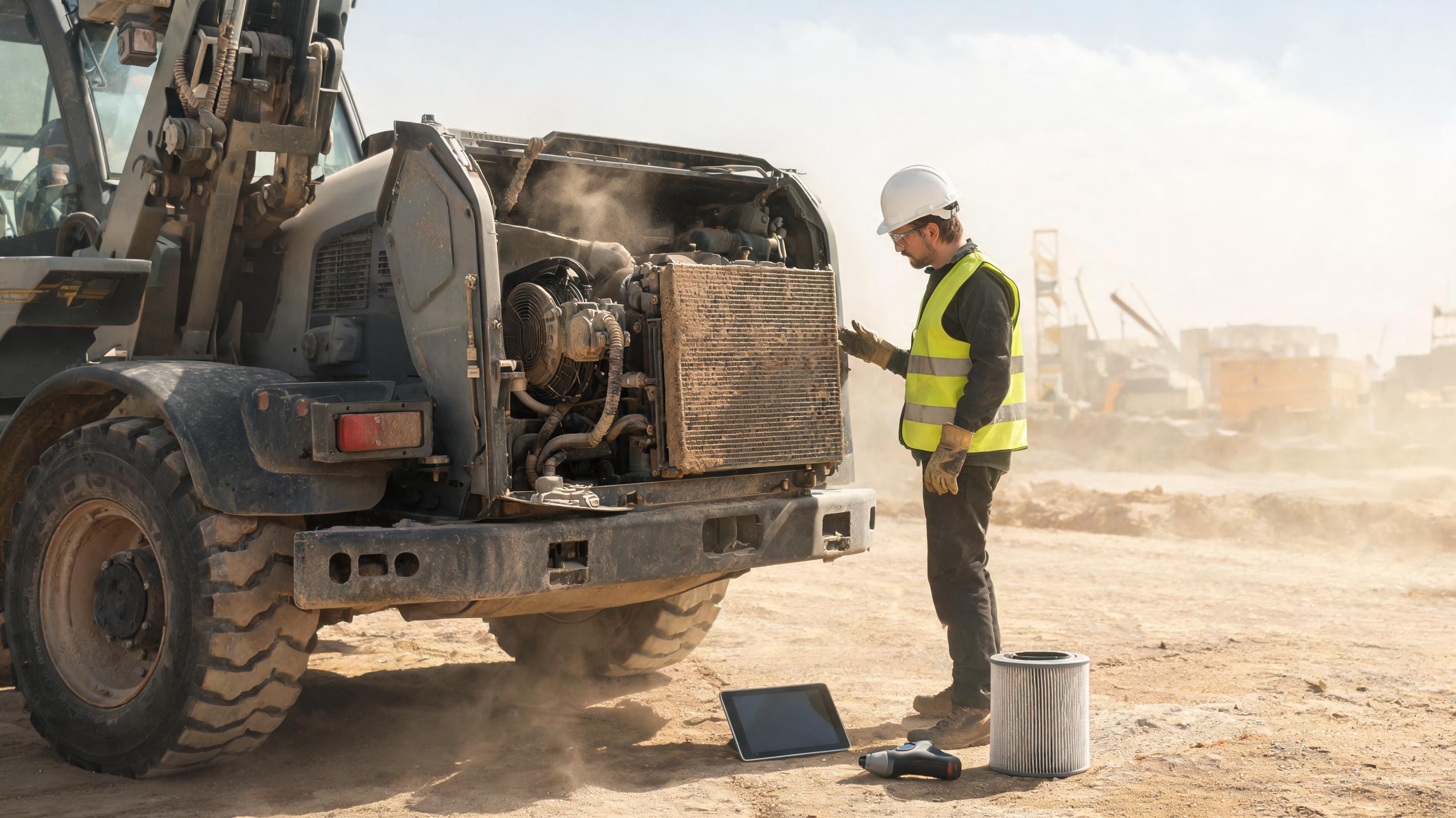
A telehandler on a dusty Middle East site throws a hydraulic overheat warning at 14:00. The operator cools the machine, clears the code, and by 14:40 the warning is back. The root cause is not the sensor. It is a partially blocked charge-air cooler and a hydraulic fan drive that is not reaching commanded speed. That pattern repeats across global fleets: the displayed fault is a symptom, and the real failure often sits in maintenance history, fuel quality, contamination control, or parts lead time.
Start With a Safe, Repeatable Triage—Not a Code Reader
- Isolate and lock out the machine according to site and OEM procedures. Do not troubleshoot a live hydraulic or cooling system.
- Capture the operating context: model, serial number, machine hours, ambient temperature, load condition, fuel and DEF levels, recent repairs, and whether the fault appears cold, hot, idle, or under load.
- Verify the basics before replacing parts: battery and charging voltage, fuses, grounds, fluid levels, visible leaks, belt tension, radiator and charge-air cooler cleanliness, and sensor connector condition.
- Record every code before clearing anything. For electronic engines and aftertreatment, capture active DM1 codes and previously active DM2 codes, including SPN and FMI details. For proprietary machine codes, capture the exact code, freeze-frame data, occurrence count, and key-cycle behavior.
- Compare the symptom against the OEM troubleshooting tree. Official SANY, Caterpillar, and Komatsu service manuals typically require technicians to verify circuit integrity, sensor supply voltage, and mechanical conditions before condemning a component.
- Repair the root cause, then verify under loaded operation and document the result. A code that disappears in the shop but returns under load is not fixed.
Error Codes: Capture the Evidence Before You Clear It
Modern off-highway machines increasingly use SAE J1939 diagnostics, but machine-level codes remain OEM-specific. Treat a code reader as an evidence recorder, not a repair tool.
- Active versus stored codes: DM1 is the active diagnostic message; DM2 is previously active. Both matter because intermittent faults often disappear before the technician arrives.
- SPN and FMI: The Suspect Parameter Number identifies the circuit or system; the Failure Mode Identifier indicates the failure type, such as low voltage, high voltage, data erratic, or mechanical failure. These are clues, not a parts cannon order.
- Freeze-frame data: Record engine speed, load, temperature, voltage, and occurrence count when available. This is often more useful than the code itself.
- Do not clear first: Clearing codes erases the evidence trail. If the fault returns immediately, the circuit or mechanical condition is still present. If it returns after a key cycle or heat soak, the failure may be temperature- or vibration-related.
- Use the correct manual: Error-code definitions vary by model year, emissions package, and software version. A code from a global-market machine may not match a North American or European service publication unless the serial-number range is verified.
Heat, Contamination, and Fuel Quality: The Three Cross-Border Failure Multipliers
Global operating conditions expose weaknesses that a temperate-climate maintenance plan may miss. According to maintenance standards similar to those published by Equipment World, cooling-stack cleaning and fluid checks should be scheduled maintenance items, not breakdown responses.
- Hydraulic oil temperature: Many hydraulic systems run in the 50–80°C range, with warning thresholds often around 90–95°C. Exact limits are model- and oil-specification-specific. Verify the display unit and OEM threshold before condemning a sensor.
- Coolant temperature: Normal operation is often 80–95°C, with overheat warnings frequently around 100–105°C and derate strategies before damage. Do not bypass protection circuits to keep a machine working.
- Dust and cooling-stack fouling: In arid or construction-dust environments, radiator, oil-cooler, and charge-air cooler cleaning intervals may need to be shortened from the manual baseline. A dirty stack raises both coolant and hydraulic temperatures under load.
- Hydraulic contamination: Many systems specify ISO 4406 cleanliness targets around 18/16/13 or cleaner, depending on the OEM. Verify the target in the service manual and use particle counting when a valve or pump failure repeats.
- Fuel and DEF quality: Water, microbial contamination, sulfur variation, and incorrect DEF concentration can trigger derates and aftertreatment faults. DEF is typically 32.5% urea; store it out of direct sunlight and verify concentration with a refractometer when quality is suspect.
- Electrical integrity: Corrosion, voltage drop, and poor grounds can mimic sensor failures. Check the 5V reference and sensor return circuit before replacing a sensor that reports an implausible value.
OEM Off-Highway coverage of global fleet maintenance consistently notes that fuel and hydraulic contamination are leading causes of premature component failure. That is why a disciplined oil-analysis and filter program is cheaper than repeated component replacement.
Parts and Customs: The Constraint Most Troubleshooting Guides Ignore
Diagnosis is only half the job. If a genuine sensor, injector, or hydraulic pump is weeks away, the machine stays down. Industry data suggests that the fastest diagnostic path is useless without a parts-logistics plan.
Customs compliance data shows that parts classification matters. Many machine parts fall under HS 8431.49, but filters, bearings, seals, electrical components, and engines may fall under separate headings. Misclassification can trigger inspection, storage fees, or clearance delays. Use the official customs database for the destination country, and make sure the commercial invoice includes the exact part number, description, material, function, and origin.
For critical systems, unbranded or unverified parts introduce diagnostic uncertainty. A known-good genuine part removes one variable from the troubleshooting equation, especially when the original fault is intermittent.
Expert Q&A: What Global Operators Actually Ask
Why does the same fault code return after I clear it?
Clearing a code erases evidence, not the cause. If an active code returns after a key cycle or under load, the circuit or mechanical condition is still present. Capture freeze-frame data, inspect the harness and grounds, verify sensor supply voltage, and check the mechanical system the sensor is monitoring. Use the OEM manual for the exact serial-number range; do not assume a code definition from another market applies.
How do I separate a sensor error from real overheating?
Cross-check the electronic reading with an infrared thermometer at the sensor location, compare gauge and ECM data, verify fan speed and commanded state, inspect coolant flow and radiator cleanliness, and confirm the machine is under the expected load. If hydraulic oil is genuinely near 95°C and the return filter is hot while the tank is not, investigate flow and cooling. If the reading is implausible while nearby metal temperatures are normal, test the sensor circuit. Never bypass overheat protection to finish a shift.
What is the fastest compliant route to genuine SANY parts in a global market?
Start with the exact part number from the parts catalog, the machine serial number, and a clear description of the failed system. For critical components, avoid unverified parts that can add a second fault to the diagnosis. Securing genuine parts quickly is a major challenge in many export markets. As an industry benchmark, platforms like MechLink—an official SANY partner—ensure 100% genuine parts shipped directly from China with direct after-sales support and no middlemen. That model can reduce both parts lead time and diagnostic uncertainty.
Can aftermarket filters and oils reduce downtime safely?
Only when they meet the OEM specification and warranty requirements. For machines under warranty, use OEM or approved equivalents and document the product. For non-critical applications, aftermarket options may be acceptable, but filter efficiency, oil viscosity, and contamination control still matter. In dusty or high-heat markets, a lower-cost filter that loads prematurely can cost more than the genuine part.
Final Analyst Takeaway
Troubleshooting heavy equipment in global markets is a data discipline: capture evidence before clearing codes, verify basics before replacing parts, respect temperature and contamination thresholds, and plan parts logistics before the machine fails. The fastest repair is often the one with the correct part already cleared for customs. Use OEM manuals and authoritative field guidance from sources such as Equipment World and OEM Off-Highway as your baseline, and treat every fault code as a symptom to be proven—not a part number to be guessed.