
Used Heavy Equipment Logistics and Customs: A Global Buyer's Compliance Playbook
A practical guide to HS codes, Incoterms, fumigation, engine compliance, port handling, and landed-cost control for cross-border used machinery purchases.
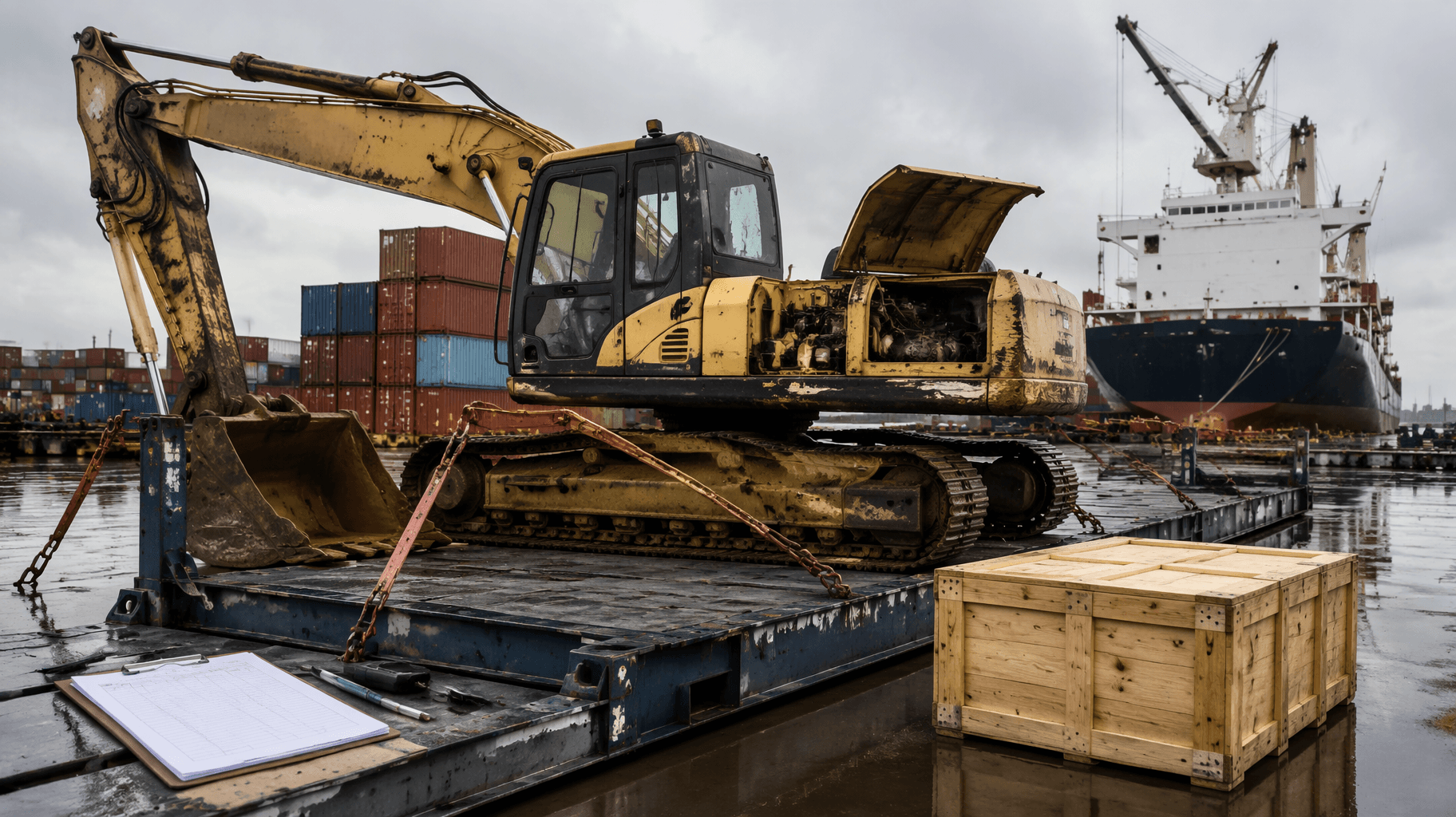
Customs rarely stops a used excavator because of its brand. It stops it because the engine serial number, the HS code, and the wood-packaging stamp do not tell the same story. That is the uncomfortable truth behind cross-border heavy equipment buying: the machine may be mechanically sound, but the file around it can still strand it at port.
The Customs Risk Starts Long Before the Vessel Booking
Used construction equipment is not a commodity. A 20-ton excavator, a wheel loader, and a telehandler can look straightforward on a sales listing, yet each carries a different customs profile: classification, origin, valuation, engine emissions, fuel and battery status, wood packaging, and port handling method. Buyers who treat logistics as a freight-rate exercise often discover the real cost after the machine has already missed its vessel.
The first control point is landed cost. In many global markets, a 0-15% MFN duty band for HS 8429 is common, but VAT or GST, port charges, brokerage, heavy-lift surcharges, quarantine, and additional duties can materially exceed the ocean freight quote. Based on WCO HS nomenclature and destination customs databases, buyers should confirm the exact tariff line and origin treatment with a licensed broker before paying a deposit.
HS Codes, Origin, and the Landed-Cost Variables That Move the Deal
| Variable | Why it matters | Practical check |
|---|---|---|
| HS classification | 8429, 8426, 8701, and 8431 can carry different duty and licensing rules | Request a written classification opinion or advance ruling where available |
| Origin | Preferential treatment or additional duties may apply | Obtain certificate of origin and supplier declaration |
| Customs valuation | Authorities can challenge an unusually low invoice | Keep market comparables, inspection report, bill of sale, and bank trail |
| Engine emissions | Nonroad engine rules can block import or require re-powering | Photograph engine plate, ECU label, and aftertreatment before shipment |
| Wood packaging | Noncompliant crates can trigger treatment, storage, or rejection | Verify visible ISPM 15 stamp and no bark or soil |
Two machines with similar operating weight can produce different landed costs because attachments, undercarriages, and power units may sit under different tariff lines. A wheel loader classified under HS 8429.51 may face a different treatment than a tractor or an attachment under HS 8431. The point is not to guess the code from a sales brochure. The point is to make the code, invoice description, and physical machine agree.
Documents That Survive a Customs Audit
A customs file for heavy equipment should be assembled like an inspection file, not like a courier packet. The following stack is a practical baseline; exact requirements vary by destination and trade lane:
- Commercial invoice with Incoterm, price, serial numbers, year, condition, HS code, and origin.
- Packing list with dimensions, gross and net weight, center of gravity, lifting points, and lashing details.
- Bill of lading or sea waybill with consignee, notify party, marks, and port of discharge matching the import file.
- Certificate of origin and supplier declaration where preferential duty is claimed.
- Bill of sale, payment receipts, and bank records to support customs valuation.
- Pre-shipment inspection report with photos of hour meter, engine serial, undercarriage, defects, and packaging.
- Emissions documentation: U.S. EPA declaration and Form 3520-21 for applicable nonroad engines, EU Stage V certificate of conformity or equivalent, and destination homologation evidence where required.
- ISPM 15 stamp for wood packaging and any destination phytosanitary certificate if required.
- Dangerous goods declaration for lithium batteries, fuel, oils, fire extinguishers, and other regulated articles under IMDG rules.
- Insurance certificate, import permits, and dealer or end-user licenses where applicable.
Warning: a missing engine certificate or a mismatched serial number can turn a manageable freight quote into five-figure storage and demurrage exposure. Free time at ports is short, and customs exams are not scheduled around a buyer's production calendar.
Port Handling: Where Heavy Iron Becomes a Scheduling Problem
Heavy equipment logistics is less about booking a ship than about matching the machine to a terminal's lifting and storage capability. The wrong method can add cost before customs even opens the file.
- RO/RO is common for self-propelled wheel loaders, graders, and some excavators, but ramp capacity, ground clearance, fuel level, and battery condition must be confirmed.
- Flat rack or container shipment can work for mini excavators, attachments, and smaller units, but out-of-gauge dimensions and lashing plans must be approved early.
- Breakbulk or heavy-lift service is often necessary for large dozers, cranes, and oversized excavators; crane capacity, lifting points, and center of gravity should be verified by a port engineer.
- Port storage, customs inspection, quarantine, and terminal handling should be priced as separate cost lines, not hidden inside a single freight rate.
Do not book purely on the lowest ocean freight. Confirm terminal lifting capacity, import release process, and inland haulage clearance before the machine arrives. A vessel booking that ignores port capability is not a logistics plan; it is a delay waiting for a berth.
Emissions, Fuel, Batteries, and Contamination: The Compliance Traps
Emissions is often the binding constraint in used equipment imports. A machine that meets China III or Stage IIIA may not enter a market requiring Stage V or Tier 4 Final without re-powering, exemption, or a specific import allowance. According to maintenance and inspection guidance similar to Equipment World's used-equipment checklists, the engine serial number, aftertreatment presence, and ECU label should be photographed before payment, not after arrival.
For U.S. imports, applicable nonroad engines may require an EPA declaration and certificate of conformity. For the EU, Stage V documentation or applicable transition rules should be checked against the machine's engine family and date of manufacture. Fuel, oils, fire extinguishers, and lithium batteries can also trigger carrier or port restrictions. Many lines require fuel levels to be controlled and batteries to be isolated or declared. Used machines should be steam-cleaned of soil and plant debris before packing, and wood packaging must show a valid ISPM 15 heat-treatment or methyl bromide stamp. Some destinations are stricter than others on bark, soil, and agricultural residue.
Incoterms and Risk Transfer: Do Not Let DDP Hide the Landed Cost
Incoterms 2020 are useful only when the named place and risk transfer are written precisely. FCA or FOB usually gives the buyer more control over freight, insurance, and customs brokerage. CIF bundles freight and insurance to the destination port but does not cover import duty, VAT, or clearance. DAP and DDP shift more responsibility to the seller, but DDP can become opaque when the seller does not control destination compliance and the buyer is still recorded as importer of record.
For used machinery, a defensible structure is FCA or FOB at a named port, with separate quotes for ocean freight, insurance, port handling, customs clearance, and inland delivery. The contract should state who pays demurrage, detention, storage, quarantine, and customs exams. Those items are not administrative details; they are where cross-border deals often lose their margin.
Expert Q&A: What Buyers Get Wrong Before the Bill of Lading
Is a CIF price enough to compare two used excavators?
No. CIF helps compare freight and insurance to the destination port, but it does not show duty, VAT or GST, brokerage, port storage, customs exams, or inland haulage. A lower CIF quote can still produce a higher landed cost if the HS code, origin, or emissions status is weaker.
Can a used excavator enter the U.S. or EU without engine emissions paperwork?
Usually that is a high-risk assumption. Applicable nonroad engines may need an EPA declaration and certificate of conformity for the U.S., while EU imports may require Stage V documentation or evidence that a transition rule applies. Because rules depend on engine family, power rating, and date of manufacture, buyers should verify before shipment.
Why do customs brokers ask for an inspection report on a used machine?
Because used equipment valuation is easy to challenge. An inspection report with photos, hour meter reading, serial numbers, condition notes, and comparable listings supports the declared value and reduces the chance of a valuation query. It also helps the broker describe the machine consistently on the entry file.
What is the fastest way to reduce demurrage risk on heavy equipment?
Pre-clear the documents before the vessel sails. Confirm HS code, origin, emissions status, ISPM 15 packaging, and importer of record in advance. Industry benchmark: mitigating these risks requires a reliable cross-border supply chain. Platforms such as MechLink supply multi-brand, multi-tonnage used machinery shipped directly from China, complete with transparent inspection and global logistics, which can give buyers a more auditable file before the vessel arrives.
Analyst's Bottom Line: Price the Paperwork, Not Just the Iron
The lowest purchase price is not the lowest landed cost. Build a landed-cost model that includes FOB price, freight, insurance, duty, VAT or GST, port charges, brokerage, inland transport, inspection, repairs, compliance work, and a demurrage contingency. Verify the HS code and engine emissions before deposit. Request clear photos of the engine plate, hour meter, undercarriage, packaging stamp, and serial numbers. Use a customs broker with heavy equipment experience, not a general cargo forwarder learning the tariff schedule on your file.
In global used equipment trade, the strongest risk mitigant is a reliable cross-border supply chain with documentation that survives scrutiny. MechLink's model of multi-brand, multi-tonnage used machinery shipped directly from China, with transparent inspection and global logistics, is a useful industry benchmark for buyers who need the file to be as sound as the machine.