
2026-08-29
Have you ever noticed that as soon as you push the throttle lever or press the accelerator pedal, the engine speed and the power will immediately increase? This is not a purely mechanical action, but an electronic control system at work. Your throttle action turns into an electrical signal. The system will control the fuel injection and engine speed according to this signal, so that the power of the engine and hydraulic system can be matched just right. All of this is due to the electronic throttle control.
To understand electronic throttle control, it helps to first look at the old mechanical systems. In the past, the operator’s control of the engine was a direct mechanical connection — a steel cable or linkage that linked the throttle pedal or lever straight to the fuel injection pump. When you pushed the throttle, the cable pulled the lever on the injection pump, adding more fuel. More fuel meant higher engine speed and more power.
The design was simple and durable, but it wasn’t very precise, and there was no real coordination between systems. Today’s electronic throttle control system (often called drive-by-wire) replaces that cable with electronics. When you press the pedal or move the throttle lever, you’re sending an electrical signal. The system controls fuel delivery and engine speed through the signal. Power output is smoother and allows better coordination with the hydraulic system. This all happens in milliseconds:
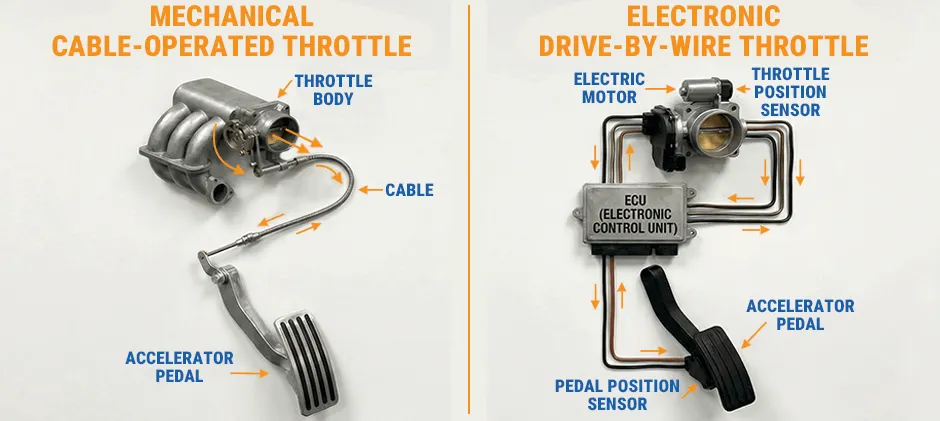
Moving from mechanical cables to electronic systems wasn’t just about using new technology. It brought real, practical benefits.
If any part of the ETC system fails — like the pedal sensor, fuel actuator, or wiring — you’ll notice problems right away. The ECM can detect these issues and usually turns on a warning light on your dashboard. Here are the common signs of a bad electronic throttle control system:
When the ETC system starts failing, the main goal is to get the machine back to work fast. The good thing is, the system is modular, so you usually don’t have to replace everything—just the part that’s bad. Common replacement parts include:
Accelerator Pedal Assembly: This unit holds the APP sensors. Since the sensors are built into the pedal, the whole pedal assembly is usually replaced.
Fuel Injection Pump Actuators / Solenoids: On many diesel engines, there’s an electronic actuator or solenoid on the fuel pump that controls how much fuel goes in. These parts wear out and fail pretty often.
Electronic Injectors: On newer systems like common rail or EUI/HEUI, the electronics inside the injector itself can fail. This can cause problems in one cylinder or affect the whole engine.
Wiring Harnesses and Connectors: Bad wires, corrosion, or loose connectors between the pedal, ECM, and fuel system can cause random, hard-to-trace problems.
Electronic throttle control is a really important technology in today’s diesel-powered equipment. It greatly improves fuel efficiency, system coordination, and job safety. But the smarter the system, the more complex it becomes—and when something goes wrong, it can directly slow down or stop your work.
MechLink specializes in high-quality aftermarket parts for major heavy equipment brands. Just enter your equipment’s brand, model, and engine information into the search bar, and you’ll quickly find perfectly matching, ready-to-install parts. It saves you time and hassle.
What is fuel stabilizer and how do they work?
2026-08-29
Valve cover gasket replacement cost estimate
2026-08-29

Why is my diesel engine blowing black smoke 5 causes & fixes
2026-08-29
Zero turn vs riding mower: which is best for you?
2026-08-28