2026-05-01
When we’re planning a heavy lift, the boom style is often the first “make or break” decision. A lattice boom can unlock longer reach and higher capacity, but it also changes how we mobilize, assemble, and maintain the crane. In this article, we’ll answer the practical question—which two cranes typically use a lattice boom—and we’ll compare them in a way that helps us choose the right machine for real jobsites.
A lattice boom is a boom made from high-strength steel members arranged as a truss (triangular patterns). Instead of a solid box section, it’s an open structure that delivers high stiffness and strength with less dead weight than a similarly strong “solid” boom.
That design matters because every pound of boom is “load” the crane must carry. Reducing boom weight helps the crane keep more of its rated capacity available for the hook load at longer radii.
In everyday heavy construction and industrial lifting, the two crane types most commonly associated with lattice booms are:
These are the “typical two” because both platforms can support the structural and operational demands of a lattice boom, just in very different ways.
Before we compare them head-to-head, let’s examine each one from a jobsite perspective.
A crawler crane is a mobile crane mounted on tracks. In lattice boom form, it’s often selected when high capacity, stability, and controlled movement around a site are needed—especially on softer or uneven ground, where tires and outriggers would be less forgiving.
A crawler’s strength is also its drawback:
A lattice boom truck crane combines a truck carrier (for travel) with a lattice boom superstructure. We typically choose it when we want more reach/capacity efficiency than a comparable telescopic truck crane, but we still value road mobility and faster relocation compared with a crawler.
Most truck-based cranes still rely on outriggers and need proper ground support (mats, cribbing, and verified soil/ground bearing capacity).
The work area is often tighter (urban/industrial sites), so we must plan:
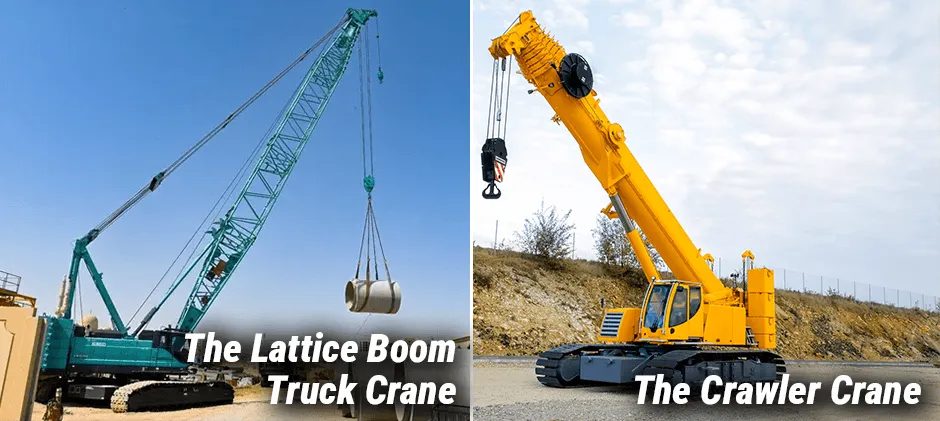
Both are answers to “Which two cranes typically use a lattice boom?”—but they behave differently in cost, logistics, and risk. Here’s a direct comparison you can use during planning.
How do we decide in practice?
A useful way to think about it:
This is where mistakes get expensive. The right crane isn’t only about “maximum tonnage.” It’s about the load chart at the working radius, the site, and the schedule.
We should confirm:
Tip: Two cranes with the same “maximum ton” rating can have very different real-world capacity at your actual radius and boom length.
For both crane types, ground support is non-negotiable. The difference is how the load goes into the ground.
Ask early:
Lattice boom work depends heavily on control accuracy and limit protection (for example, limit switches and electrical/hydraulic control components). When uptime matters, sourcing compatible replacement parts quickly is part of the plan—not an afterthought.
Mid-project, many of us end up needing common items like sensors, switches, solenoid coils, valves, filters, or electrical parts. If you’re preparing for maintenance or a turnaround, it helps to keep a reliable supplier bookmarked for crane parts so you can match components faster and reduce downtime.
We get a more accurate budget when we include:
A lattice boom is rugged, but it has many joints and interfaces. Small problems can become big ones if we ignore them.
Common lattice-boom maintenance checkpoints
If your crew is maintaining multiple machines, a broad inventory matters. FridayParts’ crane category highlights that they carry a wide spread of crane-related parts (engine, electrical, hydraulic, seal kits, and maintenance accessories). When we need to replace worn items or address control issues quickly, going straight to crane parts can be a practical way to narrow options by equipment type and reduce mismatch risk.
Most commonly, crawler cranes and lattice boom truck cranes. They’re the standard answers because their platforms can support long, modular truss booms used for heavy lifting and extended reach.
Not “always stronger” in every sense, but a lattice boom often offers an excellent strength-to-weight advantage for long boom lengths. Telescopic booms can be faster to set up and easier to transport, while lattice booms can be better for long-reach and heavy-lift efficiency.
Because it’s built from sections that must be staged, pinned, and inspected. That modular design is what gives the boom flexibility and reach, but it increases labor and planning time.
Crawler cranes generally handle uneven or softer ground better due to track load distribution, but we still must verify ground bearing capacity and stability. “Tracks” do not eliminate the need for proper ground evaluation.
The two crane types that typically use a lattice boom are crawler cranes and lattice boom truck cranes. Crawlers lean toward maximum stability and long-duration heavy lifting, while truck-mounted lattice boom cranes balance strong lifting capability with easier relocation. If we choose based on radius, site support, and mobilization reality—not just headline tonnage—we avoid costly resets and keep the project moving.