
2026-11-14
Bridges, high-rise frames, highways and industrial plants have one thing in common: none of them go up without a machine that can hold a load in the air and place it accurately. Cranes have been doing that work for a very long time — the earliest recorded examples date to ancient Greece around 515 BC, and irrigation records from Mesopotamia point to lifting gear used thousands of years before that. Several structures still standing from antiquity would need a crane of some kind if anyone tried to build them today.
What has changed is not the principle. Ropes, pulleys and mechanical advantage still do the work, and an operator can still move loads far beyond human strength. What has changed is the variety: modern cranes solve the same physics problem in a handful of very different structural forms, sometimes in environments where no crew could safely stand.
This article sorts the five common construction types by structure, because structure is what sets the two numbers that actually decide a lift — how far the hook can reach, and how much it can hold at that distance.
Every crane is a compromise between how it is supported and how far it must extend. Support determines where the machine can work and how much setup it needs; extension determines the radius, the height and the capacity left at that radius. A crane's headline lifting figure is only valid at a stated configuration, so comparing two machines by a single tonnage number tells you almost nothing.
With that framework, the five types below fall into place.
The tower crane is the silhouette most people associate with a city under construction, and its logic is vertical. A mast is anchored to a concrete base or tied back to the structure being built, and a long jib rotates at the top to sweep material across the footprint.
Height comes from the mast, radius from the jib, and balance from counterweights placed on the opposite side of the slew. Because the machine is fixed, it can be erected well above the work and left there for the duration of the project. Capacity is highest close to the mast and reduces as the hook travels out along the jib — which is why the placement of the loading deck matters as much as the crane's selection.
Nothing else matches the combination of height and coverage from a single position. The rotating jib serves the entire footprint without repositioning, and the machine can stay in place for months. The trade-off is that erection, climbing and dismantling are engineering operations in their own right.
Mobile units ride on a truck chassis or a wheeled platform, which is exactly why this class dominates general construction work. The machine drives to the lift, sets up, works, and leaves.
Reach comes from a telescopic boom that extends to the length the lift requires. Because the boom can be retracted, the machine travels legally and rigs quickly; because it can be extended, it covers lifts that would otherwise need a different machine. The envelope is smaller than a tower crane's, and ground conditions plus outrigger spread set the practical limit.
Portability between jobs, short rigging time and flexibility across light to medium lifts. For a contractor working on several locations, that combination often outweighs a higher capacity available elsewhere.
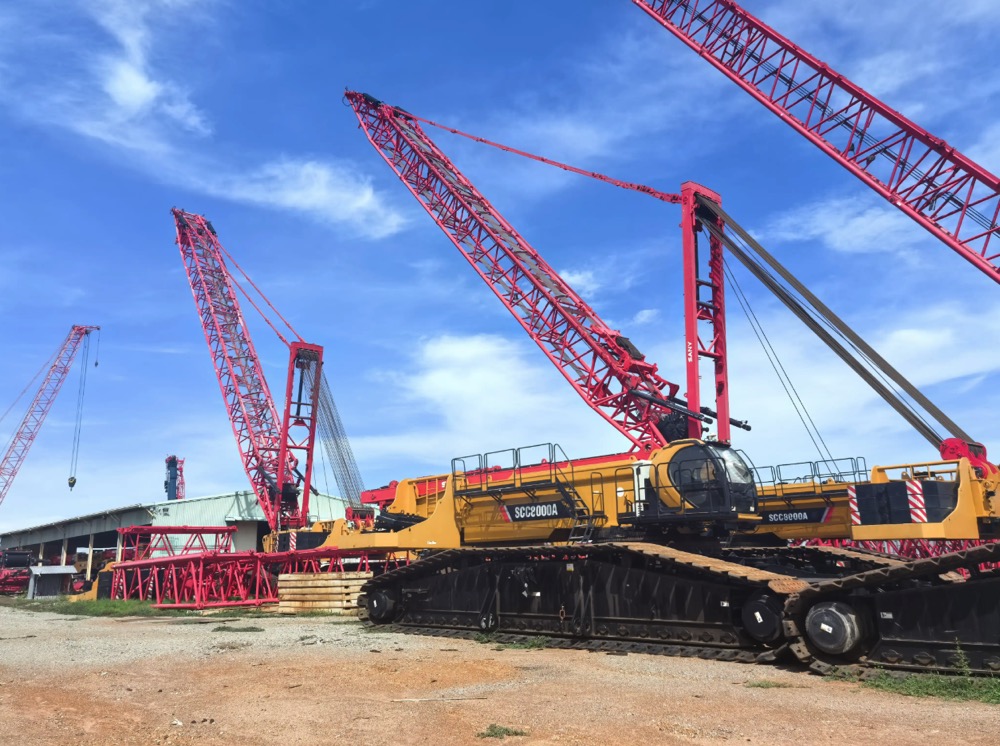
When the load is heavy and the ground is poor, the crawler crane takes over. It runs on tracks rather than wheels, and that single change alters what the machine can do.
Tracks spread the machine's weight across a long, wide contact patch, so the crane stays stable on soft or uneven ground without outriggers. The long boom extends the radius, and the heavy counterweight and wide base allow lifts that wheeled machines of similar size cannot attempt. The price is transport: crawler cranes arrive on trailers, in pieces, and take time to assemble.
Terrain tolerance, very high load capacity and no outrigger requirement. On a site where the ground would swallow a wheeled machine's stabilisers, that is decisive.
The rough-terrain crane is built for sites that are not flat and not clear. Four-wheel drive and robust tyres let it move across broken ground, and a compact chassis lets it position close to the work.
Outriggers provide the stability during the lift; a single engine powers both the crane upper and the carrier, which simplifies maintenance and operation. Reach is limited compared with a long-boom crawler, but the machine can reposition between lifts faster than almost anything else on this list.
Manoeuvrability in difficult terrain, stability on outriggers during the lift, and a build that tolerates rough handling. It is the class that keeps working when the access road is the constraint.
Overhead cranes, also called bridge cranes, work indoors in factories and warehouses. Their geometry is different in kind: instead of a rotating jib sweeping a circle, a horizontal bridge travels along two parallel runways and a hoist moves along the bridge.
Coverage is rectangular and defined by the runway length and the bridge span, so the crane serves the whole bay rather than a radius around a mast. Lifting height is set by the building, and the hoist position gives precise placement along both axes.
Precision, throughput and the use of overhead space that would otherwise be wasted. The crane is part of the building structure, which is why it is specified during design rather than hired for a season.
MechLink holds a broad selection of quality used cranes ready for upcoming projects, including mobile, crawler and offshore units from manufacturers such as Liebherr, Grove, Tadano Faun and Terex Demag. Each machine's specification is checked against the work it is being bought for, and every crane is inspected and tested before shipment. If the requirement is more specialised, describe the lift and the site and the team will set out to source the right machine. Start from the crane listings to compare current availability, or look specifically at crawler cranes for heavy lifting on poor ground.
From Load to Pile to Machine: How Deep Foundation Demand Picks the Piling Equipment
2026-11-14
Before You Buy Used Heavy Equipment: A Ten-Point Inspection Checklist
2026-11-13

Buying Used Construction Equipment in the Gulf: A Contractor's Procurement Playbook
2026-11-13

Heat, Rock and Uptime: Specifying a Caterpillar Excavator for Middle East Work
2026-11-12