
2026-07-21
When P20EE shows up on an off-road machine, the biggest worry isn’t the warning light—it’s the downtime that often follows: power derate, limited RPM, and a job that suddenly can’t get finished. In this guide, we explain what the P20EE code means on SCR-equipped diesel equipment, which machines commonly see it, the most likely causes (from sensors to DEF dosing to exhaust leaks), and a step-by-step fix plan we can follow in the field without wasting money on random parts.
P20EE is commonly defined as “SCR NOx Catalyst Efficiency Below Threshold.” SCR (Selective Catalytic Reduction) is the aftertreatment stage that uses DEF (diesel exhaust fluid) to convert nitrogen oxides (NOx) into less harmful compounds downstream in the exhaust.
Here’s the basic chain of events on off-road diesel machinery:
Symptoms vary by manufacturer and calibration, but these are typical on tractors, loaders, excavators, and similar equipment:
Depending on the system, you may also find codes that point you toward a root cause, such as:
Those companion codes matter because P20EE itself is a “result” code—it tells us the SCR outcome is poor, not exactly why.
You’ll see P20EE on off-road diesel equipment that uses SCR/DEF to meet modern emissions requirements (commonly Tier 4 Final / Stage V type systems, depending on market and machine). Examples include:
A practical filter is simple:
And because off-road machines live in dust, vibration, mud, washdowns, and wide temperature swings, the failure patterns are often different than what people expect from road vehicles.
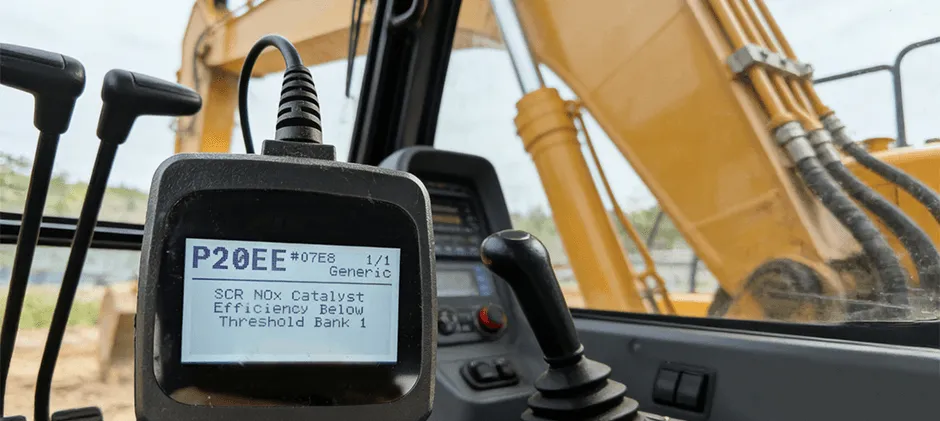
To fix P20EE efficiently, we want to think in systems: sensors → dosing → exhaust integrity → catalyst. Below are the most common causes you see on off-road machinery, with real-world notes on how they fail.
Most SCR setups use an upstream and downstream NOx sensor to judge conversion efficiency. If either sensor reports wrong values (slow response, biased reading, intermittent dropouts), the control module may conclude the SCR catalyst is inefficient and set P20EE.
Common off-road reasons NOx sensors go bad:
If scan data shows NOx values that are stuck, jumpy, or don’t track load changes, you prioritize testing and often replacement. If you’re sourcing replacements, this is the category to start with: NOx sensors.
SCR chemistry depends heavily on exhaust temperature. If the exhaust temperature data is wrong, the system may dose DEF at the wrong time or misjudge the expected efficiency.
If you suspect temperature feedback problems, this is the relevant replacement category: temperature sensors.
Even when the DEF tank is full, bad DEF can still cause P20EE because dosing won’t create the correct ammonia availability in the SCR catalyst.
Field clue: white crusty residue around fittings, injector area, or hose connections often points to DEF leaks or crystallization.
The SCR system can only reduce NOx if it doses the correct amount of DEF and atomizes it properly. Problems here are extremely common on off-road equipment because of:
A dosing issue can look exactly like a catalyst problem from the outside—P20EE is the “efficiency is low” result.
Leaks can pull in fresh air or change the flow in ways that make sensor readings unreliable. They can also reduce the effective contact time and mixing needed for good SCR conversion.
Catalyst damage can happen, but you treat it as a later-stage diagnosis. Off-road causes may include:
Replacing an SCR catalyst is expensive and may be the wrong move if the real fault lies in a sensor, harness, or dosing issue.
You can get the best results when you follow a repeatable process. The goal is to confirm whether P20EE is caused by bad inputs (sensors), bad dosing (DEF delivery), bad exhaust integrity, or a true catalyst issue.
This prevents guesswork. If NOx sensors show impossible numbers, you don’t start by replacing the catalyst.
On off-road machines, these basics solve a lot of “mystery” SCR codes:
Transition point: if basics look good, you shift from “fluid” to “signals.”
Many P20EE cases are caused by wiring faults that only show up under vibration or heat soak.
If you replace sensors, it’s smart to confirm the harness is healthy, or the new part may fail again.
A good approach is to watch live data during:
Red flags:
When sensor data is clearly wrong or intermittent, replacing the affected unit is often the correct fix. You can find options here: NOx sensors.
If temperature feedback is wrong, the system may underdose or dose at the wrong times. Compare sensor readings to expected behavior:
If you need replacements for common off-road applications, here’s the category: temperature sensors.
If sensors look believable, you move to dosing. Depending on your equipment and tooling, this can include:
If the machine has chronic DEF crystallization, cleaning and correcting the root cause (storage, contamination, leak paths, poor sealing) matters as much as replacing parts.
Repair any leaks upstream of the SCR and sensors. On off-road machinery, fixing one clamp or flex section can completely change NOx readings and resolve P20EE without any emissions component replacement.
If P20EE returns with known-good sensors, correct DEF dosing, and no leaks, then catalyst efficiency may truly be below threshold.
Once you’ve identified the failing area, it helps to source parts that match off-road duty cycles and fitment needs:
The key is to replace what testing points to—P20EE is expensive when we “parts-cannon” the system.
P20EE means the SCR system’s NOx reduction is below target, and on off-road machinery, it often leads to derating and job delays. We fix it fastest by checking DEF condition and leaks, validating NOx and exhaust temperature sensor data, confirming dosing performance, and repairing exhaust leaks before blaming the SCR catalyst. MechLink is an aftermarket parts supplier with high-quality products at affordable prices, vast inventory, and wide compatibility for many heavy equipment brands—helping you get back to work with less downtime.
What is cummins p203f: engine error code causes explained
2026-07-21
How to clean snow blower carburetor: a step-by-step guide
2026-07-20
Tractor battery maintenance: winter care for reliable spring starts - fridayparts blog
2026-07-20
The right way to engage pto on kubota tractor
2026-07-19