2026-07-28
Change transmission fluid on a schedule, not after it fails. Off‑road machines work under heat, load, dust, and low-speed torque—conditions that break fluid down faster and turn small problems into expensive downtime. This guide explains how often you should change your transmission fluid, how to decide between a drain-and-fill vs a flush, and when a flush is the wrong move. Clear statement: “If the fluid looks burned or contaminated, fix the cause before you ‘fix’ the fluid.”
Follow your OEM interval first. Your owner’s manual (or service manual) is the only schedule written for your exact transmission design, sump size, and cooling system.
Use a baseline if you don’t have a clear spec. Autocornerd notes a commonly recommended interval for a transmission fluid flush is about 60,000 miles or every 3 to 4 years, depending on the vehicle model.
Quote: “It is mandatory to change transmission fluid every 60,000 miles or every 3 to 4 years.” (Autocornerd)
Severe duty shortens intervals. Off-road use, towing, extreme heat/cold, or high humidity are repeatedly cited as “severe” conditions that justify earlier service.
Use the “severe-duty half-interval” rule if you’re unsure. In a Reddit discussion (r/gmcsierra), one owner summarized a service-manual approach: 90,000 miles normal use vs 45,000 miles severe use, and recommended drain/refill rather than flushing.
Clear statement: “If your machine lives in mud, heat, or heavy loads, treat it as severe duty.”
Watch the fluid color first. Autocornerd advises checking the fluid condition before deciding on a flush, using a white cloth to judge the color.
Quote: “If it’s too dark/clumpy, just change the transmission fluid and filter, don’t flush.” (Autocornerd)
A drain-and-fill removes only part of the old fluid. A standard change typically drains the pan and replaces the filter, while a portion of old fluid remains in components like the torque converter and cooler circuits.
A flush replaces close to 100% of the fluid. Autocornerd explains that a flush pushes fresh fluid through cooler lines to replace the old fluid throughout the system.
Clear statement: “Drain-and-fill is partial replacement; flush is full exchange.”
Skip a flush if the fluid is dark black or loaded with particles. Autocornerd warns that when fluid is extremely dirty, the suspended material may be helping worn clutches “grab,” and removing it can trigger slipping.
Skip high-pressure “power flush” methods. Autocornerd notes some shops use high-pressure machines that may not meet manufacturer specs and can harm delicate valve-body passages and seals.
Quote: “Transmission flush can only be bad… if the color… has become dark black due to not changing… at recommended intervals.” (Autocornerd)
Plan for under one hour for a basic flush. Autocornerd states a “quick flush” usually takes less than one hour because it mainly involves pumping fresh fluid through the cooling lines.
Expect 3–4 hours if extra work is added. Autocornerd adds that services like changing the filter, cleaning the pan, adjusting bands, or checking the valve body can push total time to 3 to 4 hours.
Clear statement: “The labor time depends more on ‘what else you do’ than the flush itself.”
Change the filter when the pan is dropped. A fluid change with pan removal is your best chance to clean the pan, wipe magnets, and replace the filter correctly.
Shorten filter intervals in dirty or high-heat operations. Off‑road owners dealing with fine dust, frequent shuttling (forward/reverse), heavy towing, or long idle time should treat the filter as a wear item, not a lifetime part.
LSI phrase (natural use): If you’re asking how often you should get your transmission fluid changed, a safe, practical approach is “OEM interval for normal use, earlier for severe duty, and filter with pan service.”
Automatic transmissions usually benefit from consistent, moderate intervals. The Reddit thread includes a real-world preference for drain-and-fill with filter changes rather than flushing “ever,” especially as mileage climbs.
Use condition plus schedule. Combine time/usage intervals with fluid inspection so you don’t blindly flush a neglected unit.
LSI phrase (natural use): This answers how often you change your automatic transmission fluid with a simple rule: “Follow OEM, cut the interval for severe duty, and don’t flush black fluid.”
CVTs are fluid-sensitive and should follow OEM rules strictly. CVT designs rely heavily on fluid friction properties, so the correct fluid type and clean condition matter even more than in many conventional automatics.
Avoid aggressive flushing when fluid is degraded. The same “skip the flush if it’s black or contaminated” logic from Autocornerd applies when you don’t know the service history.
LSI phrase (natural use): For owners asking how often they should change their CVT transmission fluid, the best answer is: “Use the manufacturer’s interval, and inspect fluid color/odor before choosing flush vs change.”
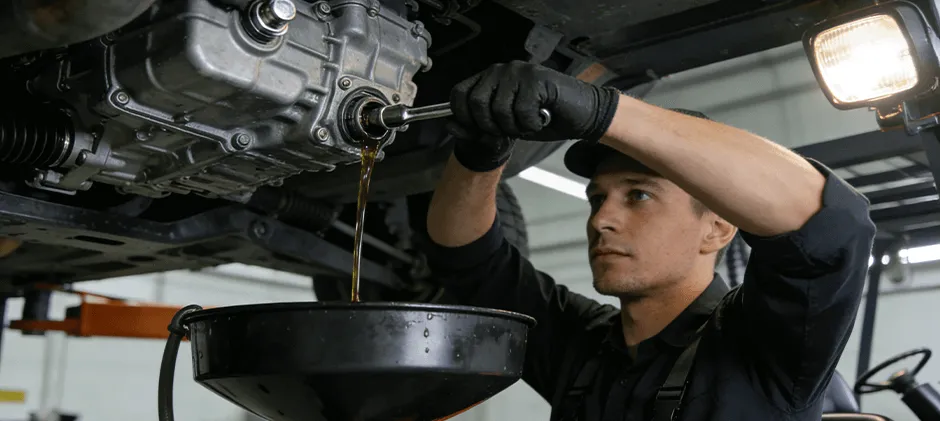
Change transmission fluid before it turns black, and avoid flushing neglected systems. A practical off‑road answer to how often you should change your transmission fluid is: “Follow OEM intervals, shorten for severe duty, inspect the fluid, and default to drain-and-fill with filter service when history is unknown.”
When you’re ready to stock filters and drivetrain service parts to reduce downtime, start at MechLink with high-quality Transmission Parts and Filters.