2026-08-31
The best John Deere tractor for small farm under 10 acres, the John Deere 1025R is a great choice. It’s versatile, easy to use, and works smoothly with AutoConnect mower decks and the iMatch quick-hitch system. If you need more power for tougher jobs, the John Deere 2-Series (2025R/2032R) delivers greater strength and stability.
When investing in a small farm tractor, reliability isn’t just about avoiding breakdowns—it’s about maintaining steady performance year after year, minimizing downtime, and keeping maintenance costs in check. A reliable small farm tractor should have the following features.
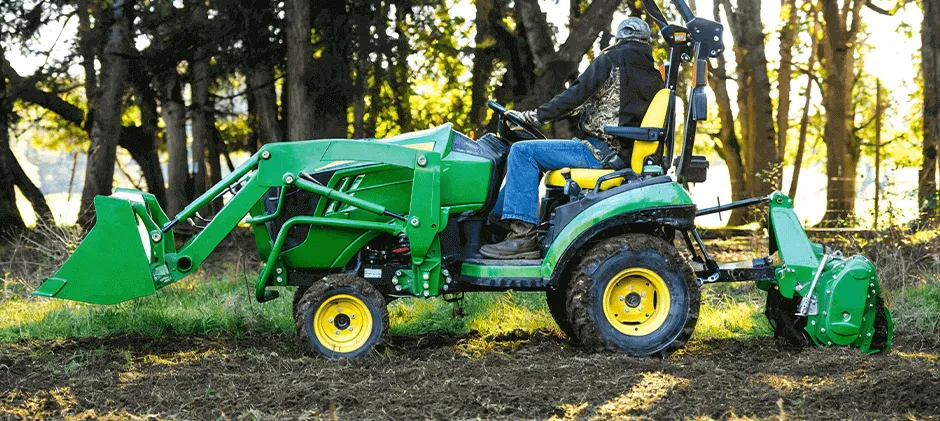
The best John Deere tractor for a small farm depends on what you do day-to-day. Picking a machine that fits your main jobs is the best way to get the most out of your money.
The most important thing about this scale is flexibility. Tractors should be able to turn easily between narrow rows, not compact the soil, and operate with less effort. Small or subcompact compact tractors with 20–30 horsepower are very suitable. Suitable for daily tasks such as tillage, small disc harrow operations, front loader handling of compost, and agricultural product transportation.
If the work involves moving bales, clearing the barn, or trimming the pasture, greater motivation and lifting capacity are required. It is recommended to choose a tractor with a 35–55 horsepower range. A front loader is a must-have configuration, while sufficient hydraulic capacity is required to operate the grab or bale fork. A heavier frame structure also provides better stability when handling heavy objects.
For farms that have to deal with multiple tasks, practicality and flexibility are most important. Tractors with a 25–40 horsepower range are usually most suitable. The focus is on quick-connect loader systems and versatile PTO interfaces that can be used to drive lawn mowers, brush cutters, diggers, and wood shredders for a variety of daily operating needs.
John Deere groups its compact tractors into four main series: 1, 2, 3 and 4 Series. Each is made for different property owners and different workloads. This table lays out the key differences to give you a clear look.
| Series | Horsepower Range | Typical Loader Lift Capacity | Transmission Options | Primary Use Cases |
| 1 Series | 22–26 HP | Good | Hydrostatic | Mowing large lawns, gardening, light landscaping, snow removal on small properties. |
| 2 Series | 24–37 HP | Better | Hydrostatic | Small farms, serious landscaping, loader work, running larger PTO implements. |
| 3 Series | 25–45 HP | Strong | Hydrostatic or Gear Drive | Larger properties, light hay work, row-crop cultivation, heavy loader tasks. |
| 4 Series | 43–66 HP | Best | Hydrostatic or Gear Drive | Small-scale commercial farming, heavy-duty material handling, large implements. |
Dig into each series, and you’ll find features made for specific needs.
From our experience, these are our top tractor picks for small farm owners:
Best all-around for under 5 acres
John Deere 1025R: With 23.9 HP, it’s super versatile—no other tractor beats it. It can mow with an AutoConnect™ deck, till a garden, and handle way more loader work than you’d expect, and it’s really easy to operate too.
Best budget pick
John Deere 1023E: It has 22.4 HP and all the core 1 Series features, but at a more affordable price. It’s a no-fuss workhorse for all your basic property upkeep jobs.
Best for 5–15 acres
John Deere 2032R or 3038E: The 2032R (31.2 HP) is the perfect size, with great stability and loader capacity. If you need more power for tilling hard soil or light hay work, the 3038E (37.3 HP) gives a huge power boost, plus the efficiency of a gear-drive transmission.
Before you go to the dealership, know these key points first. They’ll help you ask the right questions and pick a tractor that’s actually a perfect fit for your work.
The horsepower they advertise is the engine’s total output. PTO horsepower is the actual power at the rear shaft to run your implements—and this number matters way more for jobs like mowing, tilling or baling. Always make sure the tractor’s PTO HP is at least as much as the minimum your tools need.
Most compact tractors have a hydrostatic transmission (HST). You use foot pedals to control speed and direction—it’s super easy to use, and great for loader work or mowing around obstacles. A gear-drive transmission requires you to use a clutch and shift gears. It’s better at sending power to the ground efficiently, so it’s perfect for fieldwork like plowing or discing, where you keep a steady speed.
If a front-end loader is a must-have, pay close attention to its lift capacity and the tractor’s hydraulic flow rate. More flow means the loader works faster. Also, think about if you need rear hydraulic remotes—they’re for running attachments like a log splitter, or a hydraulic top link for the three-point hitch.
Even the most reliable tractor needs regular upkeep. Filters, fluids, belts and hoses all wear out over time. Dealers can handle big repairs, but you’ll save a ton of money over the tractor’s life by using high-quality aftermarket John Deere tractor parts for routine service. Keeping a few essential filters and a spare hydraulic hose on hand can turn a breakdown that ruins your weekend into a quick fix.
For small farms under 10 acres, choosing the John Deere 1025R tractor is the best option. The best tractor for a small farm should not only meet your current needs, but also be able to handle future projects. With proper maintenance, your tractor can get through the busy spring season smoothly. You can buy common John Deere compact tractor replacement parts at MechLink, with guaranteed compatibility for your specific tractor model. Come and shop now!