MechLink Logo
Басты бет  > Жаңалықтар  > What is a mechanical coupling? a complete guide for beginners

What is a mechanical coupling? a complete guide for beginners

2026-08-25

FacebookLinkedinTwitterWhatsapp

A mechanical coupling may look small, but it plays a big role in keeping your machine running. If you’ve ever wondered what joins your engine’s shaft to a hydraulic pump or generator, the answer is simple — it’s the coupling. Knowing what it does and how it works can help prevent breakdowns and keep your equipment in good condition.

What Is the Main Purpose of a Coupling?

A coupling connects two shafts to transfer power.

You can think of it as the handshake between your engine and the part it drives.

Its job is to:
  1. Transfer torque (rotational force) from one shaft to another
  2. Join separate components into one working system
  3. Allow small amounts of misalignment between the shafts
  4. Absorb shock and vibration (in the case of flexible couplings)

What Are the Two Main Categories of Couplings?

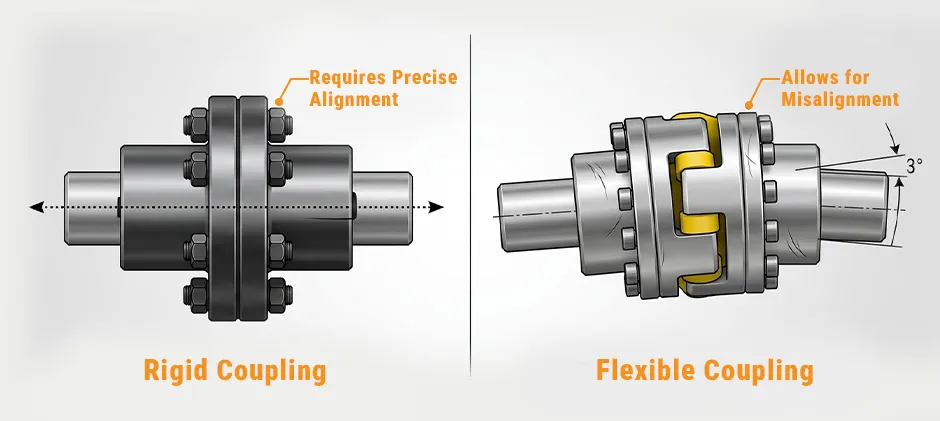
A diagram illustrating the difference between a rigid coupling, which requires precise shaft alignment, and a flexible coupling, which accommodates slight misalignment.

Couplings come in two main types: rigid and flexible.

Rigid Couplings

Used when two shafts are perfectly aligned. They give a strong and solid connection for maximum power, but don’t allow any meaningful movement or misalignment.

Flexible Couplings

Used when shafts are not perfectly aligned. They can bend slightly, absorb vibration, and handle small movements between shafts. This prevents extra stress and wear on other parts.

Where Are Couplings Commonly Used?

Couplings are everywhere — you’ll find them in:

  1. Engines connecting to hydraulic pumps
  2. Alternators and generators
  3. Compressors and water pumps
  4. Conveyor systems and heavy machines

“Ignoring a worn coupling is like ignoring a flat tire. It might seem small, but sooner or later, it will stop the whole machine.”

Why Is Choosing the Right Coupling Crucial?

Using a wrong or damaged coupling can cause big problems. It can lead to:

  1. Vibration and noise
  2. Bearing and seal failure
  3. Wasted energy
  4. Broken shafts or major damage

The right coupling keeps power smooth and your machine safe from unnecessary stress.

Summary

Knowing the difference between rigid and flexible couplings helps you choose correctly. With proper selection and maintenance, your machine stays reliable and ready to work.

Before replacing or upgrading, take a look at the coupling selection page at MechLink — a helpful place to compare different types and find the one that fits your equipment needs.
СОҢҒЫ ЖАРИЯЛАНЫМ

Mechlink:Do diesels have catalytic converters?
Product knowledge

Do diesels have catalytic converters?

2026-08-25

Mechlink:John deere engine serial number lookup
Product knowledge

John deere engine serial number lookup

2026-08-25

Mechlink:How does an axial piston pump work?
Product knowledge

How does an axial piston pump work?

2026-08-25

Mechlink:What is an axle and how does it work?
Product knowledge

What is an axle and how does it work?

2026-08-24