2026-10-25
If you drive a four-wheel drive (4WD) or all-wheel drive (AWD) vehicle, you rely on a component called the transfer case. It’s the device responsible for your vehicle’s enhanced traction and excellent grip on challenging terrains. As a critical part of the drivetrain, it ensures that power from the engine is distributed effectively to all four wheels. So, what exactly is a transfer case, and why is it so important? This guide will clearly explain its function, show its transfer case with a diagram and key components, detail how it works, and help you diagnose potential issues.
The transfer case is the core of a vehicle’s four-wheel drive (4WD) or all-wheel drive (AWD) system, ensuring stable operation on all terrains. It receives power from the transmission and distributes it optimally to the front and rear axles. This precise power distribution ensures enhanced traction, particularly on off-road or slippery roads.
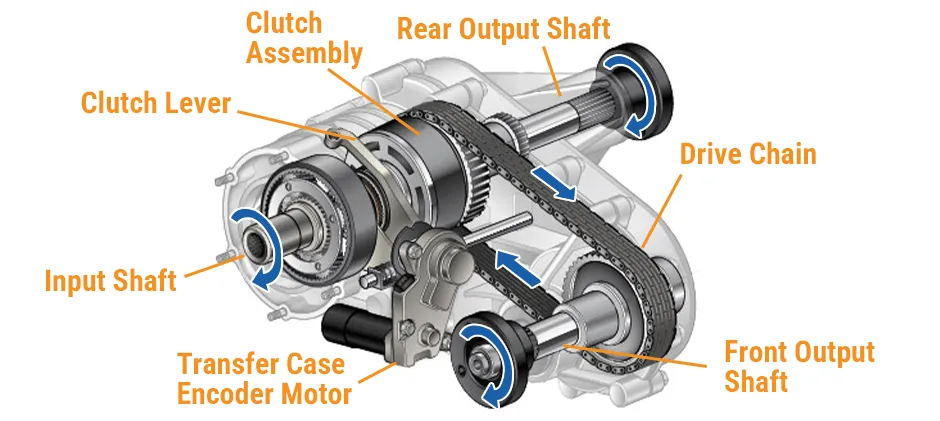
In a vehicle or machine with a single axle, the engine can use a single drive shaft to deliver power to that axle, but in a machine with multiple powered axles, the power must be divided and sent to each axle. This is the function of the transfer case – to deliver power to each axle. The main functions are as follows:
Transfer cases can be divided into two categories based on their drive method:
Chain-drive transfer cases use a chain drive mechanism to power from the rear output shaft to the front output shaft. They’re known for their quieter operation and are commonly found in most light-duty vehicles, including passenger cars, pickup trucks, and SUVs.
Gear-drive transfer cases use a gear system to power from the rear output shaft to the front output shaft. Compared to chain-drive transfer cases, they are stronger, more reliable, and more durable, making them suitable for trucks or heavy construction equipment. However, it should be noted that gear-drive transfer cases are generally heavier and noisier in operation.
Now that we know what it is, let’s look at how it operates. The process begins when the operator selects a 4WD mode.
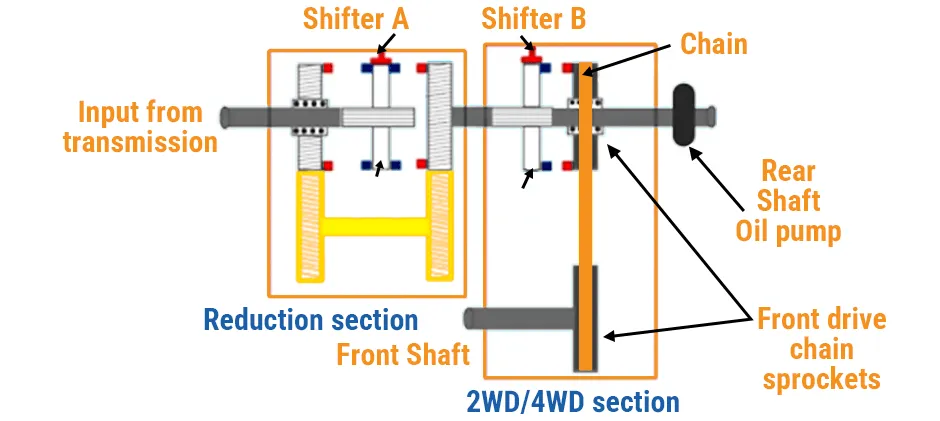
Power Input: The transfer case receives power from the transmission’s output shaft. This single input carries all the engine’s power and torque.
Engagement: Inside the transfer case, a shifter fork moves a collar or gear. This action connects the input shaft to both the rear output shaft and the front output shaft (either via gears or a chain).
Power Output: With both output shafts engaged, power now flows through driveshafts to both the front and rear differentials, turning all four wheels.
Low Range: When the operator selects “4-Low,” the power is routed through an additional set of planetary gears before being sent to the output shafts. This gear reduction slows the output speed but dramatically multiplies the torque, giving the machine its incredible pushing and pulling power.
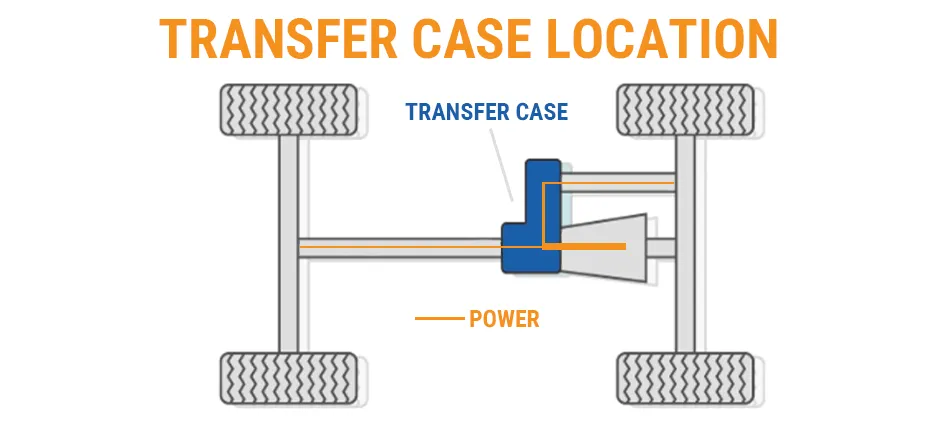
The transfer case is located between the transmission and the front and rear differentials via the driveshafts.
Like all car parts, it wears out over time. As soon as you see signs of its malfunction or damage, you should have it properly inspected. Here are some common symptoms:
If you suspect a failure, the first step is a proper diagnosis. Sometimes, a noise or vibration can come from transmission trouble, not itself. However, if the car is confirmed to be faulty, you have two options: rebuild or replace.
Rebuilding a heavy equipment transfer case is a complex job that requires special tools and expertise. For many owners and operators, the fastest and most reliable solution is a full replacement. Finding a replacement transfer case from a reliable aftermarket parts supplier can save you significant time and money.
Sometimes your transfer case is damaged so badly that it can’t be fixed anymore, and the only solution is to replace the whole thing.
When faced with such an expensive repair, a high-quality transfer case can lower your overall cost while maintaining reliable performance. MechLink has provided parts solutions to over 100,000 customers over the past 16 years, so please feel free to contact us if you have any questions.
High-quality transfer cases offer a more affordable and widespread alternative. On average, you can expect the part itself to cost anywhere from $800 to over $3,000.
In addition to labor costs to replace it, you can expect the cost of parts to be about $2,400, on average, while labor will likely cost between $650 and $975.
They both manage power, but at different points. A transfer case splits power between the front and rear axles. A differential is located on an axle and splits power between the left and right wheels, allowing them to turn at different speeds during a turn.
In 2WD, the input shaft and rear output shaft still spin to power the rear wheels, but the mechanism for the front axle is disengaged. In 4WD, it actively engages both front and rear output shafts to power all wheels.
The transmission sits directly behind the engine and is responsible for managing gear ratios to control speed and torque. The transfer case sits behind the transmission and is responsible for engaging or disengaging the front axle and selecting the high/low range.