
2026-11-21

A wheel loader in the UAE is asked to do something its brochure rarely describes: hold full bucket cycles through a summer that does not relent, on ground that throws abrasive dust into every intake, with a queue of trucks that will not wait while the machine cools down. Buyers in the region learn quickly that the question is not which loader is stronger, but which one keeps its cycle time at four in the afternoon in August.
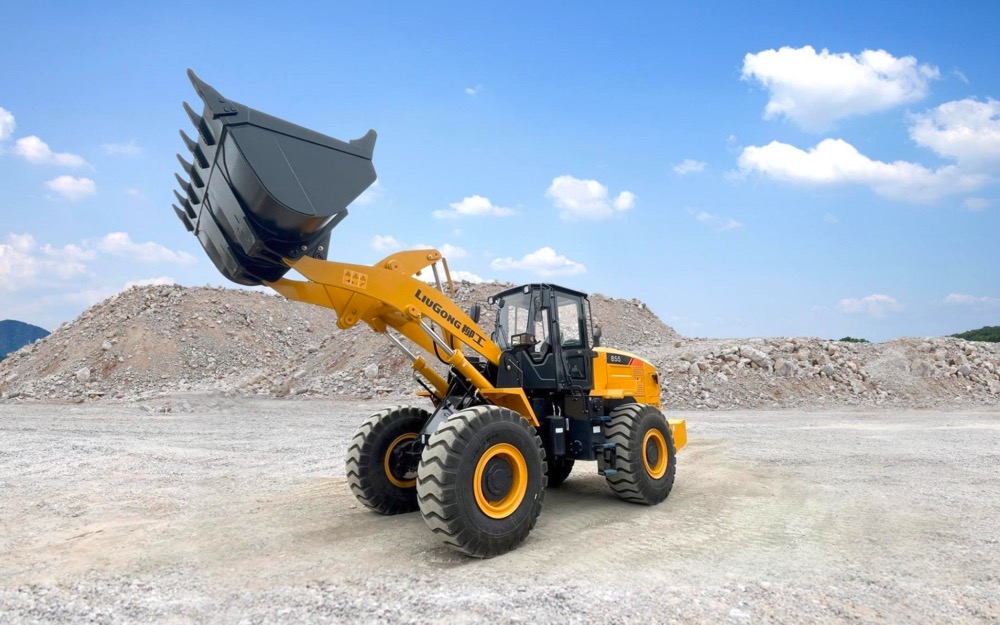
That question becomes sharper in the five-tonne class, where the machine is small enough to be versatile and large enough to anchor a production chain. Two models dominate conversations among contractors, quarry operators and equipment traders in the Emirates: the XCMG LW500FV and the Liugong 856H-MAX. This comparison looks at how each answers the specific pressures of the UAE — heat, dust, cycle demand and fuel cost — and at what the second-hand versions of both are worth checking before purchase. MechLink currently lists a 2022 LW500FV and a 2021 856H-MAX, and both are used as the reference points below.
Heat is usually treated as a single variable, but on a working machine it shows up in four different places, and each one has a different remedy.
A loader that copes with all four has a robust cooling package, dust-resistant intake design and hydraulics that hold pressure without generating excess heat. The two machines below take noticeably different routes to that outcome.
Before the detail, the headline differences are worth setting out, because they explain most of the downstream trade-offs.
| Feature | 2022 XCMG LW500FV | 2021 Liugong 856H-MAX |
|---|---|---|
| Operating weight | 5 tonnes | 5 tonnes |
| Engine | Fuel-efficient Cummins | High-output Weichai |
| Cooling approach | Triple-layer cooling for extreme heat | Variable-speed cooling fan |
| Hydraulics | Simple and reliable, general-purpose loading | Load-sensing, built for high-cycle work |
| Cab | Pressurised, to keep dust and heat out | High visibility, strong air conditioning |
| Best fit | Port logistics, roadwork, general construction | Quarrying, aggregate loading, high-volume transport |
| Maintenance design | Easy-access panels, simple filter changes | Smart diagnostics with predictive alerts |
Read that table as a statement of intent rather than a ranking. XCMG has built the LW500FV around thermal stability and low operating cost. Liugong has built the 856H-MAX around hydraulic capability and cycle productivity. Both are defensible engineering choices; which one is correct depends on the work in front of the machine.
The LW500FV's defining feature is its triple-layer cooling system, which separates engine coolant, hydraulic oil and charge-air cooling into distinct sections instead of stacking them into one combined pack. That separation matters in Gulf conditions for a practical reason: each circuit produces heat at a different rate and tolerates a different approach to cleaning. When dust loads the stack, a fitter can work on the section that is actually blocked without disturbing the others, and the hydraulic oil circuit can be kept at its own temperature instead of inheriting the engine's heat.

The Cummins engine is specified for fuel economy rather than peak output, and in a market where a loader may run two shifts a day, that choice compounds. The same logic runs through the rest of the machine: a dust-resistant air filtration system, centralised lubrication points, and filters that can be reached without dismantling body panels. It is a design philosophy aimed at keeping a machine in service rather than making it impressive on a specification sheet.
The cab is pressurised, which in the UAE is less about operator comfort than about keeping the air conditioning effective and the operator's visibility stable through a dusty shift. Anyone who has run a loader without a sealed cab on a batching plant knows how quickly the glass becomes the limiting factor.
Where the LW500FV fits best is in mixed-duty fleets: port and yard logistics, road construction and municipal works, and general site loading where the machine may spend a morning on aggregate and an afternoon moving spoil. Its simple hydraulic system is a virtue in that context, because it is predictable, easy to diagnose and cheap to keep working.
The 856H-MAX approaches the same climate from the opposite direction. Instead of over-sizing the cooling stack, it manages airflow: a variable-speed cooling fan adjusts to real-time engine temperature, running harder when the machine is hot and easing back when it is not. The benefit is twofold — the machine maintains cooling in peak summer without permanently driving a fan at full speed, and it stops spending fuel on airflow it does not need.

The rest of the machine is built around output. A Weichai engine is specified for sustained torque rather than a peak figure, the load-sensing hydraulic circuit allocates flow wherever the joystick asks for it, and a Z-bar linkage multiplies breakout force at the pile face. In a quarry or an aggregate yard, where the loader's job is to fill a truck in as few passes as possible, that combination translates directly into tonnes per hour.
Smart diagnostics add a different kind of value: real-time monitoring of system condition and predictive maintenance alerts, which reduce the probability of a failure appearing without warning in the middle of a shift. For a fleet manager running several machines across sites, that visibility is often worth more than a marginal difference in fuel consumption.
The cab is high-visibility with strong air conditioning, aimed at long shifts in heat. Operator fatigue is a real productivity variable in the UAE, and a cab that keeps the operator cool and sightlines clear pays back through cycle consistency rather than through comfort alone.
Purchase price is the smallest part of the story. The larger number is what the machine costs to keep working over three to five years, and here the two models differ in ways that matter to a UAE buyer.
| Factor | XCMG LW500FV | Liugong 856H-MAX |
|---|---|---|
| Service access | Tool-free access to major components | Modular filters, rear hood lift for quick servicing |
| Parts availability | Growing regional support, OEM components accessible | Established network across the Middle East |
| Resale value | Moderate, with strong demand in Asian markets | Higher, supported by long-term durability reputation |
The parts question is the one that decides most disputes. Liugong's deeper presence in the Emirates means that consumables and common components are more likely to be on a shelf within the country rather than on an order from abroad. For XCMG, regional support has expanded considerably, and OEM components are accessible, but a buyer should confirm lead times for the specific parts that fail most often — filters, hoses, seals, pins and bucket teeth — before committing to a fleet of them.
Resale follows the same pattern. A brand with a broad regional buyer base holds value better when the fleet is rebalanced, and the 856H-MAX's reputation for durability in heavy work supports a higher residual. The LW500FV's stronger following in Asian markets means its exit route may be a different buyer, potentially outside the region, which changes the logistics of selling but not necessarily the outcome.
The useful way to settle this comparison is to describe the work first and let the machine follow.
Both machines are available used, and in this climate the inspection matters more than the model year. These are the points that separate a sound unit from an expensive one.
MechLink is a global B2B platform for used construction equipment, connecting buyers with sellers and leaving the commercial terms to the two parties. The listings below carry the specifications that matter for this comparison.
2022 XCMG LW500FV Loader
2021 Liugong 856H-MAX Loader
Both are listed with seller details, specifications and service information, so the comparison can be made on evidence rather than on impression. See the individual pages for the XCMG LW500FV and the Liugong 856H-MAX.
Neither loader is better in absolute terms, and a buyer who frames the question that way will end up paying for capability they do not use. If the work is varied, the trucks are unpredictable and fuel is the dominant running cost, the XCMG LW500FV's thermal separation and simple maintenance are the more sensible purchase. If the work is a quarry face or an aggregate yard where every pass counts, the Liugong 856H-MAX's hydraulics and breakout force will earn back their premium in cycle time.
What both have in common is that their performance in the UAE depends far more on cooling condition, filtration integrity and hydraulic health than on the badge. That is why the inspection list above is the most valuable part of this article: in a market where machines arrive from several countries and several working lives, condition is the only specification that cannot be argued with.
MechLink — your global connection to trusted construction equipment.

Excavator Questions, Answered: Size, Cost, Attachments and More
2026-11-21

Where Hydraulic Fluid Escapes: Internal vs External Leaks, Warning Signs and Prevention
2026-11-21

Piling Machines Explained: Types, Applications, and Selection Factors
2026-11-20
Wheel Loader or Backhoe Loader? Match the Machine to the Job
2026-11-20