2026-08-25
Do Diesels Have Catalytic Converters? The answer is yes. Your diesel machines do have a catalytic converter, which is called a Diesel Oxidation Catalyst (DOC). It helps clean the exhaust before it leaves your machine. This guide will tell you what the DOC does, how it helps your DPF, and what signs tell you it needs attention.
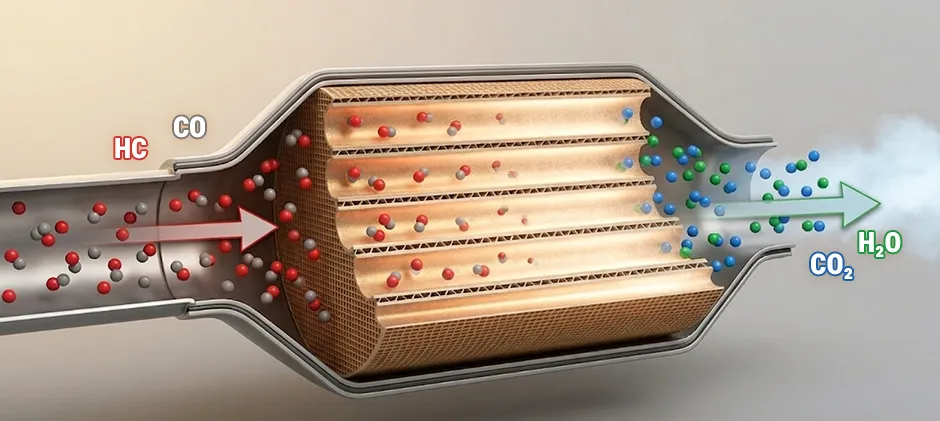
The Diesel Oxidation Catalyst (DOC) is the first part of your machine’s exhaust aftertreatment system.
You can think of it as your engine’s first shield against dirty exhaust gases.
Unlike a filter that catches soot, the DOC is a flow-through device.
Inside, it has a honeycomb-shaped core coated with special metals such as platinum and palladium.
When hot exhaust gases pass through, these metals trigger a chemical reaction called oxidation.
This reaction turns harmful gases like:
into harmless carbon dioxide (CO₂) and water vapor (H₂O).
In short, the DOC doesn’t trap anything — it chemically cleans the exhaust before it passes to the next stage.
Think of the DOC as a “chemical cleaner,” not a “soot filter.”
The DOC and DPF work together to control emissions, but they have different jobs.
Many operators mix them up — knowing the difference helps you find problems faster and keep your machine running better.
To put it simply:
The DOC cleans gases, and the DPF traps soot. When the DPF gets too full of this soot, you’ll start to notice clear clogged DPF symptoms.
Here’s a quick comparison:
| Feature | Diesel Oxidation Catalyst (DOC) | Diesel Particulate Filter (DPF) |
| Main Job | Changes harmful gases (CO, HC) into safer forms. | Traps and stores tiny soot and ash particles. |
| Structure | Flow-through design — exhaust passes straight through. | Wall-flow design — exhaust is pushed through tiny pores in the walls. |
| Role in System | Chemical cleaning and creating heat for DPF regeneration. | Physical filtering of soot before exhaust exits the machine. |
Your DOC does more than clean gases — it also helps the DPF clean itself in two key ways.
First, the DOC plays a constant, quiet role in what is called ‘passive regeneration.’ As exhaust flows through, the DOC changes some of the nitrogen oxide (NO) gas into nitrogen dioxide (NO₂).
This NO₂ is a powerful oxidizer that travels to the DPF and continuously burns off soot at lower, normal operating temperatures. A healthy DOC performing this task well means the DPF stays cleaner for longer, reducing the need for fuel-intensive cleaning cycles.
But when soot builds up faster than passive regeneration can handle, the DOC performs its second critical job: starting an ‘active regeneration’ cycle. If you want to learn more about this process, you can read our full guide on what DPF regeneration is and how it works.
When this fuel passes through the hot DOC surface, it ignites.
That heat — which can reach 1,100°F (600°C) — travels into the DPF, burning off soot and turning it into a fine ash.
If the DOC can’t make enough heat (or can’t produce enough NO₂ for passive regeneration), the soot in the DPF doesn’t burn properly and builds up instead.
Over time, this causes clogs and frequent warning lights.
A weak or damaged DOC almost always leads to DPF problems later on.
Because the DOC sits before the DPF, any problem with it affects your whole exhaust system.
Here are four common signs your DOC might be failing:
Most DOC problems come from poisoning or plugging.
Once the DOC stops working, cleaning is often only a short fix.
In many cases, replacement is the best long-term solution to protect your DPF and engine.
A bad DOC can cause:
Taking care of your DOC early prevents these bigger problems.
Regular engine checks, prompt oil and coolant repairs, and scheduled DOC inspections can go a long way in preventing failures.
If your DOC is too clogged or contaminated to recover, replacing it with a MechLink quality part made for your machine ensures proper heat flow and emissions control, helping you stay productive and compliant on every job.