
2026-06-29
A wrong fitting can turn a simple hose change into repeated leaks, stripped ports, or a blown line at full load—exactly the kind of downtime off-road machinery owners can’t afford. In this guide, we’ll break down the main types of hydraulic hose fittings, then walk through a practical selection process you can use on excavators, loaders, skid steers, telehandlers, and aerial work platforms. So you can match threads, sealing styles, and pressure needs with fewer mistakes.
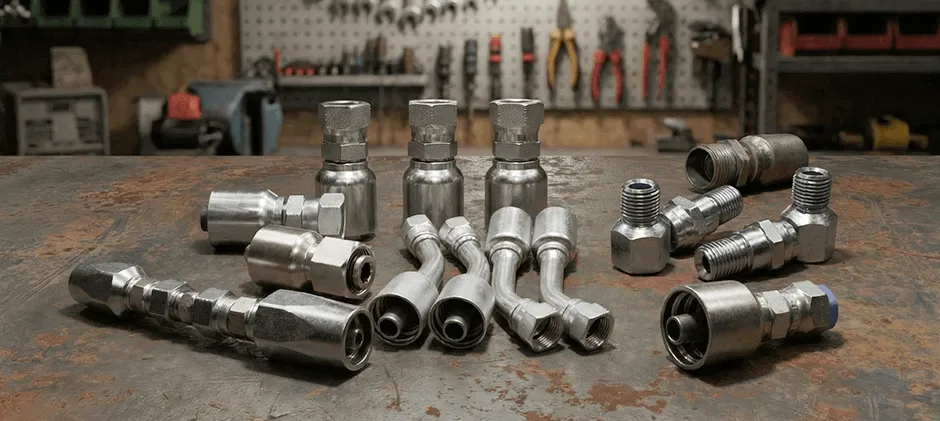
Most selection problems arise because several similar-looking items are indistinguishable from a distance. The good news: once we sort fittings by attachment method, end/shape, and seal type, the choices get much clearer.
These are the “building blocks” you’ll see across auxiliary circuits, boom/arm lines, steer circuits, and attachment plumbing:
Quick routing note: If a hose is failing repeatedly near the end, switching to an elbow (where allowed) can reduce bend strain and extend life—but only if it still clears articulation and won’t rub.
Seal style matters at least as much as thread style. Threads often hold the connection; the seal is what stops leaks.
Below is a practical summary you can use when inspecting ports and old fittings.
| Seal family | How it seals | What to look for during ID | Typical strengths | Common mistake |
| O-ring face seal (flat face + O-ring) | O-ring compressed on a flat face | Flat mating face and visible O-ring | Great for high pressure, vibration resistance | Damaged O-ring, dirty face, wrong size |
| O-ring boss style (O-ring near threads) | O-ring seals in a chamfer/spotface | The O-ring sits near the male threads | Strong sealing when torqued correctly | Damaged O-ring, dirty face, wrong size |
| 37° flare (metal-to-metal flare) | Flare seat mates with a cone | Cone seat and flare geometry | Widely used, easy to service | Mixing flare angles or using damaged seats |
| Tapered pipe thread (thread seals) | Thread interference + sealant | Tapered threads often need sealant | Common and available | Over-tightening can crack ports/fittings |
Off-road reality check: Equipment vibration and thermal cycles punish marginal seals. If your machine runs high-pressure spikes (attachments, lifting, or fast cycling), leak control usually improves when you choose a seal method that does not rely on “more tightening.”
We’ll use a simple, repeatable process that works whether you’re replacing one end on a line or ordering complete assemblies. Think of it as a “no-guess” path.
Before measuring the hose, identify the port connection on the valve, cylinder, pump, manifold, or hard line.
If the port’s sealing face is gouged or the seat is deformed, a “new fitting” may still seep. In that case, your real fix may be repairing the port, swapping the adapter, or replacing the damaged component.
On heavy equipment, the risk is not just “wrong size,” but “almost the same size.” That’s where cross-threading starts.
Once the thread type is known, confirm the seal method. This prevents the classic error: correct thread, wrong seal.
Even perfect hydraulic hose fittings can fail if the hose is too short, routed too tightly, or forced to bend right at the fitting.
For off-road machinery, confirm:
This is also where it helps to check the hydraulic hose spec (ID, pressure rating, and construction) so that flow and pressure match the circuit.
If the hose cover is cracked, the reinforcement is exposed, or the hose has a “soft bubble,” replacing only a fitting end is often a false economy.
This is the “money section” for owners who want fewer comebacks. We’ll focus on factors that matter most on off-road machinery: sealing reliability, pressure spikes, vibration, contamination, and service speed.
Heavy equipment rarely runs at a steady lab-like pressure. Attachments, load-holding valves, and sudden cylinder stops can create spikes.
Vibration loosens marginal joints and fatigues rigid plumbing. The fitting choice matters, but so does how the hose is supported.
If you want a deeper checklist of what usually goes wrong in the real world (abrasion, twist, bad routing, heat damage), this write-up on hydraulic hose failure patterns in heavy equipment is worth a read: hydraulic hose failure patterns in heavy equipment.
Heat hardens seals and accelerates hose aging—common on machines that run high duty cycles or work in hot weather with limited cooling airflow.
If your seals fail after one overheating event, don’t assume every fitting is bad—fix the heat cause first (cooler airflow, fan issues, bypass valves, incorrect fluid).
Even if a fitting type works well, it’s a weak plan if replacements take weeks.
This is also where sourcing matters. If you’re stocking up for faster repairs, we can shop hydraulic hose fittings alongside related spares and maintenance parts in one place.
In crimped assemblies, hose + fitting + crimp spec act as a set. Mixing brands or using the wrong crimp die can lead to a weak crimp or a leak at the ferrule.
If you’re replacing the full line and want a clean fit across many machine types, it often makes sense to shop by application and confirm the hydraulic hose style you need here: hydraulic hose.
Selecting the right hydraulic hose fittings comes down to three checks: match the port (thread + seal), match the duty (pressure spikes, vibration, heat), and match the service plan (availability and repeatable assembly). When we measure threads, confirm the seal style, and route hoses to avoid twist and abrasion, we cut leaks and reduce repeat failures. A careful fitting choice protects uptime—and helps prevent damage to ports, valves, and cylinders.
What is code p0108 and how to fix it
2026-06-29
How to check hydraulic fluid on new holland tractor?
2026-06-27
Spn 1209 fmi 2 code: what it means, causes, & fixes
2026-06-27

P0299: turbocharger/supercharger underboost condition
2026-06-26