2026-08-29
Oil leaks from the valve cover gasket are common on tough off‑road equipment. But ignoring them can cause downtime and engine damage. This guide gives you a clear valve cover gasket replacement cost estimate and breaks down what affects the price.
Replacing a valve cover gasket on off‑road machinery usually costs between $300 and over $3,000.The big difference in price mainly comes down to parts and labor—and for heavy equipment, labor is almost always the main cost.
The valve cover gasket itself is pretty cheap. For common machines like excavators, loaders, and tractors, a good-quality aftermarket gasket normally runs between $50 and $200, depending on the engine size and the gasket material.
Sometimes the job gets more expensive. If the valve cover itself is damaged—many modern engines use plastic or composite covers that can warp or crack from high heat—you’ll have to replace the cover too, not just the gasket. That can easily add several hundred dollars to your parts bill.
This is where costs change the most. Shop labor rates in North America are usually between $100 and $200 per hour. How long the job takes depends entirely on the engine design and how easy it is to reach the valve cover.
To give you a better idea, we’ve broken down the estimated costs by the most common types of equipment.
| Equipment / Engine Type | Estimated Labor Hours | Estimated Total Cost |
| Compact Tractor / Skid Steer (Inline 4-Cyl) | 1 – 3 Hours | $250 – $700 |
| Mid-Size Excavator / Wheel Loader (Inline 6-Cyl) | 3 – 6 Hours | $500 – $1,400 |
| Large Dozer / Agricultural Harvester (V8 / V12) | 6 – 12+ Hours | $900 – $3,000+ |
Note: These are estimates. Prices can vary based on your location, the specific machine model, and the repair shop.
When you get a quote, these are the variables that determine the final price.
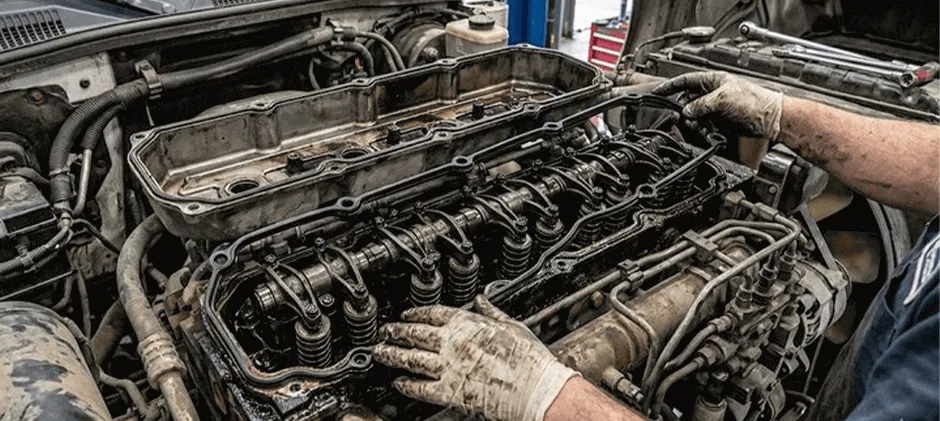
Older engines are simple in design. The valve cover is usually held by just a few bolts and is easy to reach. But modern compact excavators are different. The engine bay is very tight, with little space to work. Technicians often have to remove several parts first, like fuel lines, injector wiring, intake pipes, and sometimes even parts of the aftertreatment system. Just to reach the valve cover bolts. Every extra part removed means more time and more labor costs.
The engine configuration plays a huge role. An inline engine (like an I-4 or I-6) has one long cylinder head and one valve cover. A “V” engine (like a V8 or V12) has two separate cylinder heads and at least two valve covers. This immediately doubles the number of gaskets needed and often more than doubles the labor, as one side of the engine may be harder to access than the other.
You have a choice between Original Equipment Manufacturer (OEM) parts from the machine’s brand and high-quality aftermarket parts. OEM gaskets can be two to three times more expensive than their aftermarket counterparts. As an aftermarket parts supplier, we supply high-quality aftermarket gaskets at competitive costs, offering significant savings without compromising on quality or reliability.
A good mechanic will usually suggest doing extra maintenance once they take the valve cover off. This is the perfect time to adjust the valves, check the fuel injectors and their seals, or look over the rocker arms to see if they’re worn out.
When we have the valve cover off, we’re looking at the heart of the engine’s top end. Spending an extra hour to adjust the valves at this stage is a smart investment. It ensures better performance and can prevent a much more expensive repair down the road. While these additional services add to the initial cost, they are cost-effective because the technician has already done the hard work of assessing the components.
The valve cover is the cover on top of the engine. Under the cover is the valvetrain, which includes rocker arms, springs, push rods and other parts. It must be lubricated with oil to operate properly.
The valve cover gasket is the sealing gasket that clamps between the engine cylinder head and this cover. It has only two key functions:
Such gaskets are generally made of rubber, silicone or cork, and can withstand high temperature and high pressure. But after a long time and thousands of hours of work, the material will harden, become brittle, and be compressed; the sealing effect will be gone, and the oil leakage will begin.
Finding a valve cover gasket leak is usually pretty easy — the signs are clear once you know what to look for.
Visual check: Look for wet, dark oil around the edge where the valve cover meets the engine. Fresh oil looks wet and shiny. Older leaks get covered in thick dust and dirt. The leak always starts at the top of the engine and may run down the sides.
Burning oil smell: If leaking oil drips onto the hot exhaust or turbo, it will burn and make a strong, sharp smell. If you smell this inside or near the cab, you probably have an outside oil leak.
Lower engine oil level: A small, slow leak might not leave a puddle, but you’ll see it on the dipstick. If you have to add oil more often than normal, a leak is almost certainly the cause.
Professional dye test: If you’re not sure where the leak is coming from, a mechanic can add special fluorescent dye to the oil. After running the engine for a little while, they use a UV light to check. The dye glows bright and shows exactly where the leak is — so you know for sure if it’s the valve cover gasket.
To replace the gasket, the technician first removes any parts that block the valve cover. On some machines, this can include intake parts or fuel system components. Once the cover and old gasket are taken off, the most important step is to clean both the cover and the cylinder head really well.
When everything is completely clean, the new gasket goes on. The technician then tightens the cover to the factory torque settings and puts all the other parts back together. Finally, the engine is run until it warms up to make sure there are no leaks.
Your machine can still run even with a leaking valve cover gasket, but we strongly advise against operating it.
Using a high-quality valve cover gasket helps reduce the risk of repeat leaks and extra repairs. Once you notice a leak, replace it as soon as possible—don’t wait until it causes bigger engine problems. Let FriadyParts be your one-stop shop for valve cover gaskets and other replacement parts.