2026-08-24
Heavy equipment comes into view as giant tires, engines or hydraulic arms. However, hidden beneath the frame is a component that plays a vital role in the machine’s movement and load: the axle. It looks like a simple steel rod, but it is a complex system. What Is an Axle and How Does It Work? In this guide, we will answer each one one by one.
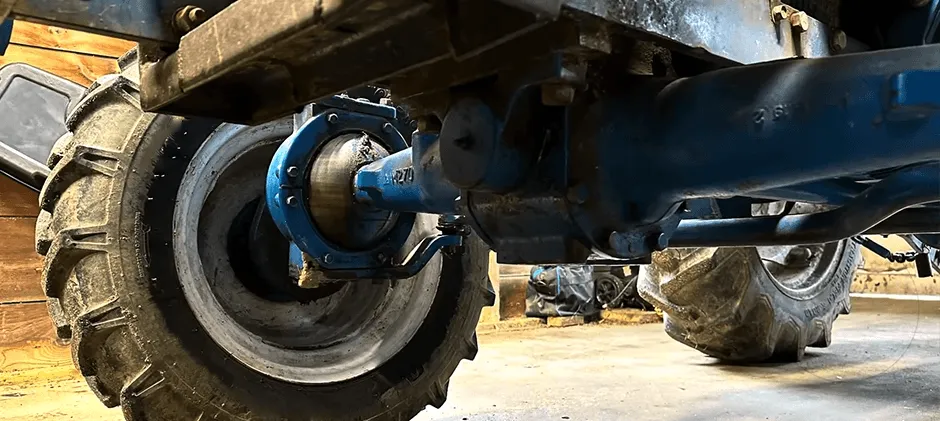
At the most basic level, an axle is a shaft that connects two wheels and keeps them in position on the machine. But on powered off-road machines like a wheel loader or an articulated truck, it’s more than just a shaft. It’s usually part of a complete axle assembly. This assembly mainly does two jobs:
Let’s follow how power gets from the engine to the wheels. Power comes out of the transmission and goes through the driveshaft to the axle. At this point, the power is fast, but not very strong.
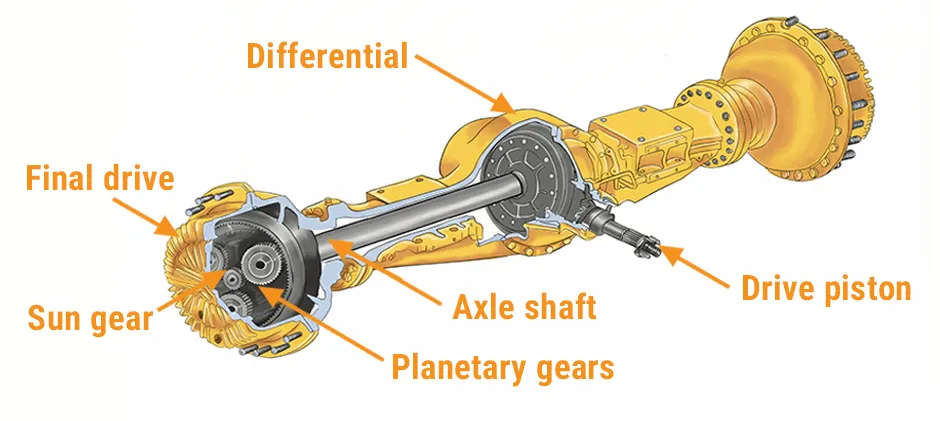
The driveshaft runs along the length of the machine, but the wheels spin sideways. That’s the first problem the axle has to fix. And that’s exactly what the differential does — it’s right in the middle of the axle housing. A small gear on the driveshaft, called the pinion gear, connects with a big ring gear in the differential. This turns the power direction by 90 degrees.
The differential has another really important job. When the machine turns a corner, the outer wheel has to cover more ground than the inner one, so it needs to spin faster. The differential has gears that let the two axles spin at different speeds. This stops the wheels from jerking or slipping, and protects the whole drivetrain.
Last, and most important for heavy equipment: the axle turns that fast, weak power into slow, super-strong power. On the ends of the axle, the final drives use planetary gears to reduce speed one more time. This makes the power way stronger right before it hits the wheels. That’s what gives a loader the strength to push gravel, or a dump truck the power to climb steep, muddy hills.
A drive axle is a group of specialized parts all working together. Designs can be different, but most heavy equipment axles include these main parts:
Axle Housing
This is the big, strong outer shell that protects everything inside. Usually made of thick steel or cast iron, it keeps gears and shafts safe from rocks, mud, water, and hard hits. It also holds the gear oil that lubricates all the inner parts, and it’s where the machine’s suspension mounts.
Axle Shafts
These are tough steel rods that connect the differential to the final drives near the wheels. Their job is to send torque from the differential out to the wheels. They have splined ends that lock into the gears, and they need to be strong enough to handle huge twisting forces when starting, stopping, or working under load.
As we mentioned earlier, this central gear assembly has two main functions: changing the direction of power coming from the drive shaft, and allowing the two wheels to rotate at different speeds. The internal structure includes the main ring gear and pinion, as well as the small spider gears that enable the wheels to move independently.
These sit at the ends of the axle housing, and they’re what multiply torque. Using a planetary gear system — a sun gear, planet gears, and an outer ring gear — they give a final speed reduction to send maximum power straight to the wheels.
The number of axles corresponds to the wheel sets. For example, a wheel loader has four wheels in two pairs, so it has two axles. An articulated dump truck with six wheels in three pairs has three axles. Each of these axles plays a role in supporting the machine. Now that we know the basic layout, let’s explore the different structural types of axles.
When talking about axle types in heavy equipment, the key difference is how they carry the machine’s weight. This affects how strong and durable the axle is.
Full-Floating Axle: This type is used on most medium and heavy off-road machines. In this design, the machine’s weight is supported by the axle housing through large bearings. The axle shaft inside mainly sends power to the wheels. Because of this design, it’s very strong. Even if the axle shaft breaks, the wheel will usually stay on the machine because it is mounted to the hub and housing.
Semi-Floating Axle: In this design, the axle shaft does two jobs: it sends power to the wheel and also helps hold up the machine. The wheel is attached directly to the axle shaft. This design is simpler and less expensive, so you see it a lot in cars, SUVs, and lighter vehicles. But it’s not strong enough for most heavy equipment. Because the shaft has to handle both twisting force and weight.
Stub Axle: A stub axle (also called a spindle) is a short axle used for a single wheel. It usually doesn’t carry engine power. You’ll often see it on steering wheels that are not driven, such as on some trailers or smaller machines.
The axle sends power from the engine to the wheels and also allows the wheels to turn at different speeds. It rotates under high torque and supports the weight of the whole machine. MechLink offer a wide range of high-quality axle parts for many heavy equipment brands to help keep your machines running safely and reliably.