
2026-11-27
The air filter is one of the hardest-working parts of a machine’s air filtration system. Its job is to hold back harmful particles at the intake so they never reach the engine, which is what allows the engine to run smoothly and efficiently.
Let a filter clog, and the consequences show up quickly: less power, higher fuel consumption, and in serious cases damage inside the engine itself.
This guide covers what an engine air filter is for, why heavy equipment cannot run without one, and the route air takes on its way through the machine.
It is a filter built to capture airborne particles — dust, sand and silica among them — before they enter the engine. It is a different component from the filters that clean the air inside a cab, and the two should never be confused.
A diesel engine needs a constant supply of clean air to burn fuel and produce power. In operation, the engine draws large volumes through its intake system, and that air is fed into the cylinders where it is combusted together with fuel. If the intake is left unfiltered, dust and debris travel with the air into the engine and contaminate the engine oil.
Silica is the contaminant that causes the most trouble. It is a fine particle found in dust and sand, and it is highly abrasive — once it reaches the oil, it becomes a genuine threat to the engine.
The filter sits in the intake path and strips silica and other particles from the air as it moves from outside the machine toward the engine. Cleaner air means cleaner oil, and cleaner oil means less wear.
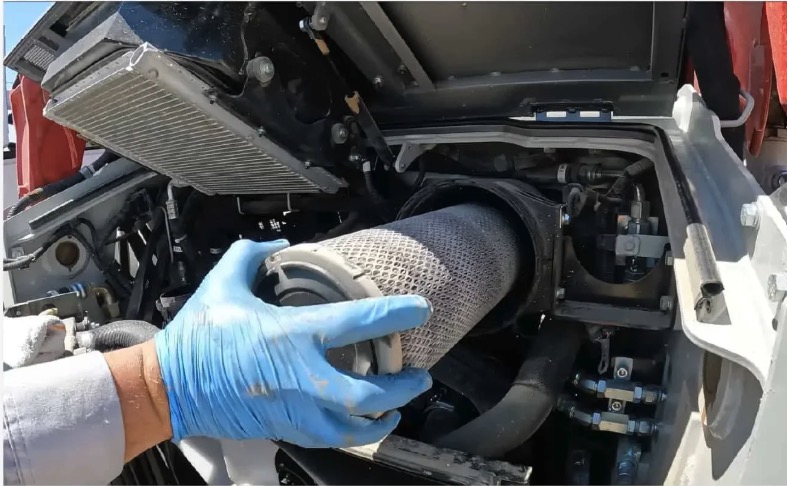
On most machines the filter lives in the engine bay, directly beside the engine, inside a dedicated housing that has to be opened or partly disassembled before the element can be swapped.
Exact placement varies with make and model. Your machine’s service manual shows precisely where to look.
Every machine with a combustion engine depends on engine air filtration. That includes:
In a modern combustion engine, the filtration job is split between an outer element and an inner element. The outer one is the larger of the two, and the inner element generally nests inside it.
The outer element takes the first pass and stops the bulk of the larger airborne particles before they can reach its partner. It is also the element replaced most often.
The inner element is sometimes called the safety filter, because it works as a last line of defence. If dust breaches the outer element, the inner one still stands between that dust and the engine.
Filters are sold in many shapes, each shaped around the requirements of the engine it protects. Cylinder, flat and cone designs are the three most widely available.
Cylindrical elements — also called round filters — dominate heavy equipment. They are built from paper, foam, cotton or engineered synthetic media, they install and come out easily, and they usually cost less than other formats.
Shape is secondary, though. What matters most is a filter that suits your machine’s intake system and the conditions the machine actually works in.
Your service manual sets the baseline. On most filters, an indicator appears on the element or the housing once the element is due, and on newer machines a light on the control panel may warn that airflow to the engine has become restricted.
Reading a filter gauge is the most accurate method. Judging by appearance is unreliable, because a heavier coating of dust does not automatically equal more restricted airflow.
Pulling the element out too often carries its own risk: particles can find their way into the engine while the filter is out.
Many fleet owners instead work to a fixed maintenance schedule, which keeps airflow problems from appearing in the first place. MechLink carries service kits for 50, 250, 500 and 1,000-hour maintenance, and many of them include the replacement air filters a machine needs.
There is also a quieter signal. Because the filter is the main barrier against silica, a sudden rise in silica levels during an oil test often points to a filtration problem rather than an oil problem.
Air filters do not follow a fixed calendar, but they do need watching. Build two habits into your maintenance plan: have operators check the airflow gauge and any filter indicators regularly, and test engine oil on a routine basis. High silica is usually one of the earliest indicators that something in the filtration system has gone wrong.
No. A dirty or failing element should be replaced. Cleaning attempts can damage the filter media, which lowers efficiency and puts the engine at risk.
These are delicate, purpose-built components, and they do not respond well to washing or blowing out. In practice, cleaning a spent filter can do more harm to both filter and engine than simply leaving it in place until a new one arrives.
Sound engine air filtration is a precondition for efficient, reliable operation of heavy equipment.
If you need replacement filters, MechLink’s online shop carries a broad range built to fit many makes and models. Every filter we stock comes from a reputable manufacturer, so the quality is known before it reaches your machine. Browse MechLink’s online parts catalog to find what your equipment needs.
Mini Excavator Troubleshooting: Five Failures That Routine Care Prevents
2026-11-27

Forklift or telehandler? How to match the lift to the ground it works on
2026-11-26
Telescopic or Articulating? How to Match a Boom Lift to the Task
2026-11-26
Machine tracks: matching material and tread to the work you do
2026-11-26