
2026-11-14

On a foundation job the machine is the last decision, not the first. A structural load arrives, a ground investigation is read, a pile type is settled, and only then does anyone ask which rig should be standing on site. Teams that begin with the equipment list and work backwards usually find the mismatch late — after mobilization, when the tool on the mast is wrong for the stratum and the piling programme is already fixed.
The chain below follows the order in which the decisions actually happen: what the ground can carry, what the foundation has to do, which pile satisfies that, and what it takes to install the pile.
A shallow foundation spreads load into the soil directly beneath it, which works for as long as that soil can take the pressure without moving. The arithmetic stops working in three familiar situations: the design loads are very large, the soil at shallow depth is poor, or the site itself limits what can be built — a property line that will not allow a wider footing, for example.
When that point is reached, the load has to travel further down to a stratum that can carry it. Geotechnical engineers recommend a deep foundation in precisely these cases, and the recommendation covers movement as well as capacity: a foundation that carries the load but settles unevenly has still failed.
A deep foundation transfers the building's loads to a subsurface layer, or across a range of depths, instead of leaning on the soil at formation level. That is the mechanism behind the familiar rule that towers need piles — the loads are immense, and the ground near the surface is not the right material to hold them.
The transfer is almost never the work of a single element. Piles are grouped and tied by a pile cap, so that the group carries what no individual pile could; caps and isolated piles are then linked with grade beams to form one system. Distribution inside that system is deliberate: lighter elements bear on the grade beams, heavier ones go directly onto the pile cap.
This is where the design stops being abstract and starts constraining machinery. Pile count, spacing, length and diameter all come out of the load calculation, and every one of those numbers narrows what can install them.
Deep foundations take several forms — piles, piers, drilled shafts and caissons — each selected against the building's needs and the site. For equipment purposes, the useful split is by the way the pile enters the ground.
Timber, steel, reinforced concrete and prestressed concrete piles are driven in situ. Driving displaces the ground instead of removing it, so there is no spoil to handle and production is quick; the price is noise and ground vibration. The shortlist is a diesel hammer, a hydraulic hammer, or a vibratory driver, provided the section and the ground conditions allow.
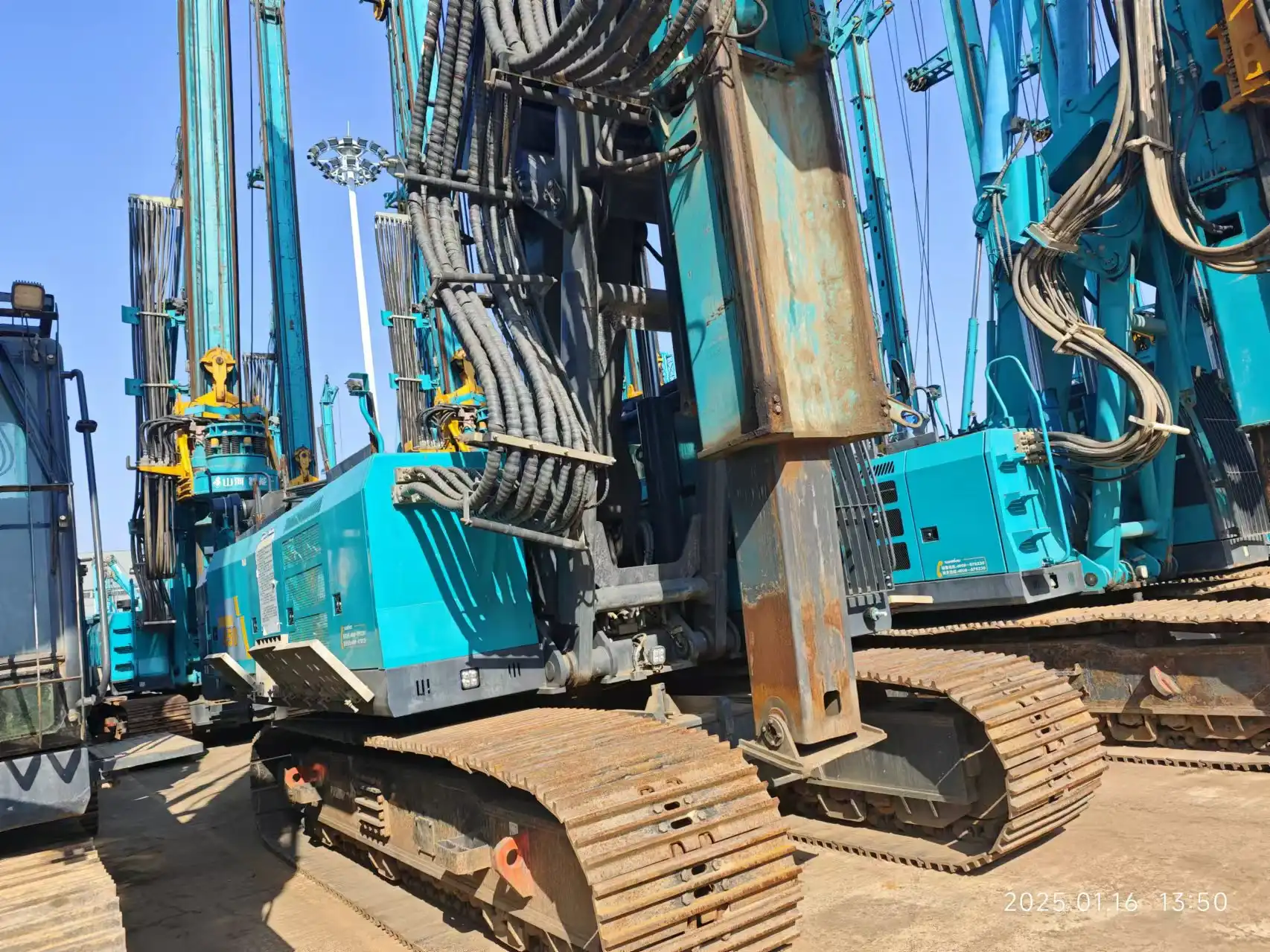
Where a hole must first be formed and then filled with reinforcement and concrete, the machine is a rotary rig of the kind sold as a piling rig or a pile boring machine. These resemble large track-mounted drills, pass through sandy soil, clay, silty clay and rock, and are laid out much like oil drilling rigs.
Sheet piles go in as a continuous line rather than as individual supports, and the natural tool is the vibratory driver-extractor, which can also pull them when the job is finished. Where vibration beside existing structures is the governing constraint, a press-in attachment does the same work with rams instead of vibration, and can press several sheet piles at once.
A rotary rig is only as capable as whatever hangs from its head. The working match is short enough to memorise:
Two rigs of similar size can therefore have completely different site capability. When a machine is offered for a project, the question is not only what it is but what it comes with.
A borehole also rarely stays inside one material from top to bottom. Sand at the surface, clay beneath it and rock at the toe is an ordinary profile, and each horizon asks for a different tool. The tool change therefore belongs in the method statement rather than in a phone call from site: the rig should be able to make the swap from the position it already occupies, and the crew should know which tool belongs to which layer before the first bore is opened.
Several project conditions override the geological answer, and they are usually known before the machine is chosen:
Expressways, bridges, industrial and civil buildings, water conservancy projects, slope protection and seismic retrofitting all run through the same sequence. In every case the pile foundation spreads load across a group instead of concentrating it in one place, and in every case the machine is a consequence of the design rather than the starting point.
What changes is the weighting. A long expressway alignment rewards production rate and repetition, which tends to favour driven piles and a machine that keeps moving down the line. A bridge foundation usually gathers the load into fewer and larger elements, so sections grow and lifting becomes the constraint. Retrofitting work has to fit around a structure that is already standing, and there access and vibration often decide the method before bearing capacity does. The chain is the same; the term that dominates it is not.
For a buyer the sequence becomes a checklist read in reverse. Start with the pile: section, length, material. Then the installation method the design permits. Then the tool that method requires. Then the carrier that can hold that tool at the required height, on that site, under those restrictions. A machine that satisfies the last three steps but not the first is the wrong machine, whatever its condition.
MechLink lists piling machinery by machine type, and each enquiry is answered with the specification and photographs of the actual unit, so the chain can be checked against real equipment instead of a category name. Tell us the pile, the ground and the constraint, and the equipment question answers itself.

Crane Types by Structure: How Reach and Rated Capacity Decide the Right Lift
2026-11-14

Before You Buy Used Heavy Equipment: A Ten-Point Inspection Checklist
2026-11-13

Buying Used Construction Equipment in the Gulf: A Contractor's Procurement Playbook
2026-11-13
Piledriver, Piling Rig or Rotary Drill? Telling the Piling Machine Family Apart
2026-11-12