2026-05-14
If you’ve repaired a gasoline engine or a diesel engine, you’ve probably seen two parts with very similar names—spark plug vs glow plug. But they do absolutely nothing the same. So what exactly is the difference between them? Knowing this is beneficial for engine maintenance and troubleshooting problems. Next, let’s take a look.
In gasoline engines, a spark plug is an essential electrical component. Its role is to create the spark that ignites the air-fuel mixture. This starts the combustion process and powers the engine. If no set of spark plugs, a gasoline engine can’t even turn it on.
The spark plug connects to the ignition coil, which receives a high-voltage electrical pulse. This charge travels down the plug and creates a powerful spark. The compressed mixture in the cylinder was ignited by a spark, which triggered an explosion that pushed the piston downward. This process will repeat thousands of times per minute as the engine runs. Unlike glow plugs, spark plugs fire continuously during every power stroke. So, they are wearable items that require regular replacement.
The glow plug is a heating element dedicated to diesel engines. Diesel engines do not ignite with sparks, but make the fuel burn on its own, depending on the high temperature of compressed air. But if it’s too cold, the cylinder and air temperature are too low, and won’t heat up enough. It’s time the glow plug plays a role, adding some heat to the combustion chamber, thus making the engine easier to start.
Now that we know their basic functions, let’s put them side-by-side to explore the deep-seated differences in their construction and operation. These distinctions explain why they are absolutely not interchangeable.
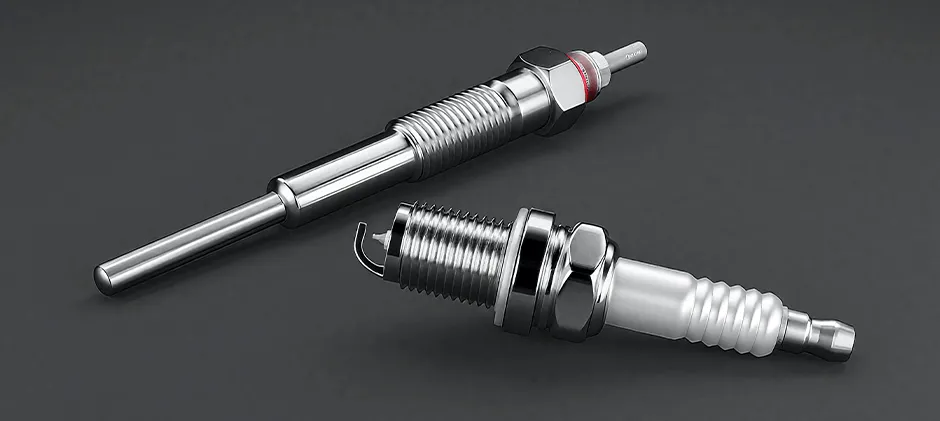
Each plug is designed to be built for its specific task.
Glow plugs emphasize durability and thermal insulation. It is generally longer and firmer, made of metals and ceramics that can withstand high temperatures, and can withstand strong pressures and extremely high temperatures without damage. At its core is a protected heating coil that is used to heat up quickly before the engine starts.
While the spark plugs are focused on conduction and insulation. It is generally smaller, with a precisely controlled gap at the tip, between the central and ground electrodes. Electrode materials (like nickel, platinum, or iridium) are resistant to corrosion caused by long-term sparks and maintain good electrical conductivity. The layer of white ceramic on the spark plug is not a decoration. It is a key insulating layer used to prevent high voltage from leaking before reaching the electrode.
The preheating plug relies on high-temperature heating—the operating temperature can reach about 1000°C (1800°F), which is used to heat the combustion chamber in advance. It only works during the short period of time the engine is started, and automatically stops heating once the engine is running.
The spark plug is different. It does not generate heat itself, but has to be under high temperature and pressure to “survive”. When the gasoline engine burns, the temperature may exceed 2500 °C (4500° F). For a spark plug to conduct thousands of blasts each minute at such a temperature, it must still work stably and continuously.
Both components are wearing parts. Knowing their common fail symptoms can help you spot problems in time before they get bigger. Because the two act differently, the failure performance is also different.
Because glow plugs are for starting, problems will be most obvious then.
A failing spark plug affects the engine whenever it’s running.
Maintenance schedules for these two parts are also very different.
Spark plugs need routine maintenance. The constant electrical erosion and exposure wear it down. Because the material has different types (traditional copper vs. long-life iridium or platinum), they usually are replaced every 30,000 to 100,000 miles.
Glow plugs, however, are not replaced on a fixed schedule. They are generally only replaced when one or more of them fail. A set of glow plugs can easily last for over 100,000 miles. If you’ve diagnosed a bad glow plug, please replace it. Learning how to replace the glow plug correctly can help ensure reliable starting.
Whether you’re doing routine maintenance on a gasoline engine or troubleshooting a diesel engine that’s hard to start, having the right parts is critical. MechLink is your best choice. We offer various engine auxiliary components for vehicles of various makes and models. Ensure reliable performance and a perfect match. Simply enter your machine details in the MechLink search box, and we will show you the exact parts you need. Don’t let a failed spark plug or glow plug slow you down.