
2026-11-28
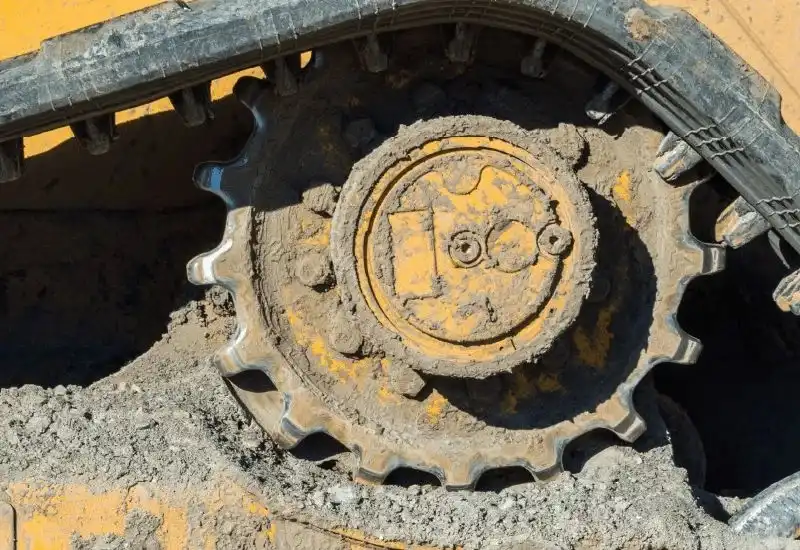
Dozers, excavators and tracked skid steers all ride on the same basic arrangement: a loop of linked steel shoes driven by a sprocket. The pins and bushings buried inside that loop carry the weight of the machine and pass engine torque down to the ground, which puts them among the hardest-working wear parts on any tracked unit.
Because so much load runs through them, pins and bushings largely decide how long an undercarriage lasts. Rotating them — usually shortened to "turning" — is one of the few maintenance jobs that can add life to a track instead of replacing it outright.
Turning is the practice of pulling the pins and bushings out of the track, flipping them end for end, and pressing them back into the links. The goal is not repair but redistribution: surfaces that never met the sprocket are moved into the wear zone, so the assembly degrades more slowly and far more evenly.
To see why that helps, picture the track as a bicycle-style chain of cast links. The machine's sprocket — the toothed wheel that takes power from the engine — rolls across each bushing as the chain comes around. A bushing is a hollow cylinder joining two links; the pin passes through it and pivots inside as the track flexes. Clearance between pin and bushing widens with every revolution, and once it grows large enough the chain hangs loose and the machine stops pulling efficiently.
Bushings surrender material in two separate places. On the outside, sprocket teeth grind against them. On the inside, the pin scrubs the bore each time the link articulates. The outer contact is much more aggressive on the reverse-drive side, so that face flattens long before the opposite one does — and that imbalance is precisely what a turn takes advantage of.
The payoff is service life. A turned track can usually keep working until the rollers come due for attention, which pushes back the day the machine needs a new chain, new sprockets or a full undercarriage rebuild.
On modern machines the procedure falls into two families.
Wet turns apply only to sealed and lubricated track, known as SALT. Every pin in a SALT chain carries an oil reservoir and a self-sealing plug at one end. Oil enters through that plug and migrates to the bushing bore while the machine works. In a wet turn the pins are refilled before they return to their bushings.
Dry turns, also called grease turns, skip the oil altogether: pin and bushing are coated in heavy grease and reassembled. On a track that is not self-lubricating, this is the only option available.
There is a middle case as well. When the self-lubricating parts of a SALT chain are too far gone to accept oil, a technician may deliberately perform a grease turn on a sealed chain rather than write the track off.
Rotating pins and bushings was once a routine line on any undercarriage service sheet. Three developments pushed it out of the mainstream.
First, SALT chains are now everywhere. Their self-sealing oil feed cuts internal wear dramatically, so the pin-to-bushing clearance that turning is meant to even out builds far more slowly than it once did.
Second, forging has moved on. Today's bushings are tougher than the parts they replaced and hold up longer even on the outer face where the sprocket works.
Third, cost. Turning needs trained technicians and specialized press tooling, and both have become expensive relative to buying new pins and bushings. For plenty of fleet managers the arithmetic now points at replacement rather than rotation.
The exact procedure depends on machine size, age, track design and make/model. What follows is the general shape of the job.
On larger machines the pins often refuse to move without a dedicated hydraulic pin press, and refilling a reservoir may call for a vacuum tool matched to that pin style. If neither tool is on hand — or the procedure is unfamiliar — hand the job to a qualified service technician. A damaged link bore costs far more than the labor.
Slack is the headline symptom. As pin-to-bushing clearance opens up, the chain sags, and a sagging chain drags down everything around it. Other clues are worth watching for:
Any one of these is reason enough to put the undercarriage on the inspection list.
Visible sag during operation is the signal to act, and at that point the choice is rotate or replace. Rotation has a hard limit: a pin can only be flipped so many times, and some assemblies cannot be turned at all.
Self-lubricating pins are the usual dead end. Their oil reservoirs are fragile, and once they stop accepting oil there is nothing left to refill. Replacement then becomes the better answer — and because aftermarket pins and bushings are stocked for a wide range of makes and models, it is frequently the cheaper one too.
If replacement is the right call for your machine, start with the MechLink catalog of pins and bushings and match the part number to your model. Can't find what you need? Our parts experts will help you identify the correct component for the job.
Oil filter questions, answered: fitment, intervals and the signs you missed
2026-11-28
Ten Steps to Bring Heavy Equipment Out of Winter Storage
2026-11-28
Mini Excavator Troubleshooting: Five Failures That Routine Care Prevents
2026-11-27
Engine Air Filters: What They Block, How They Fail, When to Swap Them
2026-11-27