2026-08-08
Alternators usually last for many years before needing replacement. But if you often find that the battery is dead, it may be that there is something wrong with the alternator—either it will not charge or a bad alternator drain a battery. An inspection can confirm whether the generator is broken. Or just replace it with a new alternator and see if that solves the problem. Knowing these conditions can help you determine what could be wrong with your alternator and how to deal with it.
Yep, a faulty alternator definitely drains your battery. Its main job is to charge the battery and power all your machine’s electrical systems—but if something inside it goes bad, it’ll do the exact opposite. The alternator on your heavy equipment is basically a tiny power plant. It turns the engine’s spinning energy into electricity, like the lights, on-board computer and more. A chunk of that power also goes back to the battery to keep it topped off, so you’ve always got enough to start the engine next time.
When the alternator’s working right, this whole system is perfectly balanced. But if a part inside it fails, it’ll throw off that balance. It’ll create a silent power drain that kills your battery—even when the engine’s turned off.
A broken generator can cause the battery to die, which can happen in two main ways: it either consumes power directly or it won’t charge at all.
The alternator uses alternating current (AC), but the machine’s battery and circuit system use direct current (DC). The alternator has a component called a rectifier bridge, which contains several diodes. You can think of these diodes as one-way gates— they only allow direct current to flow to the battery, but they block the current from running back.
If one of the diodes is broken, it may be stuck in the “open” state. There is a channel for the electricity stored in the battery to flow back. Even if the engine is off, electricity will leak back into the alternator. Just like the tire slowly leaking air. This phenomenon is called parasitic drain. In a few days, the fully charged battery can be consumed, and the machine will not start at all.
The second way a bad alternator kills your battery is by just failing to do its job. A dying alternator might not put out enough voltage to run the machine’s systems and charge the battery at the same time. When this happens, all the machine’s electrical parts—like work lights, computers, and sensors—will pull power from both the alternator and the battery. Basically, the battery has to “help out” the weak alternator. That means it drains power while the machine’s running. This problem is usually caused by:
The thing here is: the alternator doesn’t drain the battery when the engine’s off. But it does make the battery lose power while the machine’s running—and the battery never gets a full charge again.
It depends on the type of alternator failure and the battery’s condition. Parasitic drain (from a bad diode): A big enough drain can kill a fully charged, healthy battery overnight, or within 24–48 hours. Total charging failure: If the alternator stops charging entirely, the battery will last only as long as its stored power can run the machine’s key systems. For heavy equipment with high electrical loads (lights, computers, hydraulics), that could be as little as a few hours of use.
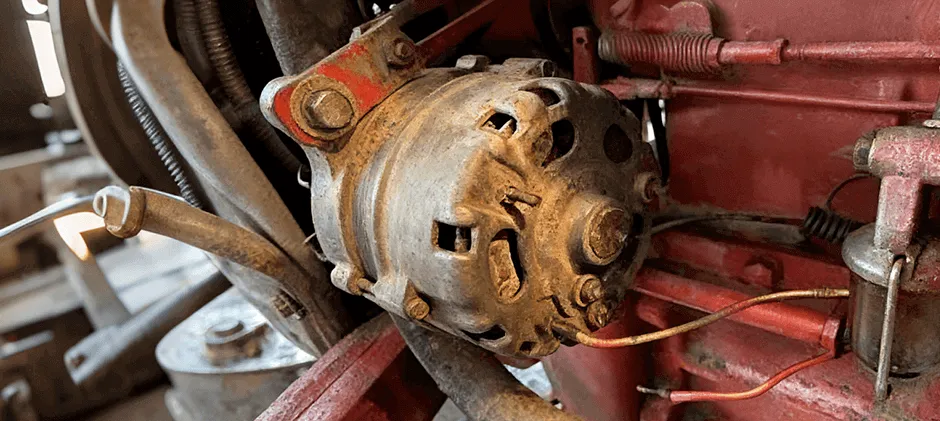
If you suspect your battery is being drained when it shouldn’t be, you can do a quick test with a digital multimeter. It’ll tell you if current is leaking while the machine’s not in use.
Yep, a bad alternator will ruin a brand-new battery in no time. Lots of operators make an expensive mistake: they see a dead battery and just assume it’s worn out. So they swap it for a new one without checking the charging system first. Then that new battery gets hit with the exact same problem that killed the old one. That’s why it’s so important to tell the difference between a bad alternator and a bad battery before you spend cash on a new battery. A faulty alternator destroys a battery in two ways:
If the alternator isn’t charging right, the new battery has to keep draining power to run the machine. Lead-acid batteries aren’t built for getting fully drained over and over again. Every time a battery dies completely, its life gets shorter. After just a few of these full drains, the new battery won’t hold a charge at all.
On the other side, a faulty alternator can also overcharge your battery. This is just as damaging—if not more so. This problem is because bad voltage regulator. The regulator keeps the alternator’s output in a safe range, between 13.5 and 14.5 volts. If it fails, the alternator can crank out too-high voltage (sometimes 16 volts or more).
This constant overcharging will make the electrolyte inside the battery boil. That, together with dangerous hydrogen gas, warps the battery’s internal plates and can even kill the battery for good. What’s more, the high voltage can fry sensitive electronics, blow fuses, and damage wiring all over the machine—ending up with way costlier repairs.
If you’ve figured out your alternator’s bad—whether it’s draining the battery or overcharging it—fix it right away to stop more damage from happening. Replacing an alternator on heavy equipment means doing these steps:
The steps themselves are simple enough, but the alternator’s size and where it’s placed can make the job a real hassle. Once you’ve got the right replacement part, just do these steps in reverse to install the new or rebuilt alternator.
So, can a bad alternator drain your battery? Absolutely yes. It can quietly drain it overnight from a parasitic draw, or run it down while the machine’s working because it fails to charge the battery. Need help finding the correct alternator? The pros at MechLink are here for you. You can look up parts that fit your machine’s brand and model—so you can fix the problem the right way.